Prayer
Psalm 5: In the Morning Will I Direct My Prayer
Quick answer
Psalm 5 is a morning prayer of David. He asks God to hear his cry, promises to bring his prayer to God in the morning and wait expectantly, contrasts God's holiness with the wicked, and ends asking God to guide him and to bless and shield the righteous. Verse 3 makes it a natural first prayer of the day.
Some psalms are tied to a time of day, and Psalm 5 is one of the clearest. Before the day has started, David brings God his words, his sighs and his cry for help. Then he says something simple enough to build a habit on: "My voice shalt thou hear in the morning, O LORD; in the morning will I direct my prayer unto thee, and will look up."
That one verse makes Psalm 5 a natural first prayer of the day. Around it, the psalm is honest about a world where people lie and do harm, and it ends with joy and protection for everyone who trusts God. This guide gives you the full King James text, walks through what it means, and shows a simple way to pray it each morning.
Psalm 5 (KJV) full text
To the chief Musician upon Nehiloth, A Psalm of David.
1 Give ear to my words, O LORD, consider my meditation.
2 Hearken unto the voice of my cry, my King, and my God: for unto thee will I pray.
3 My voice shalt thou hear in the morning, O LORD; in the morning will I direct my prayer unto thee, and will look up.
4 For thou art not a God that hath pleasure in wickedness: neither shall evil dwell with thee.
5 The foolish shall not stand in thy sight: thou hatest all workers of iniquity.
6 Thou shalt destroy them that speak leasing: the LORD will abhor the bloody and deceitful man.
7 But as for me, I will come into thy house in the multitude of thy mercy: and in thy fear will I worship toward thy holy temple.
8 Lead me, O LORD, in thy righteousness because of mine enemies; make thy way straight before my face.
9 For there is no faithfulness in their mouth; their inward part is very wickedness; their throat is an open sepulchre; they flatter with their tongue.
10 Destroy thou them, O God; let them fall by their own counsels; cast them out in the multitude of their transgressions; for they have rebelled against thee.
11 But let all those that put their trust in thee rejoice: let them ever shout for joy, because thou defendest them: let them also that love thy name be joyful in thee.
12 For thou, LORD, wilt bless the righteous; with favour wilt thou compass him as with a shield.
What Psalm 5 means, verse by verse
The heading. The psalm is addressed to the chief musician and attributed to David. "Nehiloth" appears only here in Scripture, and its exact meaning is uncertain. Many scholars think it refers to flutes, which is why some modern translations, such as the Berean Standard Bible, render the heading "to be accompanied by flutes."
Verses 1–3: a cry, then a morning promise. David asks God to listen, not only to his words but to his "meditation," the quieter groaning underneath them. He calls God "my King, and my God," which is personal and trusting at once. Then comes verse 3. In the morning God will hear his voice; in the morning he will "direct" his prayer, setting it out before God, and "look up." That last phrase is the posture of someone who has prayed and now waits, expecting God to answer.
Verses 4–6: who God is. David's confidence rests on God's character. God takes no pleasure in wickedness, and evil does not live with Him. The proud and the deceitful cannot stand before Him. "Leasing" is an old English word for lies. These verses are not a list of other people to look down on. They are a reminder that God is good, and that a holy God is exactly the One you can trust with an unfair day.
Verses 7–8: coming in by mercy. "But as for me" marks a turn. David does not come to God because he is better than anyone else. He comes "in the multitude of thy mercy." Then he prays one of the most useful lines in the psalm for the start of a day: "Lead me, O LORD, in thy righteousness because of mine enemies; make thy way straight before my face." He asks for guidance, a clear path and God's way, not his own.
Verses 9–10: an honest lament. David describes people whose words cannot be trusted, whose flattery hides harm. The apostle Paul later quotes part of verse 9 in Romans 3:13. Verse 10 asks God to let wrongdoers "fall by their own counsels." It is strong language, and it is a prayer, not a plan. David hands justice to God rather than taking it into his own hands. When you have been hurt by someone's lies, this is permission to be honest with God about it, and to leave the outcome with Him.
Verses 11–12: joy and a shield. The psalm ends looking outward. Everyone who trusts in God is invited to rejoice and "ever shout for joy," because God defends them. The last image is a shield: God's favour surrounds the righteous like a soldier's shield. That is not a promise that nothing hard will happen. It is a picture of being kept and covered by God in the middle of whatever the day brings.
Why Psalm 5 is a morning psalm
Verse 3 names the morning twice. Before emails, news or the first conversation, David sets his prayer before God and waits. That order matters. When you pray first, the day's worries arrive at a heart that has already been placed in God's hands.
If you are new to praying Scripture at the start of the day, our guide to praying the Psalms in the morning shows how to begin, and our page on morning prayer offers simple patterns. To slow down with a single line, try the steps in how to meditate on Scripture in the morning.
How to pray Psalm 5 when you wake up
You can pray this psalm in a few minutes:
- Speak plainly. Read verses 1 and 2 and tell God what is actually on your mind, including the parts that are only a sigh.
- Set your prayer in order. Following verse 3, name the day ahead: the meetings, the tasks, the people. Lay them before God one by one.
- Look up. Pause for a moment of quiet, expecting God to be at work today.
- Ask for a straight path. Pray verse 8 in your own words: lead me in your righteousness; make your way clear in front of me.
- Rest under the shield. Close with verses 11 and 12, thanking God that He surrounds His people with favour.
You might jot the verse you prayed in a prayer journal and come back to it in the evening.
A short prayer to start:
"LORD, hear my words this morning, and the worries I can't put into words. I bring you this day before it begins. Lead me in your righteousness and make your way straight in front of me. Help me to trust you, to be glad in you, and to rest under your favour like a shield. Amen."
Psalm 5 for an anxious or hard day
Some mornings start with dread: a hard conversation, a workplace where someone is unkind, or a fear you cannot name. Psalm 5 does not pretend those things away. David prays with enemies in view. But he starts with God's care, asks to be led, and ends with joy and a shield.
On a heavy morning, you do not need perfect words. Verse 1 asks God to consider your meditation, even the groaning. Verse 8 asks Him to lead. Verses 11 and 12 remind you that God defends those who trust Him. If anxiety meets you before the workday, our guide to morning prayer for anxiety before work offers gentle next steps.
Psalm 5 sits alongside other psalms we have written about: Psalm 1, Psalm 23, Psalm 27, Psalm 34, Psalm 37, Psalm 51, Psalm 91, Psalm 121 and Psalm 139.
Build the habit with Koum
A morning habit is easier when Scripture is the first thing you meet. Koum is a Bible verse alarm clock: you wake up to a verse and can set up a simple morning reading and prayer routine.
To begin, follow our guide to setting up a Bible alarm for morning reading. You can also read more about using a Christian alarm clock app. Then, when the alarm sounds, open Psalm 5 and let verse 3 be your first prayer: bring God the day, and look up.
Put this into practice with Koum.
Koum asks you to open, scan, speak, or type a Bible verse before the alarm ends. Then it gives the morning room for prayer, a devotional, and a private reflection.
Get Koum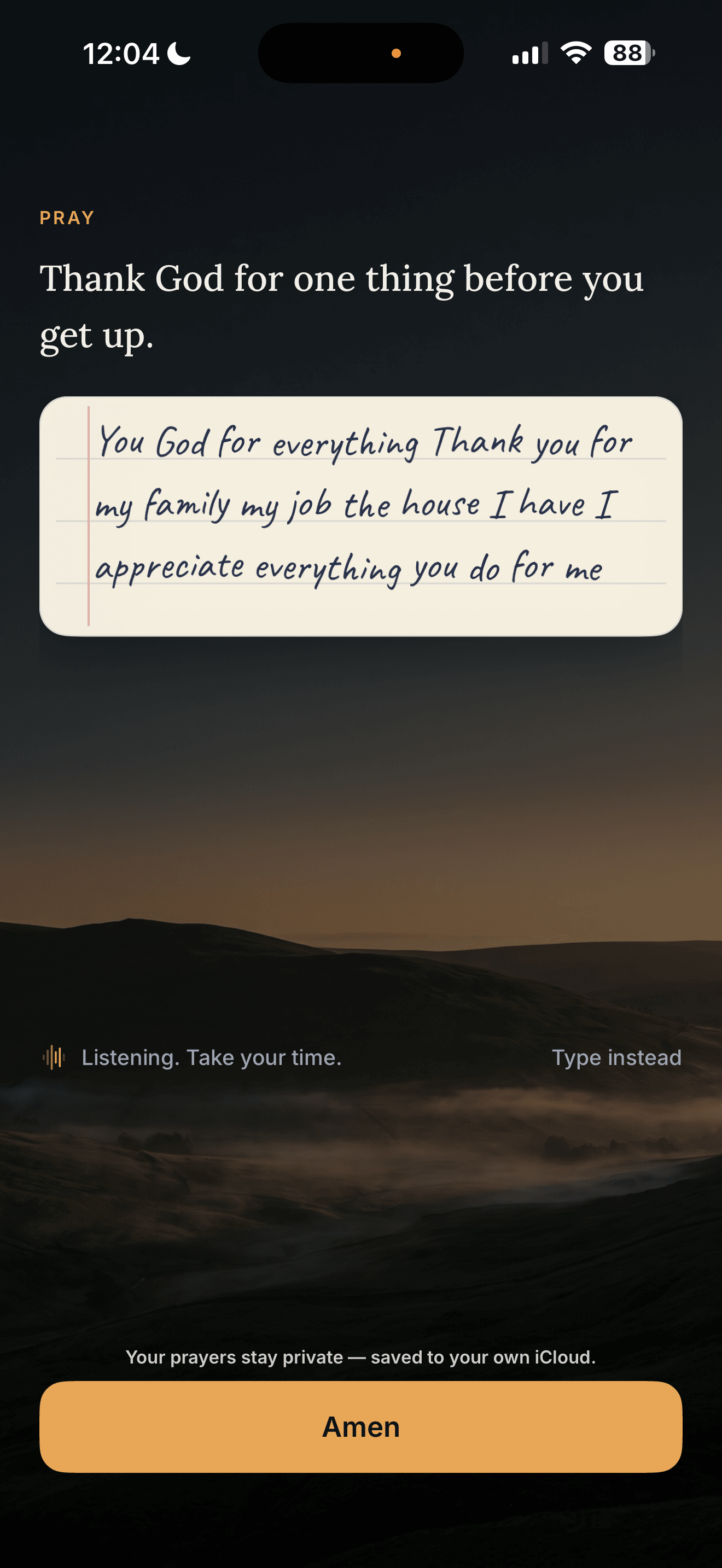
Frequently asked questions
What is Psalm 5 about?
Psalm 5 is a morning prayer of David. He asks God to hear him, sets his prayer before God in the morning and waits, contrasts God's goodness with deceit and harm, and ends with joy and protection for everyone who trusts God.
What does Psalm 5:3 mean?
In verse 3, David says God will hear his voice in the morning and that he will "direct" his prayer to God and "look up." He lays his requests before God at the start of the day and then waits, expecting God to answer.
Why pray in the morning?
Praying first places the day in God's hands before its pressures arrive. Psalm 5:3 models this: David brings his prayer to God in the morning and waits on Him. Many people find a short morning prayer helps them begin the day with trust instead of hurry.
How can I pray Psalm 5 every day?
Read verses 1 to 3, tell God honestly what is on your heart, lay out the day ahead, pray verse 8 asking Him to lead you, and close with verses 11 and 12, thanking Him for His favour and protection.
Sources and fact checks
- 01Psalm 5 (KJV) — Verbatim quotation checked on Bible Gateway, King James Bible Online and Bible Hub 2026-11-16 (12/12). Divine name rendered LORD (KJV small-caps / YHWH). KJV public domain in the U.S. Superscription from KJBO/Bible Hub.
- 02Psalms Chapter 5, King James Bible Online — 12/12 verse match and superscription, checked 2026-11-16.