Prayer
How to Start a Prayer Journal (With a Template)
Quick answer
A prayer journal is where you write your prayers to God instead of only thinking them: praise, confession, thanks, and requests, each with a date. Five minutes and a simple four-part template are enough to start. Over time it also becomes a record you can look back on to see what you prayed for and how God answered.
What a prayer journal is (and isn't)
Writing a prayer slows it down, and that helps. Half-awake, your mind wanders. With a pen in your hand, the sentence won't finish itself.
In the King James Version, Psalm 62:8 says: "Trust in him at all times; ye people, pour out your heart before him: God is a refuge for us." A prayer journal is just a practical place to do that pouring out.
What it isn't:
- It isn't a test. You don't need nice handwriting, long entries, or a perfect streak.
- It isn't a replacement for praying out loud or praying with other people. It sits alongside both.
- It isn't a regular diary. A diary is about your day. A prayer journal is written to God.
If you want to write about a passage you just read, that's a slightly different habit, and we cover it in how to journal after reading the Bible in the morning. This page is about writing your prayers and keeping track of what you ask for.
A four-part template: adoration, confession, thanksgiving, supplication (ACTS)
Many Christians use a simple structure called ACTS. It's an English acronym, one letter for each part of the prayer. It keeps your journal from turning into nothing but a list of requests.
- Adoration: start with who God is, not with you. One honest line is enough, such as "You are faithful even when I am not."
- Confession: name what you need to own, briefly and specifically. 1 John 1:9 promises: "If we confess our sins, he is faithful and just to forgive us our sins, and to cleanse us from all unrighteousness."
- Thanksgiving: write three specific things from the last 24 hours. The more specific, the better. "My sister's phone call" beats "my family."
- Supplication: ask for what you need, for yourself and for other people. Put a date next to each request so you can come back to it later.
You don't have to cover all four parts every day. Some mornings you'll only have thanks in you, and that's fine.
A template to copy
Copy these lines into a notebook, a journal, or a notes app, and fill in whatever you have time for:
- Date:
- Today's verse (optional):
- Adoration: Today I praise you because…
- Confession: Forgive me for…
- Thanksgiving: Thank you for… (three things)
- For me: I'm asking you for…
- For others: I'm praying for…
- One line to carry into today:
The same template works for anyone, whether you're looking for a prayer journal for women, for men, or for your small group. Keep the structure and personalize the prompts below so they fit your own life.
30 prayer journal prompts
For the days you open the page and nothing comes. Pick one and write a few lines.
Adoration
- What does today's verse show you about God?
- Where have you seen God's faithfulness this week?
- Which name or picture of God in the Bible (Shepherd, Rock, Father) means the most to you right now, and why?
- What part of creation made you stop and notice recently?
- If you wrote a one-line psalm today, what would it say?
Confession
- What did you say or do this week that you wish you could take back?
- Where are you trusting yourself more than God?
- Is there someone you need to ask for forgiveness?
- What worry are you feeding instead of handing over?
- What habit keeps pulling you away from prayer?
Thanksgiving
- What three specific things from yesterday are you grateful for?
- Who helped you without being asked?
- Which answered prayer might you be taking for granted?
- What hard season from your past do you see differently now?
- What small thing from this morning was a gift?
Asking for yourself
- What are you worried about today, and what exactly would you like to ask God for?
- What decision is in front of you? James 1:5 says: "If any of you lack wisdom, let him ask of God, that giveth to all men liberally, and upbraideth not; and it shall be given him."
- Where do you need strength this week?
- What would you like God to change in you over the next year?
- What fear do you want to bring into the light?
Asking for others
- Who in your family do you want to pray for today, and for what specifically?
- Who around you is going through something hard?
- Who in your church or community could use your prayers?
- Is there someone you find hard to love? Pray for them by name.
- What situation in your city or the world weighs on you?
Listening and responding
- What do you sense God inviting you to do today?
- Which verse do you want to carry with you through the day?
- What have you learned from a prayer that wasn't answered the way you expected?
- What would you change about your prayer time tomorrow?
- Write out the Lord's Prayer (Matthew 6:9–13) in your own words, one line at a time.
If the Lord's Prayer prompt helps, we have a short guide to praying the Lord's Prayer in the morning.
Keep a record of requests and answers
One of the most valuable things a prayer journal does is let you look back. Without a record, answered prayers blur together and you forget what you asked for in the first place. A simple system:
- Write each request with the date you first prayed it.
- Leave space next to it, or a margin on the right, to note when and how you saw an answer, even if it wasn't the answer you expected.
- Once a month, reread the last few weeks. You'll likely find answers you'd forgotten and requests that quietly changed.
- Don't erase requests that are still open. Seeing how long you've carried something is part of the story.
This isn't keeping score with God. It's remembering, and on discouraged days a page of dated answers helps.
Paper or app?
Both work. Here's how they compare:
- Paper, pros: no screen and no notifications, and writing by hand forces you to slow down.
- Paper, cons: hard to search, easy to leave at home, and it can get lost.
- App, pros: always with you, searchable, you can dictate when you don't feel like typing, and entries are organized by date.
- App, cons: your phone comes with distractions, and you need to know where your entries are stored.
- Choose paper if you have a quiet, fixed time and place to pray.
- Choose an app if you pray in scattered moments or want your journal next to your Bible reading.
There's no right answer. If you're unsure, start with whatever you already have. We weigh a similar choice in reading the Bible on your phone or on paper.
How Koum connects your alarm, prayer and journal
Koum is a Christian Bible alarm. Instead of a snooze button, the alarm stops when you scan, say or type the day's Scripture. Then your Morning opens:
- Prayer: write or dictate your prayer, then say Amen when you're ready.
- Devotional: spend a few more moments with the verse.
- Journal: keep what stayed with you.
You can go back to the verses, prayers and journal entries from earlier days, browse them by calendar, or search your own words, so the prayers you wrote down are there when you want to look back and see how God answered.
Your prayers and journal stay in your private iCloud, never on Koum's servers. You don't need an account or an email address, and prayer audio never leaves your device.
Koum requires iOS 26 or later. After onboarding, the Bible alarm and the full Morning experience require a subscription.
Download Koum on the App Store
If you're building a whole morning around prayer, these may help: a Christian morning routine built on prayer and praying before and after you read the Bible.
Put this into practice with Koum.
Koum asks you to open, scan, speak, or type a Bible verse before the alarm ends. Then it gives the morning room for prayer, a devotional, and a private reflection.
Get Koum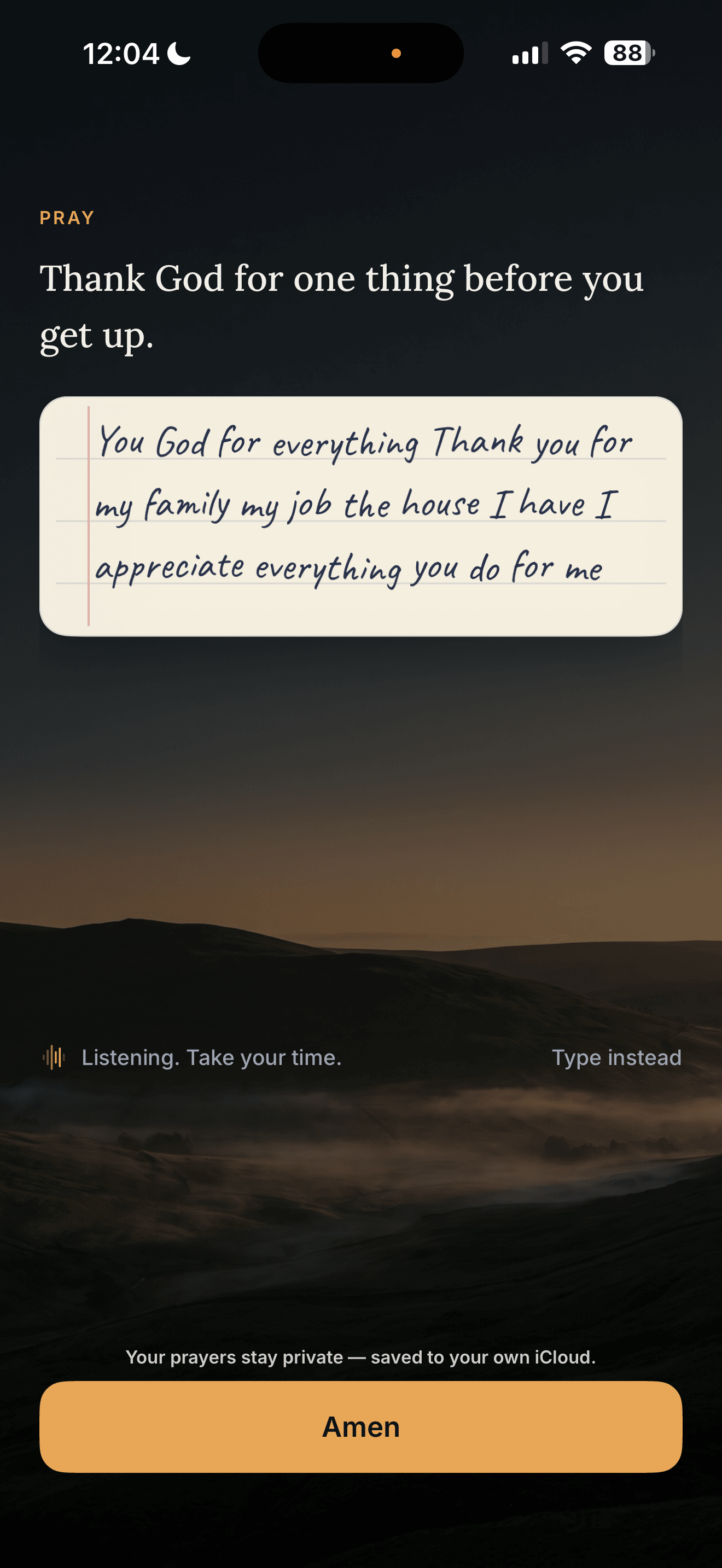
Frequently asked questions
What do you write in a prayer journal?
Whatever you'd say to God: praise, confession, thanks and requests, with the date. The four-part ACTS template above gives you a starting structure, and the prompts help on blank days.
How long should a prayer journal entry be?
Five minutes is plenty to start. A few honest lines you write most days will do more for you than a long entry once a month.
Do I have to write every day?
No. Many people write a few days a week. What helps most is a regular time and place, so the habit has somewhere to live.
What if I don't know what to write?
Pick one of the 30 prompts, copy out today's verse and write one sentence about it, or just list three things you're thankful for.
Is it safe to keep a prayer journal on my phone?
It depends on the app. In Koum, your prayers and journal stay in your private iCloud, not on Koum's servers. Whatever app you use, check its privacy policy before writing anything personal.
Sources and fact checks
- 01Psalm 62:8 (KJV) — Verbatim quotation checked on Bible Gateway.
- 021 John 1:9 (KJV) — Verbatim quotation checked on Bible Gateway.
- 03James 1:5 (KJV) — Verbatim quotation checked on Bible Gateway.
- 04Matthew 6:9–13 (KJV) — Cited by reference (Lord's Prayer prompt).
- 05Koum on the App Store — Supports Koum feature, privacy and subscription statements (US listing, checked 2026-10-19).