Prayer
Psalm 139: You Have Searched Me and Known Me
Quick answer
Psalm 139 is David's prayer of wonder that God knows him completely, is present everywhere, and formed him before birth. It ends by inviting God to search the heart and lead in the everlasting way. Verse 18, "when I awake, I am still with thee", makes it a natural first prayer of the day.
Some psalms ask God to act. Psalm 139 mostly stops to notice. It is a prayer of someone who has realized that they are fully known, never out of God's reach and lovingly made, and who answers that discovery with wonder rather than fear.
In the King James Version the psalm carries the heading "To the chief Musician, A Psalm of David." It moves through four movements: God's knowledge, God's presence, God's work in forming a life, and finally an honest prayer for God to search the heart. Along the way it gives one of Scripture's most morning-shaped lines: "when I awake, I am still with thee."
Below you will find the full KJV text, a section-by-section reading, and a simple way to pray it as you begin your day.
Psalm 139 (KJV) full text
1 O LORD, thou hast searched me, and known me.
2 Thou knowest my downsitting and mine uprising, thou understandest my thought afar off.
3 Thou compassest my path and my lying down, and art acquainted with all my ways.
4 For there is not a word in my tongue, but, lo, O LORD, thou knowest it altogether.
5 Thou hast beset me behind and before, and laid thine hand upon me.
6 Such knowledge is too wonderful for me; it is high, I cannot attain unto it.
7 Whither shall I go from thy spirit? or whither shall I flee from thy presence?
8 If I ascend up into heaven, thou art there: if I make my bed in hell, behold, thou art there.
9 If I take the wings of the morning, and dwell in the uttermost parts of the sea;
10 Even there shall thy hand lead me, and thy right hand shall hold me.
11 If I say, Surely the darkness shall cover me; even the night shall be light about me.
12 Yea, the darkness hideth not from thee; but the night shineth as the day: the darkness and the light are both alike to thee.
13 For thou hast possessed my reins: thou hast covered me in my mother's womb.
14 I will praise thee; for I am fearfully and wonderfully made: marvellous are thy works; and that my soul knoweth right well.
15 My substance was not hid from thee, when I was made in secret, and curiously wrought in the lowest parts of the earth.
16 Thine eyes did see my substance, yet being unperfect; and in thy book all my members were written, which in continuance were fashioned, when as yet there was none of them.
17 How precious also are thy thoughts unto me, O God! how great is the sum of them!
18 If I should count them, they are more in number than the sand: when I awake, I am still with thee.
19 Surely thou wilt slay the wicked, O God: depart from me therefore, ye bloody men.
20 For they speak against thee wickedly, and thine enemies take thy name in vain.
21 Do not I hate them, O LORD, that hate thee? and am not I grieved with those that rise up against thee?
22 I hate them with perfect hatred: I count them mine enemies.
23 Search me, O God, and know my heart: try me, and know my thoughts:
24 And see if there be any wicked way in me, and lead me in the way everlasting.
What Psalm 139 means, section by section
Verses 1–6: God knows me completely. The psalm opens with the past tense: "thou hast searched me, and known me." God's knowledge is not a guess or a first impression. It covers sitting down and getting up, the paths we walk and the place we rest, even a word before it reaches the tongue. The psalmist does not try to explain this. He simply admits that "such knowledge is too wonderful for me." To be known this deeply could feel exposing, but in this psalm it comes together with God's hand laid upon the one who prays.
Verses 7–12: There is nowhere God is absent. Next the psalm asks a question: where could I go from your presence? It tries every direction. Up to heaven, down to the depths, out on "the wings of the morning" and on to "the uttermost parts of the sea." Many readers hear in this the full width of the world, from the sunrise to the farthest sea. Every answer is the same: God is there, and his hand still leads and holds. Even darkness does not hide anything from him, because "the darkness and the light are both alike to thee." This is not a threat that we cannot escape. It is a comfort that we cannot be lost.
Verses 13–18: Formed and remembered. The psalm then turns to the beginning of life. God knew the psalmist's inner parts and covered him in his mother's womb, shaping him in secret before anyone else could see. Verse 14 responds with praise: "I am fearfully and wonderfully made." Verse 16 adds that God's eyes saw him before he was complete, and that all his members were written in God's book before any of them existed. The section ends with God's thoughts, so many that counting them would be like counting sand, and then the line that fits every morning: "when I awake, I am still with thee." Sleep has not interrupted God's attention for a moment.
Verses 19–22: Honest anger handed to God. Here the tone changes suddenly. The psalmist speaks with strong anger about people who oppose God and misuse his name. These verses can surprise readers. One gentle way to read them is that the psalm does not hide difficult feelings from the God who already knows every thought. The anger is brought into prayer and placed before God, rather than acted on. The very next lines also turn the searching light back on the one praying.
Verses 23–24: "Search me, O God." The psalm ends where it began, with God's searching, but now it is a request rather than an observation. "Search me, O God, and know my heart." Having remembered that God knows everything, the psalmist invites him to look closer still: to test anxious thoughts, to show anything wrong and to "lead me in the way everlasting." It is a humble, hopeful place to finish a prayer, and an honest place to start a day.
Why Psalm 139 fits the morning
Mornings often begin with a quick inventory: what is waiting, what is unfinished, what might go wrong. Psalm 139 offers a different first thought. Before the day asks anything of you, you are already known and already accompanied. Verse 18 says it plainly: "when I awake, I am still with thee."
The psalm also uses morning imagery in verse 9. Whether the day takes you far from home or keeps you in a familiar routine, the "wings of the morning" do not carry you anywhere God is not.
If you already read the psalms at the start of the day, see our guide to praying the psalms in the morning. For a broader rhythm, try a short morning prayer or learn how to meditate on Scripture in the morning. Psalm 139 also pairs well with Psalm 121, another psalm about God's constant watch, and Psalm 23, with its picture of a Shepherd who stays near.
How to pray Psalm 139
You do not need a long time. Five quiet minutes are enough to begin.
- Read slowly. Read the whole psalm once without stopping, or choose one section if time is short.
- Notice one line. Let a phrase stand out to you, such as "thou hast searched me, and known me" or "when I awake, I am still with thee."
- Thank God for being known. Name one way you are glad that God knows you, including the parts of you no one else sees.
- Ask God to search you. Pray verses 23–24 in your own words. Mention any worry or unsettled feeling you are carrying into the day.
- Carry one phrase with you. Choose a short line to return to during the day. You might memorize a Bible verse in the morning using that phrase.
A short sample prayer:
"Lord, you have searched me and known me. Before I said a word this morning, you were already here. Thank you that I am never out of your sight and never out of your care. Search my heart today. Show me what is not right, quiet what is anxious, and lead me in your everlasting way. Amen."
Psalm 139 when you feel unseen or anxious
There are seasons when it feels like nobody notices you, or when your thoughts race before you have even got out of bed. Psalm 139 speaks gently into both.
If you feel unseen, verses 1–6 remind you that God's attention is not occasional. He knows your sitting and rising and every path you take. If you feel anxious, verse 23 gives you words to bring those thoughts to him instead of carrying them alone. The psalm does not promise that every feeling will change at once. It does promise presence: in the dark, at the farthest edge, and again when you wake.
If prayer feels dry right now, you are not alone. Our guide on how to pray when you feel spiritually dry offers small, grace-filled steps. You may also find Psalm 27 and Psalm 91 helpful companions for anxious days, and Psalm 51 when the "search me" of verse 23 brings something to confess. If you are just beginning with the Psalms, Psalm 1 is a gentle place to start. At the end of the day, a short night prayer can close the loop that Psalm 139 opens in the morning.
Build the habit with Koum
A morning habit is easier when Scripture is the first thing you meet. Koum is a Bible verse alarm clock: you wake up to a verse and can set up a simple morning reading and prayer routine.
To begin, follow our guide to setting up a Bible alarm for morning reading. You can also read more about using a Christian alarm clock app. Then, when the alarm sounds, open Psalm 139 and let your first prayer be its simplest truth: when I awake, I am still with thee.
Put this into practice with Koum.
Koum asks you to open, scan, speak, or type a Bible verse before the alarm ends. Then it gives the morning room for prayer, a devotional, and a private reflection.
Get Koum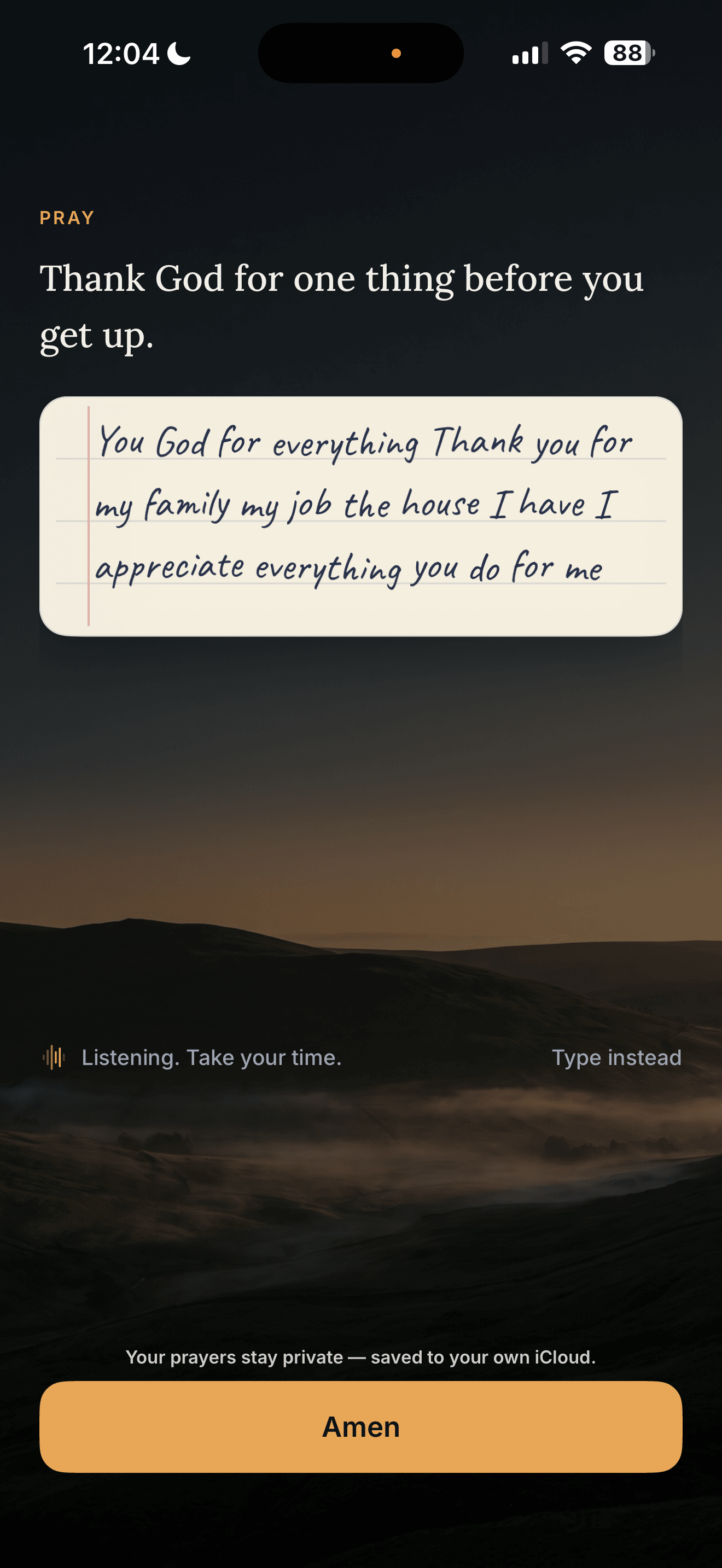
Frequently asked questions
What is Psalm 139 about?
Psalm 139 is a prayer of wonder that God knows the person praying completely, is present everywhere and formed them before birth. It ends by asking God to search the heart and lead in "the way everlasting."
What does "the wings of the morning" mean?
In verse 9, "the wings of the morning" is often read as a poetic picture of traveling as far as the sunrise in the east, set against "the uttermost parts of the sea" in the west. The point is that even at the farthest distance, God's hand still leads and holds.
Why does Psalm 139 change tone in verses 19–22?
The psalmist suddenly voices strong anger at people who oppose God. A gentle reading is that the psalm brings even hard feelings honestly into prayer before God, instead of hiding them or acting on them, and then immediately asks God to search the psalmist's own heart in verses 23–24.
How can I pray Psalm 139 in the morning?
Read it slowly, choose one line that stands out, thank God that he knows you and ask him to search your heart using verses 23–24. Carry a short phrase, such as "when I awake, I am still with thee," into your day.
Sources and fact checks
- 01Psalm 139 (KJV) — Verbatim quotation checked on Bible Gateway 2026-11-09 (24/24). Divine name rendered O LORD (KJV small-caps / YHWH) in vv. 1, 4, 21, matching kingjamesbibleonline.org. KJV public domain in the U.S.
- 02Psalm 139 (KJV) on King James Bible Online — Confirms superscription and O LORD rendering. Checked 2026-11-09.
- 03Koum on the App Store — Supports Koum feature and privacy statements.