Prayer
Psalm 1: Blessed Is the Man
Quick answer
Psalm 1 opens the Psalter by contrasting two ways of life: delighting in the Lord's law, or walking with the wicked. It promises a rooted, fruitful life for the person who meditates on God's word, and it fits a quiet morning reading.
Before the book of Psalms fills our ears with songs of praise, sorrow, trust and thanksgiving, Psalm 1 invites us to consider the ground beneath our lives. Two paths open before us. One is shaped by the counsel of the ungodly; the other delights in God’s word. One leads to windblown chaff. The other is pictured as a tree, settled beside water and fruitful in its season.
The psalm doesn't give us a hurried formula for a successful morning. It gives us a place to stand. Read it slowly, with its tree in mind, and let its simple words help you return to Scripture with delight.
Psalm 1 (KJV) full text
Read all six verses from the King James Version on Bible Gateway:
1 Blessed is the man that walketh not in the counsel of the ungodly, nor standeth in the way of sinners, nor sitteth in the seat of the scornful.
2 But his delight is in the law of the Lord; and in his law doth he meditate day and night.
3 And he shall be like a tree planted by the rivers of water, that bringeth forth his fruit in his season; his leaf also shall not wither; and whatsoever he doeth shall prosper.
4 The ungodly are not so: but are like the chaff which the wind driveth away.
5 Therefore the ungodly shall not stand in the judgment, nor sinners in the congregation of the righteous.
6 For the Lord knoweth the way of the righteous: but the way of the ungodly shall perish.
What Psalm 1 means, section by section
Verses 1–2: Delighting in God's instruction
Verse 1 describes influences that can gradually become a way of life: walking, standing, sitting. The righteous person does not let ungodly counsel become their natural resting place. That doesn't mean isolation from everyone who thinks differently; it means refusing to make scorn and sin the guidance system of your life.
Then the psalm moves from what is avoided to what is loved: “his delight is in the law of the Lord.” Meditation here isn't emptying your mind. It's dwelling on God's instruction and letting it remain with you “day and night.” This image begins not with outward achievement but with an inward affection for God’s word.
Verse 3: The tree by the water
A planted tree doesn't hop from place to place searching for nourishment. It has water and roots. Psalm 1 offers this as a picture of a life continually nourished by God's word. Its fruit comes “in his season,” not instantly or on demand.
The leaves and fruit belong to a life of steady dependence. The verse isn't permission to claim that everything will go exactly as you want; its focus is the flourishing, fruitful life that meditation on God's instruction pictures. You can receive the image as an invitation to be fed rather than a demand to keep producing.
Verses 4–5: Chaff in the wind
The contrast is severe and intentionally visual. Chaff is light and separated from the grain; it has no rooted stability. The ungodly life is not moving toward the flourishing described in verse 3. Its path can't stand in the judgment or remain among the congregation of the righteous.
These verses keep us from treating Psalm 1 as merely general life advice independent of God. The two paths lead somewhere. Let that seriousness clarify your direction rather than drive you into hiding.
Verse 6: God knows the righteous path
“For the Lord knoweth the way of the righteous” brings the picture back to personal care. God isn't an observer of abstract principles; it is he who knows the way of those who trust and follow him. The final contrast makes the psalm’s choice plain: it presents the way of the righteous with the way that leads to perishing.
Why Psalm 1 fits the morning
Morning gives you a place to put down roots before the day’s requests begin. The psalm's “day and night” includes ordinary waking hours and ordinary evening moments. You don't need to master six verses before coffee. You can read one phrase, repeat it and carry it into the day.
Try reading Psalm 1 alongside a morning prayer, and make “delight” a quiet request rather than a performance goal. If you'd like a wider rhythm, explore praying Psalms in the morning and a seven-day plan of morning Bible verses. For another daily habit, consider reading Proverbs in the morning.
Psalm 1 also reads well beside Psalm 23, which pictures God’s tender guidance, or Psalm 91, which focuses on trust in God’s shelter. Each gives you different words for a rooted faith.
How to pray Psalm 1
- Read verse 1 and ask God to show you the voices shaping your choices.
- Repeat verse 2 slowly. Ask for real delight in Scripture, even if you begin with only a desire for it.
- Picture the tree in verse 3. Name one area where you need steady nourishment rather than hurried results.
- Let verses 4–6 make your direction clear. Trust that God sees your path.
- Finish with one simple intention: a verse to carry, a decision to make or someone to encourage today.
Here is a prayer you can use:
Lord, I want my life to be rooted near you. Where voices of cynicism or selfishness have shaped me, give me a new direction. Grow my delight in your word. When I am restless, let me receive your nourishment like a tree beside water. Teach me to bear fruit in your time, without demanding instant results. You know my path; guide me in your righteousness today. Amen.
Psalm 1 when you feel unrooted
There are mornings when you don't feel like a flourishing tree. Your thoughts are scattered, your routines are unsettled, or prayer feels like one more thing you can't keep up. Psalm 1 doesn't ask you to pretend otherwise. Its first picture is one of receiving: a planted tree watered at its roots.
Start small. If a full reading feels distant, read one verse. Let your prayer be, “Lord, give me roots.” Delight can return gradually; you don't need to produce it by force.
Our guide to praying when you feel spiritually dry can help you take that small, honest next step. For another psalm to turn toward, read Psalm 27 or Psalm 51. If finishing the day is when you feel most spiritually scattered, Psalm 1 can become a bookend for the next morning too.
Build the habit with Koum
Koum is a Bible verse alarm clock that helps you begin the day with Scripture. The alarm does not stop at a button. It stops when you engage with the day's verse, proving it by scanning an open physical Bible, speaking it aloud or typing it. There's no snooze, and with the Chase setting, "If you give up," Koum can call you back until you prove the verse.
Your verified morning opens into Prayer, Devotional and Journal. You can write or dictate a prayer, spend a little longer with the verse and keep what stayed with you. Koum includes a built-in Bible, so you can open Psalm 1 after the alarm and meditate on verse 2 or 3.
Your prayers and journal stay in your private iCloud, and you don't need an account to get started. Read how to set up a Bible alarm for morning reading, or explore our Christian alarm clock app guide.
Wake up to a verse like Psalm 1 with Koum.
Put this into practice with Koum.
Koum asks you to open, scan, speak, or type a Bible verse before the alarm ends. Then it gives the morning room for prayer, a devotional, and a private reflection.
Get Koum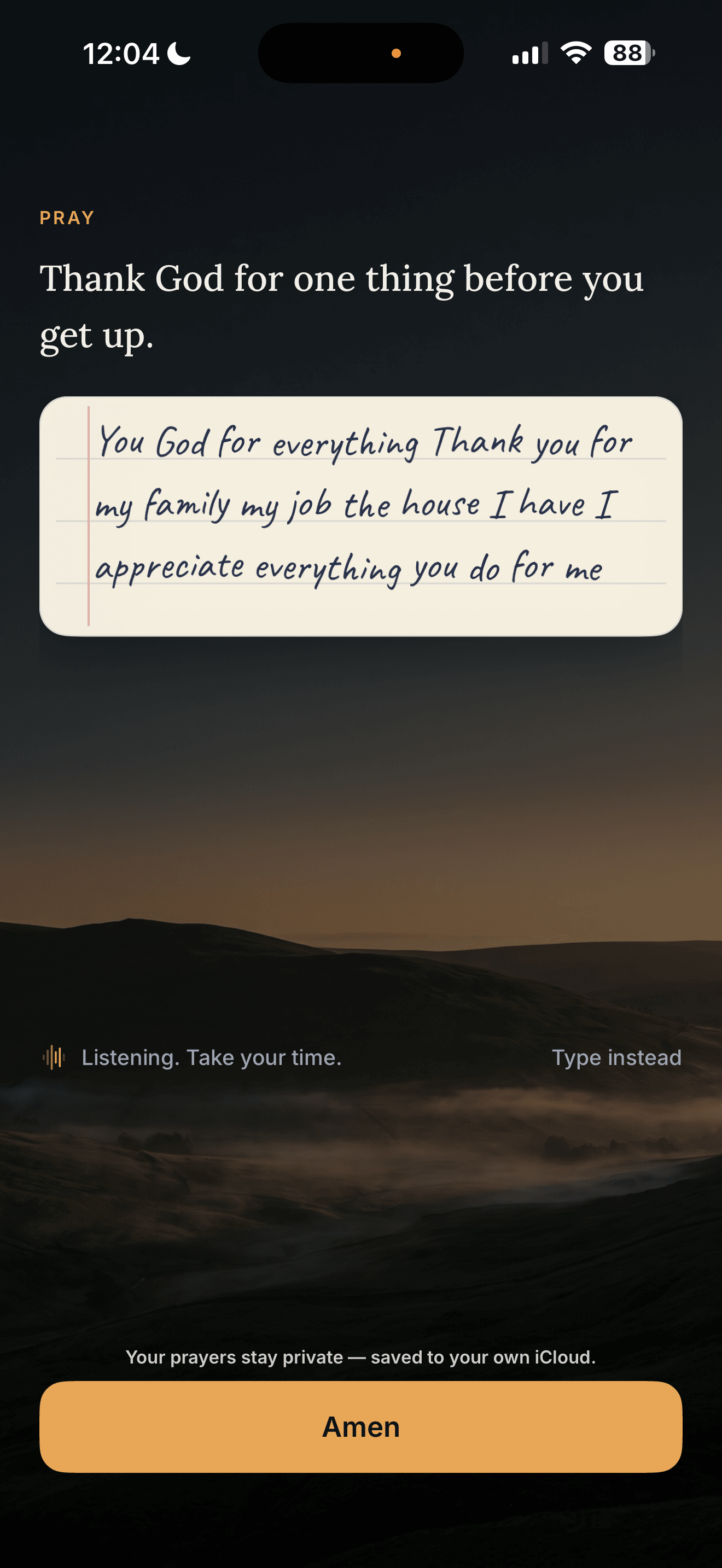
Frequently asked questions
What is Psalm 1 about?
Psalm 1 contrasts a life that delights in God’s instruction and becomes rooted in it with the path of the ungodly. The tree and windblown chaff pictures show two very different ways to live.
What does “blessed is the man” mean?
It describes the flourishing person who doesn't settle into ungodly counsel but delights in God's word. The rest of the psalm explains this happiness as a rooted, spiritually fruitful life guided by what God says.
What does the tree by the water mean?
The tree pictures the person in verse 2 whose meditation on God's instruction nourishes their life. It represents rootedness, fruit in its season and a life sustained rather than scattered.
What is a simple way to pray Psalm 1 in the morning?
Read it slowly once, pause at verse 2 or 3 and ask God to deepen your delight in Scripture. Then pray about one choice you will face today and one way you wish to stay rooted in him. End by carrying a phrase from the psalm into your day.
Sources and fact checks
- 01Psalm 1 (KJV) — Verbatim quotation checked on Bible Gateway 2026-11-06. KJV public domain in the U.S.
- 02Koum on the App Store — Supports Koum feature and privacy statements (same approved wording as the Psalm 51 post).