Prayer
A morning prayer for anxiety before work or school
Quick answer
When anxiety is loud, begin with a short prayer: name what you fear, ask for today’s help, take one manageable next step, and reach out for qualified support when anxiety persists or feels unsafe.
Start with the real morning in front of you
Some mornings begin with a racing mind before your feet reach the floor. Work, school, money, relationships, health, and unfinished conversations can all arrive at once. A morning prayer does not diagnose anxiety or promise that difficult feelings will disappear. It gives you a truthful place to bring them. Philippians 4:6–7 invites believers to bring requests to God with thanksgiving, and Matthew 11:28–30 records Jesus’ invitation to come to him when weary and burdened. Begin without pretending you are calm: ‘God, I am anxious about this meeting, this class, this bill, this conversation, or this unknown. You already know it, and I am bringing it to you.’ Naming a fear is not faithlessness. It can be the beginning of refusing to let unnamed fear direct every choice. Let the prayer be brief enough to say aloud, even when concentration is thin.
Make the practice small enough to keep
Try a simple four-part prayer. First, breathe slowly and thank God for one present gift, however small. Second, name the concern in plain words rather than giving it a dramatic story. Third, ask for what you need for the next hour: wisdom, a clear mind, courage, patience, or help asking for assistance. Fourth, choose one next action that is within your reach: drink water, review the first task, tell a trusted person you are struggling, or step outside for a minute. This is not a technique for controlling God or a substitute for care. It is a way to reconnect prayer with the real decisions of the morning. If your thoughts keep returning, repeat one short line such as ‘God, hold what I cannot hold.’ The goal is not to win an argument with your feelings. The goal is to place yourself, again and again, in God’s care while taking the next wise step. It may be useful to distinguish between a problem you can address and a fear that asks you to rehearse every possible outcome. Write two columns: ‘what I know’ and ‘what I am imagining.’ Put only facts in the first column. In the second, write the predictions that are draining you. Then pray over both without pretending that facts are harmless or predictions are certain. This can create enough space to make a wiser choice. If you have a workplace accommodation, a school counselor, a medical appointment, or a support person, use the resources available to you. Avoid making major decisions in the first minutes of a panic response if you can safely wait and talk with someone. Prayer can make room for wisdom, but it does not require you to handle a serious situation alone. The next faithful step may be asking for help before you try to be brave in isolation.
Pray honestly and carry Scripture into the day
Be gentle and practical with your body as well as your prayers. The CDC notes that sufficient sleep supports health and well-being; it does not say prayer or an app is a medical treatment for anxiety. If anxiety is persistent, worsening, making daily life hard, or bringing thoughts of self-harm, talk with a qualified health professional or local emergency service promptly. Reach out to a trusted person today rather than carrying it alone. Spiritual support and professional care do not have to compete. A pastor, counselor, physician, or licensed therapist can each help in different ways. Prayer can accompany treatment; it should not be used to shame someone for needing it. God’s care is not measured by whether a hard feeling leaves on schedule. Make the prayer concrete enough that it creates a bridge to support. If you are anxious about a presentation, write the name of one person you can ask to review it. If you are anxious about school, list the first assignment rather than the whole semester. If you are anxious about conflict, decide whether the next faithful step is a conversation, a boundary, an apology, or a pause until you are calmer. Avoid using spiritual language to force yourself through danger, exhaustion, or abuse. Wisdom may include leaving a situation, seeking counsel, or making a safety plan. You do not have to prove faith by handling everything alone. Keep the prayer and the practical step together: ‘God, help me contact this person,’ then contact them. ‘God, give me courage for this appointment,’ then keep the appointment. This is not a bargain with God; it is a way of responding to care with the next available act of trust.
Put this into practice with Koum
Koum can help create a quieter first moment by requiring a Scripture interaction before its Bible alarm ends, then offering room for prayer and private reflection. You might set a single verse from Philippians 4 as the first text you see, write one concern you are releasing, and choose a calm next action. The app cannot treat anxiety, guarantee sleep, or replace a clinician, a pastor, or a supportive community. Its useful role is smaller: it can help interrupt automatic scrolling and open a moment for Scripture before the day accelerates. If you use it, keep the plan modest and compassionate. A faithful morning may look like one verse, one honest prayer, one call for help, and one step forward. If anxiety changes your plans, write down what helped and what made things harder. Take that note to a clinician, counselor, pastor, or trusted person who can help you make a more durable plan. You deserve care that is specific, safe, and compassionate, not pressure to endure alone.
Put this into practice with Koum.
Koum asks you to open, scan, speak, or type a Bible verse before the alarm ends. Then it gives the morning room for prayer, a devotional, and a private reflection.
Get Koum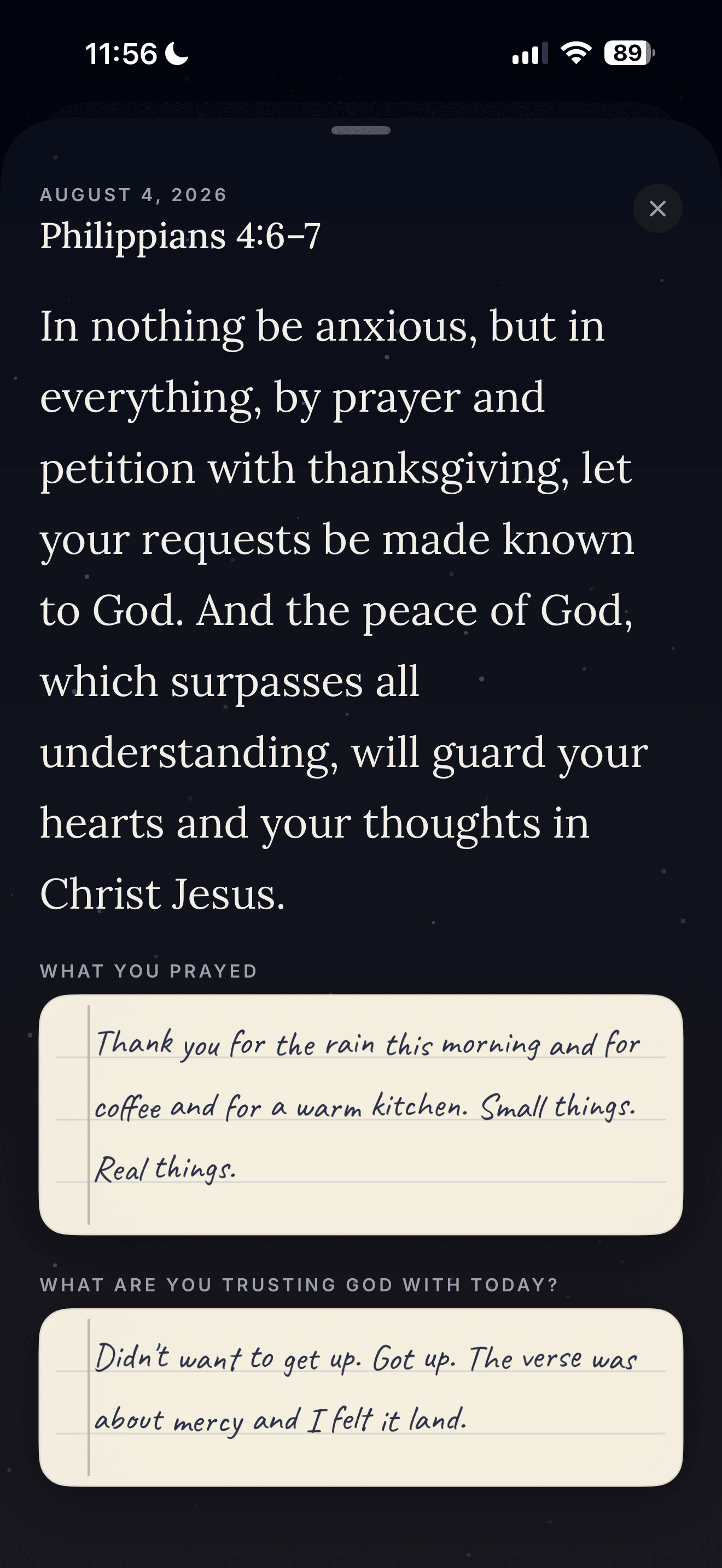
Frequently asked questions
Can prayer replace therapy or medical care for anxiety?
No. Prayer can be meaningful spiritual support, but persistent, severe, or unsafe anxiety deserves qualified professional care and immediate local help in a crisis.
What is a short prayer for an anxious morning?
Try: ‘God, you know what I fear. Give me enough grace for the next step, and help me receive the care I need today.’
Sources and fact checks
- 01Philippians 4:6–7, NIV — A biblical invitation to bring requests to God.
- 02Matthew 11:28–30, NIV — Jesus’ invitation to the weary and burdened.
- 03CDC: About Sleep — General public-health context for sleep, not a claim that prayer or Koum treats anxiety.
- 04Koum support — Verified product capabilities and limits.