Bible reading
How to meditate on Scripture in the morning without rushing
Quick answer
Meditate on Scripture in the morning by choosing one short passage, reading it slowly in context, noticing what it reveals about God and your life, answering with prayer, and choosing one faithful action. The goal is not to finish a large amount of text or produce a certain feeling. It is to remain with God’s Word long enough for attention, prayer, and obedience to meet.
Start with one passage, not a performance
Morning Scripture meditation begins with a smaller decision than many people expect: choose one passage you can actually attend to. A paragraph or a few verses is enough. You do not need to prove your seriousness by reading an entire book before breakfast. Choose a translation you can understand, put the passage where you will see it, and give yourself permission to return to it tomorrow. A sustainable practice leaves room for the life you already have: children waking up, a commute, a shift beginning early, a body that needs sleep, or a mind that takes time to become clear.
Psalm 1:2 gives a picture of delighting in God’s instruction and meditating on it day and night. That picture is not a demand to create a perfect morning performance. It is an invitation to let Scripture remain present. Joshua 1:8 also connects meditation with keeping the Word close and living it out. Both passages keep meditation from becoming a vague exercise in emptying your mind. Christian meditation gives attention to what God has spoken so that your thinking, praying, and choices can be shaped by it.
Begin by choosing a passage for a reason. If you need courage, read a passage about God’s presence. If you need wisdom, choose a prayer for guidance. If you are grateful, stay with a song of praise. You are not using Scripture as a fortune cookie to predict the day. You are bringing a real day into conversation with a trustworthy text. Write down the reference before you close the Bible so that you can find the larger context again.
Read for attention before you search for an explanation
Read the passage twice, slowly enough to notice words you would normally pass over. On the first reading, ask what is actually there. Who is speaking? Who is being addressed? What situation or movement does the passage describe? On the second reading, notice repetition, contrast, commands, promises, questions, and changes in tone. These simple observations protect you from turning the first sentence that catches your eye into a message detached from its setting.
Meditation is more than staring at a verse until it feels meaningful. It is a patient form of listening. You can read the paragraph around the verse, check a trustworthy Bible reference, or compare a translation when a phrase is difficult. You do not need to solve every interpretive question before prayer, but you should resist making the passage say whatever your mood needs it to say. Humility is part of reading well. If the meaning is unclear, record the question and return to it with a pastor, study group, or trusted commentary rather than forcing certainty.
Try a simple noticing exercise. Write three words from the passage that stand out, then write one sentence describing the movement of the text. For example, a passage may move from fear to trust, hearing to doing, or request to waiting. Do not rush to turn those words into a slogan. Let them remain specific. A morning meditation becomes richer when you pay attention to the Bible in front of you instead of only searching for a line that confirms what you already wanted to hear.
Ask what the passage reveals and requires
After noticing the text, ask two questions: What does this show me about God, and what does it bring into view about me? The first question keeps meditation centered on God’s character rather than self-improvement. You might see patience, holiness, mercy, wisdom, faithfulness, or a willingness to hear. The second question helps the reading become honest. You may notice fear, resentment, avoidance, gratitude, grief, or a habit of reacting before listening.
Do not treat every passage as a command to accomplish more. Sometimes the faithful response is to receive comfort, confess a wrong, wait, forgive, ask for help, or rest. Other times the passage will expose a concrete responsibility. James 1:22–25 warns against hearing the Word and immediately forgetting it; the image points toward a life that responds to what it has seen. That response does not need to be dramatic. It can be one truthful conversation, one act of patience, one decision to make amends, or one task done without cutting corners.
Write one observation and one response. Your observation should be anchored to the passage: God notices, the writer waits, Jesus withdraws to pray, the command addresses speech. Your response should be modest enough to practice before lunch. Avoid promising to transform your entire personality by tomorrow. A specific response gives the meditation somewhere to go while leaving the deeper work of formation in God’s hands.
Turn one observation into prayer and action
Let the passage become prayer in your own words. You might say, God, I see that I am trying to control this conversation; help me listen before I defend myself. Or, Thank you for meeting people in weakness; help me ask for help instead of hiding today. Prayer keeps meditation relational. You are not merely analyzing a text or grading your spiritual performance. You are answering God with the truth the reading has brought to the surface.
Then choose one way to carry the passage into the next part of the day. Put the reference on a note, repeat a short phrase while you make breakfast, or set a midday reminder to reread it. If the passage calls you toward patience, decide where you will practice it. If it invites trust, name the specific worry you will release in prayer. If it reveals a need for reconciliation, plan a careful first step rather than sending an impulsive message. The action should honor the passage without pretending that one morning can solve a complex relationship.
Keep the practice gentle when your attention wanders. Notice the distraction, name it to God, and return to the sentence in front of you. A distracted morning is not evidence that the reading was useless. It is an ordinary opportunity to practice returning. If you miss a day, continue with the same passage or begin again tomorrow. Consistency grows through return, not through shame. Protect the practice from becoming another scoreboard that makes you avoid God whenever you feel you have failed.
Put this into practice with Koum
Koum can support the first transition of this practice by placing a Bible verse before the morning’s notifications. Its Bible alarm can ask you to open, scan, say, or type a verse before the alarm ends. After that Scripture-first step, the app makes room for a devotional, prayer, and private reflection. Those features can help you remember the passage and capture the response you want to carry into the day, but they do not interpret Scripture for you or make a morning automatically faithful.
Set up the passage before you go to sleep and choose a wake time that does not require you to sacrifice needed rest. When the alarm asks for the verse, treat the response as an invitation to open the text, not as a spiritual score. Read the surrounding passage, take the few minutes you have, and write one honest sentence. If you need a longer study, save the question for later. A short morning encounter can be the beginning of deeper reading rather than a substitute for it.
The best meditation practice is one that returns you to Scripture, prayer, obedience, and the people in your actual life. Koum may reduce the distance between waking and opening a passage, while your church, trusted relationships, and ordinary responsibilities give the reading a wider home. Start with one text tomorrow. Read what is there. Ask what it reveals and requires. Pray your response, then take one faithful step before the day carries you somewhere else.
Put this into practice with Koum.
Koum asks you to open, scan, speak, or type a Bible verse before the alarm ends. Then it gives the morning room for prayer, a devotional, and a private reflection.
Get Koum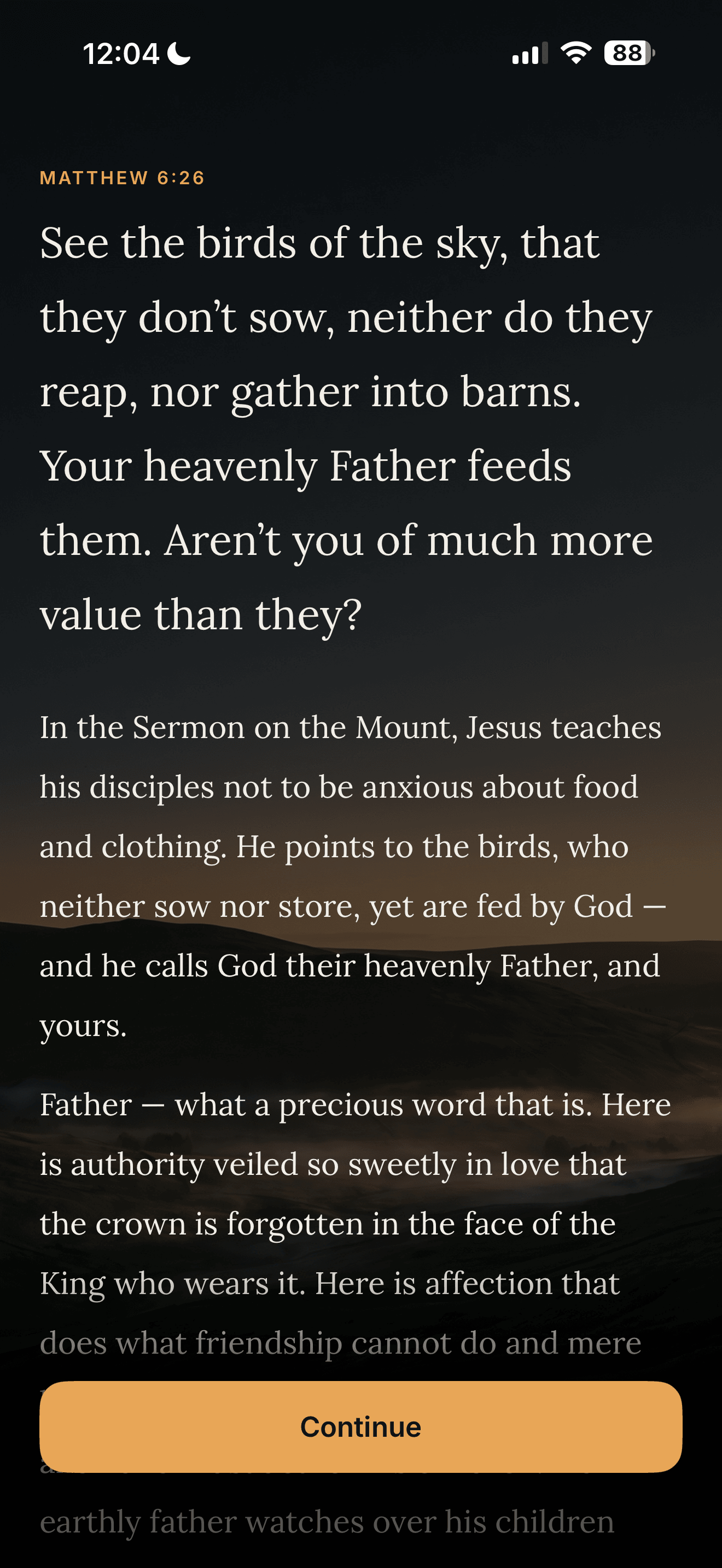
Frequently asked questions
How long should morning Scripture meditation take?
There is no required length. Start with five to fifteen focused minutes if that is realistic, and protect sleep and responsibilities. Reading one short passage carefully, praying one honest response, and choosing one action can be more useful than rushing through several chapters.
What should I do if I do not understand the passage?
Read the surrounding paragraph, note the question, and consult a trustworthy study resource or mature Christian. You can still pray from what is clear without pretending to have solved every detail. Returning to the passage later is part of faithful reading, not a failure.
Sources and fact checks
- 01Psalm 1:2, NIV — Meditation on God’s instruction as an ongoing posture of attention.
- 02Joshua 1:8, NIV — Keeping the Book of the Law close, meditating on it, and living it out.
- 03James 1:22–25, NIV — The connection between hearing the Word, remembering it, and doing it.
- 04CDC: About Sleep — Sleep supports health and emotional well-being; morning practice should not be built by neglecting needed rest.
- 05Koum support — Repository-checked product claims about Scripture-first alarms, verse response modes, and the prayer, devotional, and reflection steps.