Prayer
Psalm 23: What "The Lord Is My Shepherd" Means and How to Pray It
Quick answer
Psalm 23 is a psalm of David that pictures God as a shepherd who cares for his sheep and as a host who welcomes a guest to his table. Its message is simple and deep: God provides, guides, protects and stays with you, even through the darkest valley, and his goodness follows you to a lasting home with him.
Psalm 23 may be the most loved passage in the whole Bible. Many people learned it as children, and many reach for it in hospital rooms, at funerals and on sleepless nights. It's only six verses long, but it holds a whole life inside it: rest and work, danger and comfort, enemies and celebration, this life and the next.
In this guide you'll read Psalm 23 in full, walk through what each verse means, and learn a simple way to pray it for yourself.
Psalm 23 in full
Here is the whole psalm, quoted from the King James Version.
A Psalm of David.
1 The LORD is my shepherd; I shall not want.
2 He maketh me to lie down in green pastures: he leadeth me beside the still waters.
3 He restoreth my soul: he leadeth me in the paths of righteousness for his name's sake.
4 Yea, though I walk through the valley of the shadow of death, I will fear no evil: for thou art with me; thy rod and thy staff they comfort me.
5 Thou preparest a table before me in the presence of mine enemies: thou anointest my head with oil; my cup runneth over.
6 Surely goodness and mercy shall follow me all the days of my life: and I will dwell in the house of the LORD for ever.
What Psalm 23 means, verse by verse
Verse 1: "The LORD is my shepherd; I shall not want." The whole psalm grows out of this first line. A shepherd is responsible for everything his sheep need: food, water, direction and safety. David doesn't say "a shepherd" but "my shepherd". This is personal. "I shall not want" doesn't mean you'll get everything you wish for. It means that with God caring for you, you won't lack what you truly need.
Verse 2: green pastures and still waters. Sheep don't lie down when they're hungry, afraid or restless. A shepherd who makes them lie down in green pastures has fed them and made them feel safe. Still waters are calm water a sheep can drink from without fear. This verse is about rest that God gives, not rest you have to earn.
Verse 3: "He restoreth my soul." God doesn't only keep you going; he brings you back to life when you're worn out or have wandered off. He also leads you "in the paths of righteousness", the right way to walk, and he does it "for his name's sake". His guidance rests on his own faithful character, not on how well you've done this week.
Verse 4: the valley of the shadow of death. The scenery changes. The path goes down into a dark valley, and the psalm doesn't pretend otherwise. Notice two things. First, you walk through the valley; it isn't where the journey ends. Second, the language shifts from "he" to "thou". In the darkest place, David stops talking about God and starts talking to him: "for thou art with me". The rod and staff were the shepherd's tools for protecting and guiding the flock. Seeing them is a comfort, because they mean the shepherd is close.
Verse 5: a table before my enemies. Now God is pictured as a generous host. Enemies are still nearby, but they can't stop the meal. Anointing a guest's head with oil was a sign of welcome and honor, and a cup that "runneth over" means more than enough. God's care isn't only about getting you through. It's about receiving you with joy.
Verse 6: goodness and mercy. The psalm ends looking forward. Goodness and mercy don't just wait for you; they "follow" you, every day of your life. And the journey has a destination: "I will dwell in the house of the LORD for ever." The sheep who started in the field ends at home with God.
Who wrote Psalm 23 and why it matters
The heading of the psalm reads "A Psalm of David." That matters, because David knew the work of a shepherd firsthand. When the prophet Samuel came looking for Israel's next king, David was the youngest son, out keeping the sheep (1 Samuel 16:11). Later, David told King Saul, "Thy servant kept his father's sheep, and there came a lion, and a bear, and took a lamb out of the flock," and described how he went after it and rescued the lamb (1 Samuel 17:34–35).
So when David calls God his shepherd, he's describing someone who will put himself between you and danger. Centuries later, Jesus used the same picture of himself: "I am the good shepherd: the good shepherd giveth his life for the sheep" (John 10:11). For Christians, Psalm 23 points forward to that Shepherd.
How to pray Psalm 23
You don't need to say anything clever to pray this psalm. Let its words become your words. Here's a simple way to start:
- Read it slowly. Read all six verses once, out loud if you can, without hurrying.
- Pause on one line. Notice which phrase stays with you today, and stay there for a minute.
- Turn each line into prayer. Change "The LORD is my shepherd" to "Lord, you are my shepherd." Change "He restoreth my soul" to "Restore my soul today."
- Name your valley. Tell God honestly what the dark place is for you right now: a diagnosis, a conflict, a fear about money, a loss.
- End with trust. Finish with verse 6, thanking God that his goodness and mercy will follow you today.
If you'd like a prayer to start with, you can pray this one:
"Lord, you are my shepherd, and I have everything I truly need in you. Lead me today. When I rush, make me lie down in green pastures. When I'm tired, lead me beside still waters and restore my soul. Show me the right path, for your name's sake. You know the valley I'm walking through right now. I won't pretend it isn't dark, but you are with me, and that's enough. Thank you for the table you prepare for me, even here. Let your goodness and mercy follow me all day, and bring me home to you. Amen."
Psalm 23 for specific moments
When you're afraid or anxious. Hold on to verse 4: "I will fear no evil: for thou art with me." The reason not to fear isn't that the valley is safe. It's that the Shepherd is there. If anxiety meets you as soon as you wake up, these prayers for anxiety before work may help.
In grief or loss. Psalm 23 doesn't rush you out of sorrow. It names the valley of the shadow of death and promises company inside it. You can simply read the psalm and let it say what you can't say yourself.
Before a hard day at work or school. Pray verse 3 before you leave: "Lead me in the paths of righteousness today." Ask God for the next right step, not the whole map.
At night. Verse 2 is a picture of rest. Read it before you sleep and ask God to quiet your mind. For more, see these short night prayers.
For someone you love. Pray the psalm for them by name: "Lord, be Sarah's shepherd. Lead her beside still waters. Be with her in this valley." It's one of the simplest ways to pray for someone when you don't know what else to say.
Start your morning with Psalm 23
The best time to let Psalm 23 shape you is before the day starts shaping you. Try this tomorrow: when your alarm rings, read the psalm before you check your phone, pray one line of it, and write down the phrase that stayed with you.
Koum is built for mornings like that. In Koum, the alarm stops when you prove the day's verse by scanning an open physical Bible, speaking it aloud or typing it. There's no snooze. Then your Morning opens into Prayer, where you can write or dictate a prayer and say Amen when you're ready, followed by a devotional and your journal. Koum has a built-in Bible, so you can open Psalm 23 right after your alarm and pray it in the Prayer step. Your prayers and journal stay in your private iCloud, and you don't need an account to get started.
For more ideas, read about praying the Psalms in the morning, try these short morning prayers, or start a prayer journal. If you want to carry the psalm with you all day, here's how to memorize a Bible verse in the morning.
Put this into practice with Koum.
Koum asks you to open, scan, speak, or type a Bible verse before the alarm ends. Then it gives the morning room for prayer, a devotional, and a private reflection.
Get Koum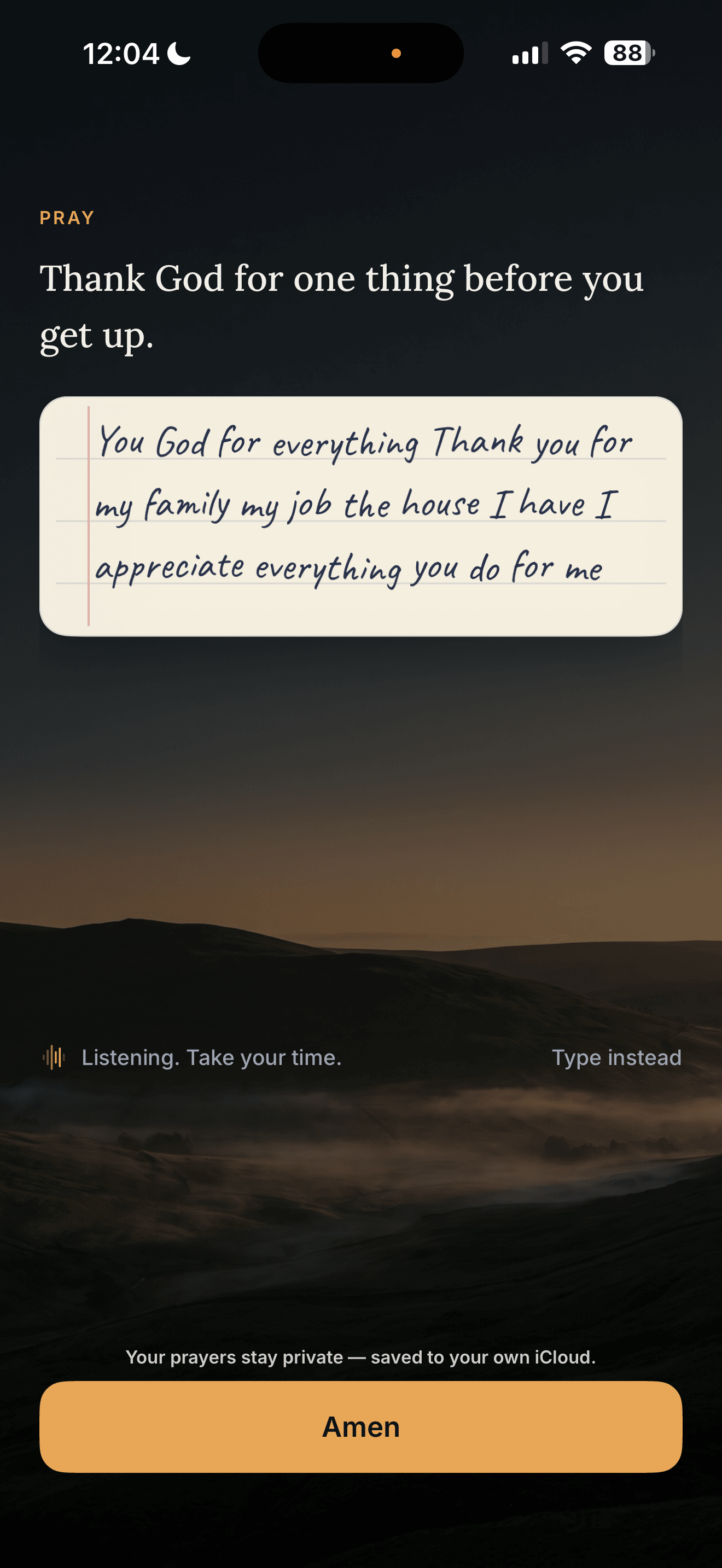
Frequently asked questions
What is the main message of Psalm 23?
God cares for his people like a good shepherd. He provides what they need, gives them rest, guides them, stays with them through danger and welcomes them home for ever.
Who wrote Psalm 23?
The heading of the psalm says "A Psalm of David." David worked as a shepherd before he became king, as 1 Samuel 16 and 17 describe.
What does "the valley of the shadow of death" mean?
It's a picture of the darkest, most dangerous stretch of life's path: illness, grief, fear or the nearness of death. The psalm's promise is that you walk through it, and that God is with you there.
Is Psalm 23 good to pray at night or in hard times?
Yes. Its words about rest, comfort and God's presence make it a natural prayer at the end of the day and in difficult seasons. Read it slowly and turn each line into your own prayer.
What does "my cup runneth over" mean?
It means God gives more than enough. A cup filled until it overflows is a picture of generous welcome and blessing.
Sources and fact checks
- 01Psalm 23 (KJV) — Verbatim quotation checked on Bible Gateway 2026-10-26.
- 021 Samuel 16:11; 1 Samuel 17:34-35; John 10:11 (KJV) — Verbatim quotation checked on Bible Gateway 2026-10-26.
- 03Koum on the App Store — Supports Koum feature and privacy statements (listing checked 2026-10-26).