Prayer
Psalm 121: What It Means and How to Pray It Each Morning
Quick answer
Psalm 121 is a short Song of Ascents, a pilgrim song of trust. It says your help comes from the LORD, the maker of heaven and earth, who never sleeps and keeps you by day and by night, in your going out and your coming in.
Psalm 121 is only eight verses long, but it has carried travelers, worried parents and sleepless people for generations. It begins with someone looking up at the hills and asking where help will come from, and it ends with a promise that God will keep their going out and their coming in. It's a natural psalm for the start of a day, when you're about to walk out the door into whatever is waiting. Below you'll find the whole psalm, what each part means, and simple ways to make it your own prayer.
Psalm 121 in full
Here is the whole psalm, quoted from the King James Version.
1 I will lift up mine eyes unto the hills, from whence cometh my help.
2 My help cometh from the LORD, which made heaven and earth.
3 He will not suffer thy foot to be moved: he that keepeth thee will not slumber.
4 Behold, he that keepeth Israel shall neither slumber nor sleep.
5 The LORD is thy keeper: the LORD is thy shade upon thy right hand.
6 The sun shall not smite thee by day, nor the moon by night.
7 The LORD shall preserve thee from all evil: he shall preserve thy soul.
8 The LORD shall preserve thy going out and thy coming in from this time forth, and even for evermore.
What Psalm 121 means, verse by verse
Verses 1–2: Where help comes from. The psalm opens with a question. The writer looks up at the hills, perhaps the hills a pilgrim would see on the road, and asks where help will come from. The answer in verse 2 is clear: the hills aren't the source of help. Help comes from the LORD, who made heaven and earth, including the hills themselves. The God who made everything is the one you can turn to.
Verses 3–4: The God who doesn't sleep. Verse 3 promises that he will not let your foot be moved, a picture of a steady step on a hard road. Then comes one of the psalm's most comforting lines: the one who keeps you "will not slumber," and the one who keeps Israel "shall neither slumber nor sleep." You have to rest; God doesn't. If you pray at the end of the day, these verses fit well with a night prayer, because you can let go of the day knowing he is still awake.
Verses 5–6: Keeper and shade. Verse 5 calls the LORD "thy keeper" and "thy shade upon thy right hand." Shade was a real gift in a hot, dry land, and the right hand was the place of a close companion. Verse 6 widens the promise to every hour: the sun won't strike you by day, nor the moon by night. Day and night together say that there's no moment when you're outside his care.
Verses 7–8: Kept for life. The last two verses repeat one word: preserve. The LORD will preserve you from all evil, preserve your soul, and preserve your going out and your coming in, from now on and forever. "Going out and coming in" covers the ordinary rhythm of life: leaving home in the morning, coming back at night, and every journey in between.
The psalm promises God's keeping presence, not a life without hardship. Its comfort is that whatever the day holds, you won't face it unwatched or alone.
A Song of Ascents
Psalm 121 is one of the Songs of Ascents, a group of fifteen psalms, Psalms 120–134, that carry that title in many Bibles. It's widely held that these were songs for the journey up to Jerusalem, sung by pilgrims on the road to worship. That setting helps explain the hills in verse 1 and the steady foot in verse 3. Psalm 121 is a song for people on the way, which is why it still speaks to anyone starting a day or setting out on a trip.
How to pray Psalm 121
You don't need special words to pray this psalm. Let its lines become yours:
- Look up from the worry. Before you start planning the day, lift your eyes the way verse 1 does and turn your attention to God.
- Say verse 2 as your first words: "My help cometh from the LORD, which made heaven and earth."
- Thank him that he didn't sleep while you did. He kept watch through the night (verses 3–4).
- Name where you're going today: work, school, a hospital visit, a long drive. Ask him to keep your foot steady there.
- End with verse 8, asking him to preserve your going out and your coming in.
Here's a prayer based on Psalm 121 you can pray in the morning:
Lord, I lift up my eyes to you this morning. My help doesn't come from my plans, my strength or the people around me. It comes from you, the maker of heaven and earth. Thank you that you didn't sleep while I slept, and that you kept watch over me through the night. Today I'm going out into a day I can't fully see. Keep my foot from slipping. Be my shade when the day is heavy and my peace when it's quiet. Guard my soul from evil, and keep my going out and my coming in, today and always. Amen.
Psalm 121 for specific moments
Before travel or leaving home. Verse 8 makes Psalm 121 a natural traveler's prayer. Read it before a trip, a commute or a first day somewhere new, and ask God to keep your going out and your coming in.
When you're anxious about the day. If you wake up already worried, start with verses 1–2 and let them reset where you look for help. For a step-by-step approach to mornings like that, see our morning prayer for anxiety before work.
For someone you love who is far away. You can pray the psalm for another person by putting their name in it: "The LORD is ___'s keeper." It's a simple way to hand someone you can't reach over to the one who never sleeps.
At night, when you can't sleep. Verses 3–4 are made for those hours. You can rest because God doesn't, and you don't have to keep watch over everything yourself.
Start your morning with Psalm 121
Psalm 121 is a going-out psalm, and the morning is when you go out. Try this tomorrow: when your alarm rings, read Psalm 121 before you check your phone, pray verse 2 as your first words and write down the line that stayed with you. If you'd like to make this a habit with other psalms, see how to pray the Psalms in the morning, or continue with Psalm 91 and Psalm 23.
Koum is built for mornings like that. In Koum, the alarm stops when you prove the day's verse by scanning an open physical Bible, speaking it aloud or typing it. There's no snooze, and the Chase you choose can call you back until you prove the verse. Then your Morning opens into Prayer, Devotional and Journal. Koum has a built-in Bible, so you can read Psalm 121 after your alarm, pray it in the Prayer step and save what you noticed in your prayer journal. Your prayers and journal stay in your private iCloud, and you don't need an account to get started. To set it up, read how to set up a Bible alarm for morning reading, or see our guide to choosing a Christian alarm clock app. For more ideas, read our morning prayer guide.
Put this into practice with Koum.
Koum asks you to open, scan, speak, or type a Bible verse before the alarm ends. Then it gives the morning room for prayer, a devotional, and a private reflection.
Get Koum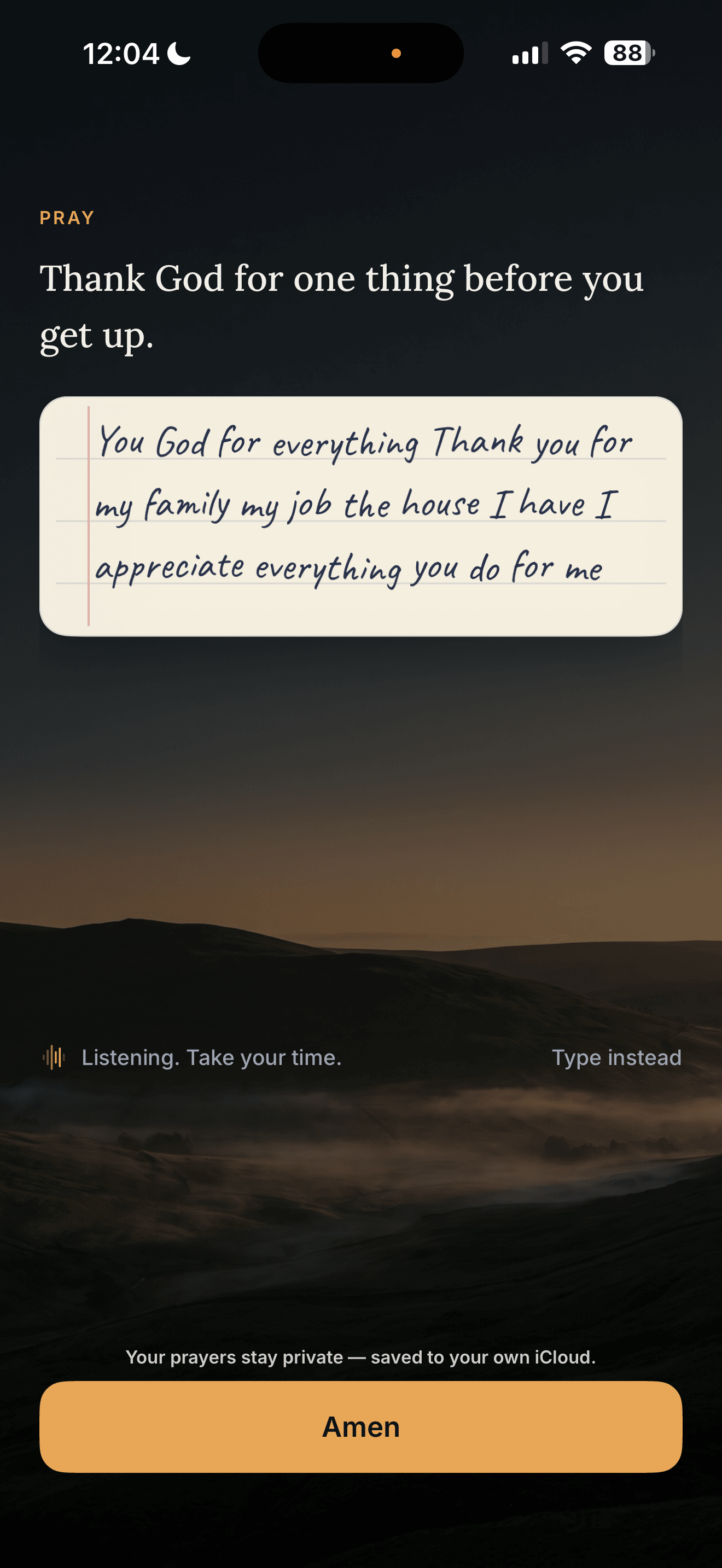
Frequently asked questions
What is the main message of Psalm 121?
Your help comes from the LORD, the maker of heaven and earth, and he keeps you all the time. He never sleeps, he watches over you by day and by night, and he preserves your going out and your coming in.
Who wrote Psalm 121?
The psalm doesn't name its author. Its title calls it a Song of Ascents but gives no writer, so it's best described as unattributed.
Why is Psalm 121 called a Song of Ascents?
It's one of fifteen psalms, Psalms 120–134, that carry that title. They're widely understood as songs for the journey up to Jerusalem, sung by pilgrims on their way to worship.
Is Psalm 121 a prayer for travel?
Many people pray it before a trip, because verse 8 asks God to preserve "thy going out and thy coming in." It also fits any ordinary day, since every morning is a kind of going out.
Why does Psalm 121 say God will not slumber?
Verses 3–4 contrast God with people. We need sleep, but he doesn't, so he's always keeping watch. That's why many people read these verses at night.
Sources and fact checks
- 01Psalm 121 (KJV) — Verbatim quotation checked on Bible Gateway 2026-10-30.
- 02Koum on the App Store — Supports Koum feature and privacy statements (same wording as the Psalm 91 post).