Prayer
Psalm 91: What It Means and How to Pray It for Protection
Quick answer
Psalm 91 is a psalm of trust that calls God a refuge and a fortress for the one who dwells close to him. Its core message is God's protection and presence in danger, and it ends with God's own promise to deliver, answer and be with the one who loves him (vv. 14–16).
Psalm 91 is one of the Bible's best-loved prayers for protection. People read it when they're afraid, when someone they love is sick, before a journey and at the end of a long day. It doesn't ask you to be strong. It invites you to come close to God and stay there. Below you'll find the whole psalm, what each part means, and simple ways to make it your own prayer.
Psalm 91 in full
Here is the whole psalm, quoted from the King James Version.
1 He that dwelleth in the secret place of the most High shall abide under the shadow of the Almighty.
2 I will say of the LORD, He is my refuge and my fortress: my God; in him will I trust.
3 Surely he shall deliver thee from the snare of the fowler, and from the noisome pestilence.
4 He shall cover thee with his feathers, and under his wings shalt thou trust: his truth shall be thy shield and buckler.
5 Thou shalt not be afraid for the terror by night; nor for the arrow that flieth by day;
6 Nor for the pestilence that walketh in darkness; nor for the destruction that wasteth at noonday.
7 A thousand shall fall at thy side, and ten thousand at thy right hand; but it shall not come nigh thee.
8 Only with thine eyes shalt thou behold and see the reward of the wicked.
9 Because thou hast made the LORD, which is my refuge, even the most High, thy habitation;
10 There shall no evil befall thee, neither shall any plague come nigh thy dwelling.
11 For he shall give his angels charge over thee, to keep thee in all thy ways.
12 They shall bear thee up in their hands, lest thou dash thy foot against a stone.
13 Thou shalt tread upon the lion and adder: the young lion and the dragon shalt thou trample under feet.
14 Because he hath set his love upon me, therefore will I deliver him: I will set him on high, because he hath known my name.
15 He shall call upon me, and I will answer him: I will be with him in trouble; I will deliver him, and honour him.
16 With long life will I satisfy him, and shew him my salvation.
What Psalm 91 means, verse by verse
Verses 1–2: the secret place of the most High. The psalm opens with a picture of someone who lives close to God, in "the secret place of the most High" and "under the shadow of the Almighty". A shadow is only possible when you're near the one who casts it. Then the voice turns personal: "He is my refuge and my fortress: my God; in him will I trust." Refuge is a place to run to. A fortress is a place that holds when everything around it is under attack. The whole psalm grows out of that one decision to trust.
Verses 3–4: under his wings. The snare of the fowler is a hidden trap, the kind of danger you don't see coming. The pestilence is the kind of danger no one can fight alone. Against both, God is pictured as a bird covering its young with its feathers. It's a tender image, not a military one. Then comes a strong one: "his truth shall be thy shield and buckler." God's faithfulness is what stands between you and harm.
Verses 5–8: the terror by night. These verses cover every hour: terror by night, the arrow by day, pestilence in darkness, destruction at noonday. Nothing in the day or the night falls outside God's care. "A thousand shall fall at thy side" describes a battlefield, and the promise is that the one who trusts God doesn't face it alone or unseen.
Verses 9–13: angels in all thy ways. The psalm repeats its reason: "Because thou hast made the LORD... thy habitation". God is not just a place you visit in an emergency, but your home. Verses 11 and 12 speak of angels sent to keep you "in all thy ways", and verse 13 pictures walking over the lion and the adder, danger that is strong and danger that strikes from below.
Verses 14–16: God speaks. In the last three verses, God himself answers. "Because he hath set his love upon me, therefore will I deliver him." He promises to answer when you call, to be with you in trouble, to deliver and honour you, and to show you his salvation. Notice the words "I will be with him in trouble". Psalm 91 is a promise of God's presence and care, not a guarantee that those who trust him will never suffer.
Psalm 91 and Jesus' temptation
Psalm 91 appears in one of the most striking scenes in the Gospels. When the devil tempts Jesus in the wilderness, he quotes verses 11 and 12 and tells Jesus to throw himself down from the temple (Matthew 4:6; Luke 4:10–11). In Matthew 4:6 he says, "If thou be the Son of God, cast thyself down: for it is written, He shall give his angels charge concerning thee: and in their hands they shall bear thee up, lest at any time thou dash thy foot against a stone."
Jesus answers with Deuteronomy 6:16: "It is written again, Thou shalt not tempt the Lord thy God" (Matthew 4:7; see also Luke 4:12). The lesson is simple. Psalm 91 is meant to be trusted, not used to test God. We pray it to rest in his care, not to demand a sign.
How to pray Psalm 91
You don't need special words to pray this psalm. Let its words become yours:
- Read it slowly. Read the whole psalm once, then go back to the line that caught your attention.
- Make verse 2 personal. Say it to God directly: "Lord, you are my refuge and my fortress. You are my God, and I trust you."
- Name what you fear. Be honest about the snare or the terror you're facing today, and place it under his wings.
- Pray it for someone else. Put a name in place of "thee": "Lord, cover [name] with your feathers."
- End with verses 14–16. Finish by listening to God's own promise: he will answer, he will be with you in trouble, and he will show you his salvation.
Here is a prayer based on Psalm 91 that you can pray as it is or in your own words:
Lord, you are my refuge and my fortress. You are my God, and I trust you. Today I come to the secret place and rest under your shadow. You know what I'm afraid of, the dangers I can see and the ones I can't. Cover me with your feathers, and let your truth be my shield. Keep the people I love in all their ways. When I call, answer me. When trouble comes, be with me in it. I set my love on you, Lord, and I wait for your salvation. Amen.
Psalm 91 for specific moments
When you're afraid or anxious. "Thou shalt not be afraid" isn't a command to stop feeling fear. It's a reminder of who is with you in it. Read verses 1–2 slowly and breathe between the lines. If anxiety meets you as soon as you wake up, our guide to morning prayer for anxiety before work can help you take the next step.
For someone who is sick. Many people pray Psalm 91 at a hospital bed or for a loved one far away. Pray verses 14–16 with their name, ask God to be with them in trouble, and keep praying for the doctors and nurses who care for them. Prayer and medical care belong together, so keep following the advice of their care team.
For your family and home. Verse 10 speaks of "thy dwelling". You can pray the psalm over your home and each person in it, asking God to keep them in all their ways as they leave in the morning and come back at night.
At night. Verse 5 names "the terror by night", which is often when worries feel loudest. Read verses 1–5 before you sleep and hand the day back to God. For more ways to end the day with him, see our night prayer guide.
Before travel or a hard day. Verses 11 and 12 speak of being kept "in all thy ways". Pray them before a trip, a hard conversation, a medical appointment or any day you're dreading.
Start your morning with Psalm 91
Psalm 91 begins with someone who dwells close to God, and the easiest place to start is the first minutes of the day. Try this tomorrow: when your alarm rings, read Psalm 91 before you check your phone, pray verse 2 as your first words, and write down the line that stayed with you. If you'd like to make this a habit with other psalms, read how to pray the Psalms in the morning, or try Psalm 23 next.
Koum is built for mornings like that. In Koum, the alarm stops when you prove the day's verse by scanning an open physical Bible, speaking it aloud or typing it. There's no snooze. Then your Morning opens into Prayer, Devotional and Journal. Koum has a built-in Bible, so you can read Psalm 91 after your alarm, pray it in the Prayer step and keep what you noticed in your prayer journal. Your prayers and journal stay in your private iCloud, and you don't need an account to get started. For more ideas, see our guide to morning prayer.
Put this into practice with Koum.
Koum asks you to open, scan, speak, or type a Bible verse before the alarm ends. Then it gives the morning room for prayer, a devotional, and a private reflection.
Get Koum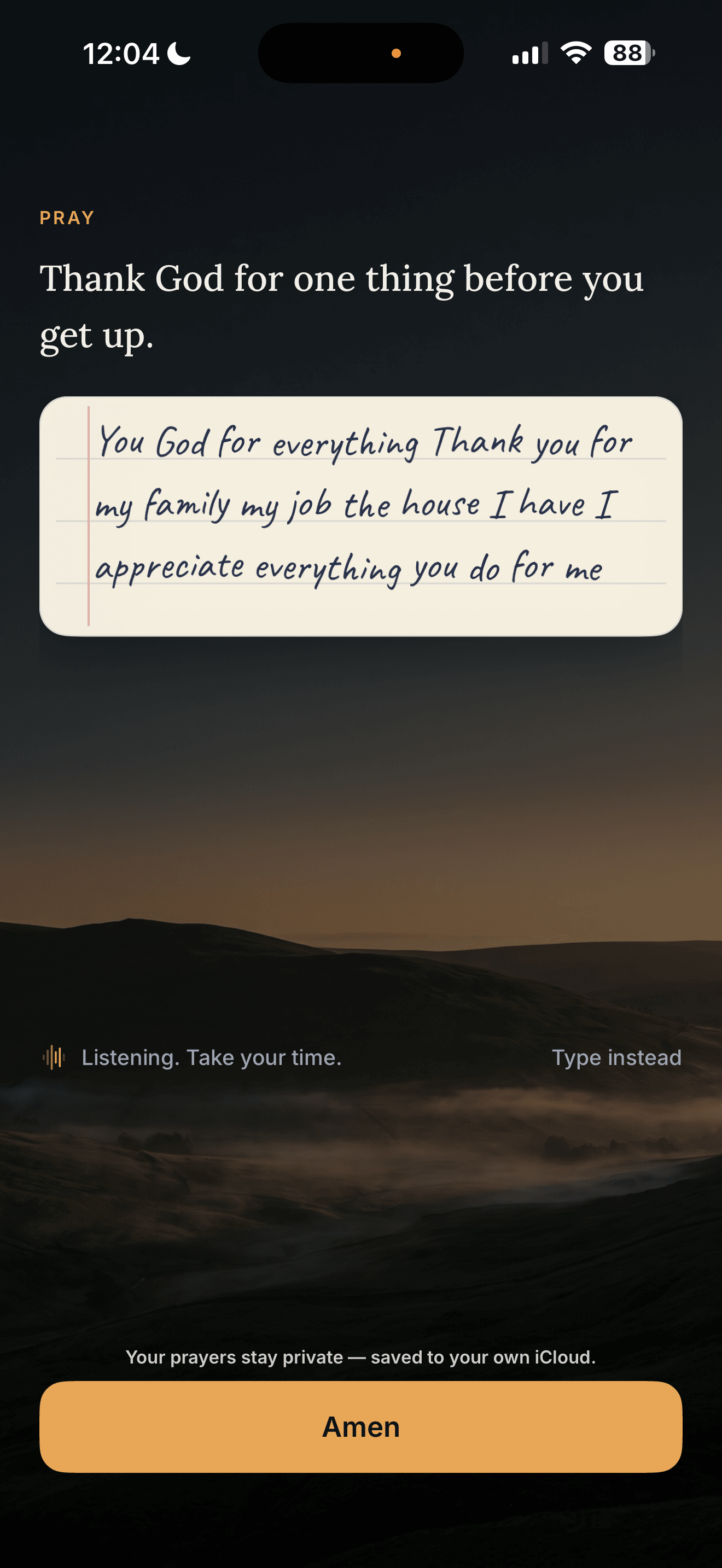
Frequently asked questions
What is the main message of Psalm 91?
Psalm 91 is about trusting God as your refuge and fortress. It promises his protection and presence for the one who dwells close to him, and it ends with God's own words: he will deliver, answer and be with the one who loves him.
Who wrote Psalm 91?
Psalm 91 doesn't name its author. Unlike many psalms, it has no heading that attributes it to anyone, so the writer is unknown.
Does Psalm 91 mean nothing bad will happen to believers?
No. Psalm 91 is a promise of God's presence and care, not a guarantee that believers never suffer. God himself says, "I will be with him in trouble", which assumes trouble can come.
Can I pray Psalm 91 for someone who is sick?
Yes. Many people pray it for someone who is ill, often using verses 14–16 with that person's name. Pray for God's presence and comfort, and keep supporting the medical care they receive.
Why does Psalm 91 appear in the temptation of Jesus?
The devil quotes verses 11–12 to tempt Jesus to throw himself from the temple (Matthew 4:6; Luke 4:10–11). Jesus answers with Deuteronomy 6:16, "Thou shalt not tempt the Lord thy God", showing the psalm is for trusting God, not testing him.
Sources and fact checks
- 01Psalm 91 (KJV) — Verbatim quotation checked on Bible Gateway 2026-10-28.
- 02Matthew 4:6-7; Luke 4:10-12; Deuteronomy 6:16 (KJV) — Verbatim quotation checked on Bible Gateway 2026-10-28.
- 03Koum on the App Store — Supports Koum feature and privacy statements (same wording as the Psalm 23 post, listing checked 2026-10-26).