Bible practice
How to Memorize a Bible Verse in the Morning: A Simple Practice
Quick answer
Choose one short verse, read its context, divide it into phrases, say it from memory, and return to it at midday and evening. Pray through its meaning and connect it to one real decision. A small, repeatable practice is more useful than a rushed attempt to memorize a large passage.
Memorizing a Bible verse in the morning does not require a perfect memory, a long quiet time, or a stack of flashcards. It begins with one short passage, read slowly enough to understand, and a few honest returns to the words before the day gets loud. The goal is not to perform Bible knowledge. The goal is to carry Scripture with you so it can shape prayer, attention, and one faithful choice.
A simple morning pattern is enough: choose one verse, read its surrounding passage, break it into phrases, say it without looking, and return to it later. Keep the practice connected to the meaning of the text. If remembering a line makes you more patient, truthful, grateful, or ready to trust God, the verse is doing more than occupying your memory.
Start with one verse, not a whole chapter
Choose a verse that speaks to the season you are actually in. A person facing worry might begin with a promise or prayer; someone learning to forgive might choose a passage about mercy; someone beginning a new habit might choose a verse about wisdom or faithfulness. Let the need guide your attention, but let the passage guide your interpretation.
Keep the first assignment small. One or two sentences are enough for a morning. A short verse that you revisit with understanding will serve you better than a long chapter you rush through once and cannot recall. You can always add another verse after this one has become familiar.
Read around the verse before you memorize it
Read the paragraph, scene, or psalm around your chosen verse. Ask who is speaking, what problem or praise surrounds the words, and what the verse is doing in its passage. This protects you from turning a sentence into a slogan that says something the text never intended.
Write a one-sentence summary in your own words before you begin memorizing. For example: “This verse teaches me to bring my first attention to God,” or “This is a prayer for steadiness, not a promise that every morning will feel easy.” Understanding gives your memory something meaningful to hold.
Make the verse small enough to carry
Look at the verse and divide it into natural phrases. Mark the main action, the person acting, and the reason or result. If the verse has a repeated pattern, preserve that pattern. Your first goal is not speed; it is to notice the shape of the sentence.
Use a reference card, note, or Bible bookmark with the passage written out. Include the reference every time. Remembering the words without remembering where they belong makes it harder to find the verse again and reconnect it to its context.
Use a four-part morning practice
First, read the verse aloud two or three times while looking at it. Read it as Scripture, not as a test. Notice a word that catches your attention and let yourself ask why it matters today.
Second, cover one phrase and try to say the whole verse. Then uncover it, correct yourself without embarrassment, and repeat. Third, cover the verse completely and retrieve it from memory. Fourth, turn its meaning into a short prayer. These four movements—read, cover, retrieve, pray—fit into a few quiet minutes.
If the verse is longer, work with one phrase at a time. Add the next phrase only after you can say the first one calmly. At the end, connect the phrases and say the whole verse once. A gentle pace helps you pay attention to the words instead of racing toward completion.
Say the verse before you check it
Looking at the verse again is useful, but trying to retrieve it first is what shows you what you actually remember. Pause before opening the note. Say the first phrase, continue as far as you can, and then check the text. Treat every correction as information, not failure.
Use a different starting point on different mornings. Begin with the reference, the final phrase, or the central verb. This keeps you from remembering only the sound of the verse in one fixed order and helps you recognize its meaning wherever you meet it.
Write it, then test your memory
Write the verse by hand once after you have read it. Then write it again with a few words missing. The blank spaces should help you notice the structure, not turn the exercise into punishment. If writing is not practical, type the first letters of each word or record yourself saying the passage and listen back later.
Do not correct every detail while you are still trying to recall the thought. Finish your attempt, compare it with the Bible, and circle the places where you drifted. Review those phrases on their own. Precision matters, but shame does not improve a prayerful practice.
Connect the verse to a real moment
Choose one ordinary moment when you will bring the verse back: while the kettle heats, when you open your laptop, during a walk, or before you answer a difficult message. A memory becomes more available when it has a place in your real day instead of living only on the morning page.
Let the verse name a response. If it speaks about trust, use it when you notice yourself rehearsing worst-case scenarios. If it speaks about compassion, repeat it before a conversation that may test your patience. You are not using Scripture as a charm; you are allowing it to reframe the moment in front of you.
Review it throughout the day
Return to the verse once near midday and once in the evening. Try to say it before looking, then read the reference and surrounding passage again. Short reviews are easier to keep than one exhausting session, and they give you a chance to see whether the verse still makes sense outside the quiet of your first coffee.
On the next morning, begin by retrieving yesterday’s verse before choosing whether to add anything new. If it is still fragile, keep it for another day. If it is steady, say it once and choose a fresh passage. A slower rotation is not a lack of progress; it is room for the word to settle.
Let memorization lead to obedience
James warns against hearing the word without doing it. That does not mean a memorized verse earns God’s approval. It means remembrance is meant to become a lived response. Ask, “What would faithfulness look like in the next small decision this verse touches?” Keep the answer concrete and possible.
Write one action beside the reference: apologize without defending yourself, tell the truth, make time to pray, encourage a friend, or release a worry to God. The action may be quiet and unseen. Its size does not determine its value.
Keep the practice gentle and repeatable
Some mornings your mind will be clear; other mornings you will be tired, late, or distracted. On a hard day, read the verse once and pray one sentence. On a better day, work through the full pattern. Consistency grows when the practice has a smaller version you can still do.
Do not measure the morning by how impressive your recall sounds. Measure it by whether you gave Scripture patient attention and carried one truthful response into the day. Memorization is a way of making room, not another achievement to display.
Put this into practice with Koum.
Koum asks you to open, scan, speak, or type a Bible verse before the alarm ends. Then it gives the morning room for prayer, a devotional, and a private reflection.
Get Koum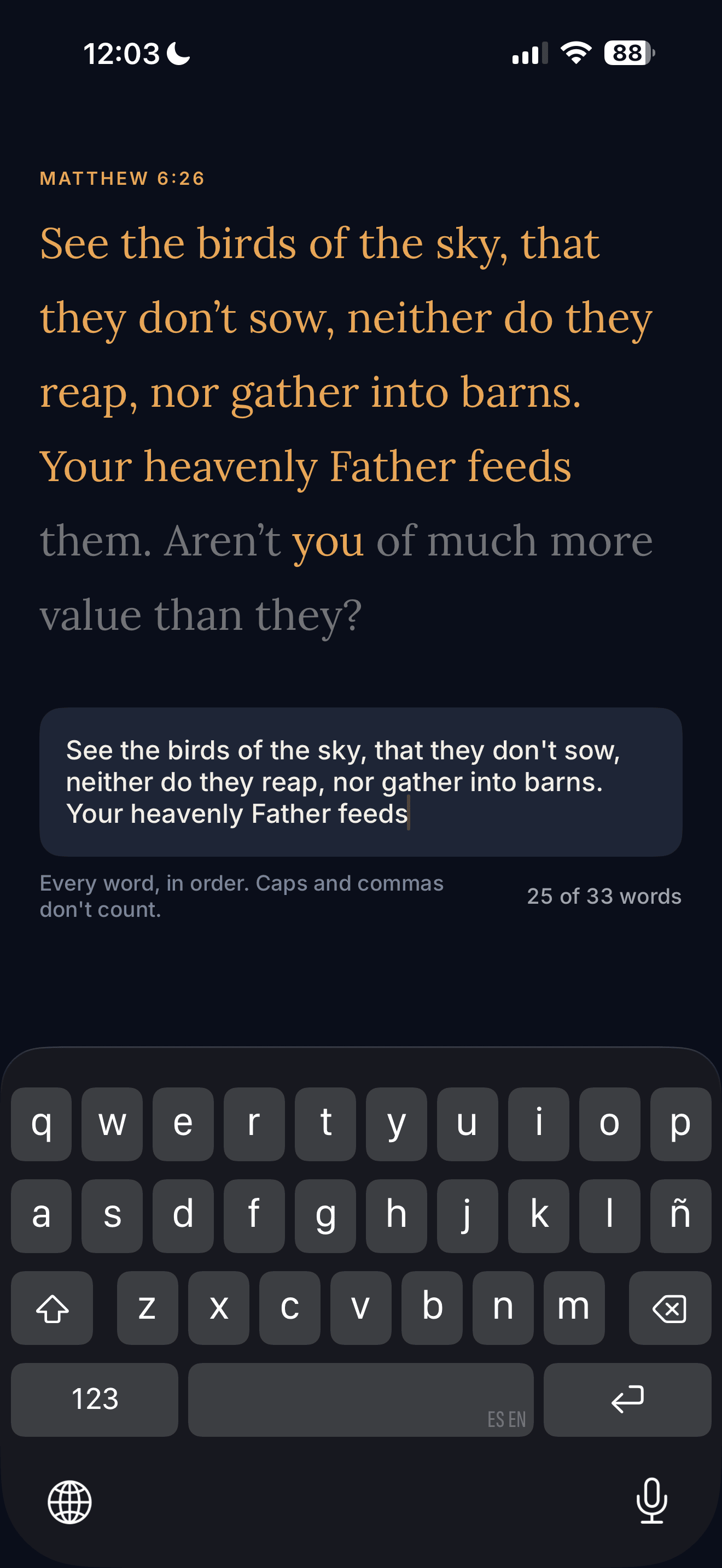
Frequently asked questions
How long should it take to memorize a Bible verse?
There is no required timeline. A short verse may become familiar in a few mornings, while a longer passage may need repeated review for weeks. Stay with the verse until you can recall its meaning and words without turning the practice into pressure.
What should I do when I cannot remember the whole verse?
Return to the text, find the phrase where you lost your place, and practice only that section. Then reconnect it to the beginning. You can also read the verse aloud, write it with missing words, or pray the portion you do remember.
Should I memorize an entire chapter in the morning?
You can, but you do not need to begin there. One verse or a short paragraph gives you room to understand the context and revisit the words. Add more only when the smaller passage is becoming familiar and the practice remains life-giving.
Sources and fact checks
- 01Psalm 119:11 (Bible Gateway) — Supports treasuring God’s word in the heart as a reason to remember Scripture.
- 02Deuteronomy 6:6–7 (Bible Gateway) — Supports keeping God’s words on the heart and returning to them when you get up.
- 03Colossians 3:16 (Bible Gateway) — Supports letting the message of Christ dwell richly and respond with gratitude.
- 04Joshua 1:8 (Bible Gateway) — Supports keeping Scripture on the lips, meditating on it, and practicing what it says.
- 05James 1:22–25 (Bible Gateway) — Supports moving from hearing the word to doing it.
- 06Psalm 1:1–3 (Bible Gateway) — Supports a picture of steady meditation that bears fruit in season.