Prayer
How to pray in the morning when you feel spiritually dry
Quick answer
When you feel spiritually dry, do not wait for a stronger emotion before praying. Name the dryness honestly, read one short Scripture passage, turn one phrase into a simple prayer, and choose one faithful response for the day. A small return to God is still a real return; the goal is not to perform a feeling but to meet God with truth and attention.
Start by naming the dryness honestly
A spiritually dry morning does not need a polished explanation. You may still believe, still love God, and still want to pray while feeling no warmth, urgency, or clear words. Begin there. Tell God what is true: “I want to seek you, but I feel distant. I do not know what to say. Please meet me in this small act of attention.” That is not a failed prayer. It is an honest beginning.
Psalm 42 gives language to a person who longs for God, remembers worship, asks hard questions, and then speaks hope back to a discouraged soul. The psalm does not pretend that desire and sorrow cannot exist together. Read the whole movement slowly. Spiritual dryness is not a command to manufacture a feeling before you approach God; it is an invitation to bring the lack itself into the light. You do not have to call the morning joyful in order to enter it faithfully.
Let Scripture give you the first words
When your own words feel unavailable, borrow the words Scripture has already given you. Choose one short passage rather than opening ten tabs or searching for the perfect devotional. Psalm 63 begins with a desire for God in a dry place. Psalm 42 speaks of thirst, tears, memory, and hope. Romans 8:26 acknowledges that believers may not know how to pray as they ought. These passages make room for prayer that is unfinished, quiet, or repeated.
Read the passage once to understand its direction. Read it a second time and notice one phrase that describes your morning. Read it a third time as a response to God. You do not need to explain every verse or produce a lesson. Ask three simple questions: What does this show me about God? What is true about me right now? What small response can I offer today? If one sentence stays with you, let that sentence be enough for this morning.
Use a four-part prayer when you have no script
A simple structure can lower the pressure without turning prayer into a performance. Move through these four parts in your own language, spending as little or as much time as you have.
First, acknowledge: “God, you are here, and I am here.” Second, be honest: “I feel numb, distracted, tired, or far away.” Third, ask: “Give me what I need to love you and obey you today.” Fourth, release: “I place this morning, this feeling, and this next responsibility in your hands.” If you can only say one part, say one part. A short, truthful prayer is better than postponing prayer until you can sound strong.
You can also turn a line from the passage into a breath prayer. On the inhale, receive a few words such as “My soul thirsts for you.” On the exhale, respond, “Meet me here, Lord.” This is not a technique that earns God’s attention. It is simply a way to keep returning your attention when it wanders. If breath-focused prayer is uncomfortable for you, skip it and read aloud instead.
Stay with one passage instead of chasing a feeling
Dryness often makes people search for a more intense experience: a different plan, a longer prayer, a new worship playlist, or a verse that promises an immediate emotional change. Those tools can be useful, but they cannot be the measure of whether God is near or whether your morning mattered. Mark 1:35 shows Jesus choosing a quiet place for prayer early in the day; it does not give a required duration or guarantee a particular sensation.
Try staying with one short passage for a week. Keep the same basic questions and write down one sentence after each morning. You may notice a repeated concern, a needed confession, a person to pray for, or a practical act of love. You may also notice nothing dramatic. Faithfulness can look like returning to the same page with an open hand. Let Scripture correct your picture of prayer: the goal is communion and response, not a daily score for emotional intensity.
Make the practice small enough to return tomorrow
A morning prayer for a dry season should be realistic about sleep, work, children, health, and the responsibilities already waiting. Put the Bible or reading plan where you will see it. Decide the passage the night before. Set a modest time boundary, perhaps five or ten minutes, so the practice has a clear doorway. Sit up, drink water, and begin with the first sentence instead of waiting to feel ready.
If you miss a morning, do not turn the next morning into punishment. Resume with the same small pattern. You can pray one sentence while the coffee brews, read a paragraph at lunch, or return to the passage before bed. A consistent return is more helpful than an ambitious plan that makes you ashamed. Koum can support this kind of return by putting a Bible passage before the alarm ends, then giving you space for prayer, a devotional, and a private reflection. It is a prompt, not a replacement for Scripture, church, pastoral care, or your own honest attention.
Carry one faithful response into the day
End by choosing one response that can be practiced before the day is over. It might be apologizing without defending yourself, sending encouragement, refusing a familiar temptation, asking for help, or doing your next task with patience. Keep it specific enough to recognize. “Be more spiritual” is too vague; “I will answer that difficult message without anger” gives your prayer a direction.
Write the response beside the passage and return to it later. If the day goes badly, you have not disproved the prayer. You have discovered another moment to return to God. James 4:8 describes drawing near to God as an active movement, not a mood we must first create. Romans 8:26 also keeps the burden from resting entirely on our ability to find perfect words. On a dry morning, faith may be as simple as opening the page, speaking the truth, and taking the next faithful step.
Put this into practice with Koum.
Koum asks you to open, scan, speak, or type a Bible verse before the alarm ends. Then it gives the morning room for prayer, a devotional, and a private reflection.
Get Koum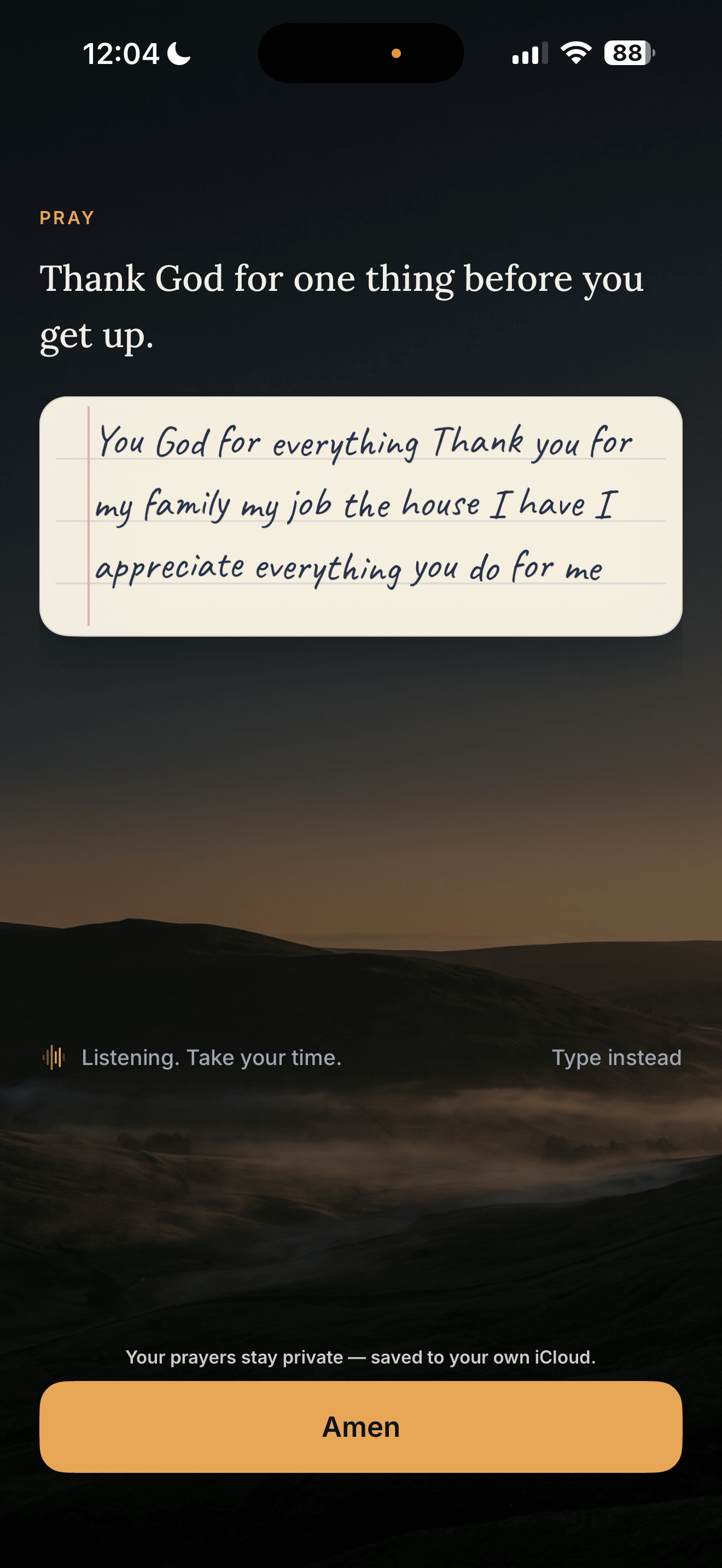
Frequently asked questions
Is it wrong to pray when I do not feel close to God?
No. You can bring the distance itself to God. Scripture includes prayers of longing, discouragement, questions, and hope. Begin with a truthful sentence rather than trying to create an emotion you do not have.
How long should a morning prayer be during a dry season?
There is no required length in this practice. Choose a time you can return to, even five or ten minutes, and let the passage guide you. If the morning is crowded, one honest sentence and one small response can be enough to begin.
Can Koum replace Bible reading or pastoral care?
No. Koum is a Bible alarm and morning prompt that can help you open Scripture before the alarm ends and make room for prayer, a devotional, and reflection. It does not replace the Bible, Christian community, pastoral care, or professional support when you need it.
Sources and fact checks
- 01Bible Gateway — Psalm 42 (World English Bible) — The psalm gives language for spiritual longing, discouragement, honest questions, memory, and hope.
- 02Bible Gateway — Psalm 63:1–8 (World English Bible) — The passage describes seeking God and thirsting for him in a dry place.
- 03Bible Gateway — Mark 1:35 (World English Bible) — Jesus withdraws early to a quiet place and prays; it supports the example, not a required schedule.
- 04Bible Gateway — Romans 8:26 (World English Bible) — The verse acknowledges weakness and not knowing how to pray.
- 05Bible Gateway — James 4:8 (World English Bible) — The passage encourages drawing near to God.