Bible reading
How to Read Proverbs in the Morning: A 31-Day Beginner’s Plan
Quick answer
To read Proverbs in the morning, use its 31 chapters as a flexible 31-day frame. Read the chapter’s shape, notice one repeated contrast or invitation, pray from what you actually saw, and choose one small practice for the day. If you miss a morning, continue without shame. The goal is not to finish a checklist but to become a more attentive listener to God’s wisdom.
Why Proverbs is a strong place to begin in the morning
If you want a morning Bible reading practice that meets ordinary decisions, Proverbs is a wise place to begin. It speaks about attention, speech, work, money, friendship, correction, patience, desire, and the shape of a trustworthy life. That makes it different from a collection of inspirational lines to post and forget. It invites you to become a listener before you become a collector.
The opening of Proverbs says the book is for learning wisdom and instruction, understanding words of insight, and receiving guidance for living with righteousness, justice, and integrity. Its goal is not simply to make you informed. It is to train the kind of judgment that shows up in a conversation, a purchase, a work decision, or the way you answer someone who has disappointed you.
The book also gives you a necessary posture for reading: the fear of the Lord is the beginning of wisdom. That is reverence, humility, and willingness to be corrected—not panic. A morning reading of Proverbs begins by admitting that your first instinct is not always your wisest guide. You open the text to receive wisdom, not to recruit a verse to approve whatever you already planned.
Use the 31-day frame without turning it into a checklist
Proverbs has 31 chapters, so a simple 31-day plan is easy to remember: read one chapter each morning, beginning with Proverbs 1 on day one and continuing through Proverbs 31. This is a helpful frame, not a spiritual scorecard. Some chapters will take longer than others, and some mornings will give you only enough attention for a section.
Before bed, choose tomorrow's chapter and decide what a faithful version of the plan will look like. On an open morning, you might read the whole chapter. On a crowded morning, read one section and mark where you stopped. On a very tired morning, read a smaller portion and keep the next place visible. The point of the sequence is to make returning easy, not to make missing a day shameful.
Keep the chapter number connected to the date only if that helps you. There is no biblical requirement to match Proverbs 12 with the twelfth day of the month. If you begin on a Thursday, call it day one. If you miss three mornings, continue with the next chapter or repeat the last one. A plan serves attention; it does not measure your worth before God.
Read each chapter in three calm passes
First, read for the shape of the chapter. Notice whether you are hearing a father teach, wisdom call, a collection of short sayings, a prayer, or a closing poem. Proverbs 1–9 contains extended instruction and poems, while much of Proverbs 10–29 gathers shorter sayings, and chapters 30–31 form a closing frame. Recognizing the kind of writing helps you read wisely instead of expecting every line to work the same way.
Second, read for repeated words and contrasts. Look for images such as paths, lips, ears, eyes, heart, hands, and feet. Notice how the chapter contrasts wisdom and folly, patience and anger, generosity and greed, honesty and deception. Do not rush to underline everything. Choose one movement or repeated idea that seems to organize the passage.
Third, read for response. Ask what this chapter is inviting you to trust, practice, confess, resist, or discuss. A response should grow out of the passage, not out of a search for a dramatic life lesson. If the chapter raises a question, write the question. If it corrects you, name the correction without exaggerating it. If it gives you hope, receive that hope without demanding a perfect day.
What to notice in a morning Proverbs reading
Pay attention to the direction of your attention. Proverbs 4 tells its hearer to incline the ear, keep the words in sight, guard the heart, watch the path, and keep the foot from evil. You can turn that sequence into a morning check: What am I listening to? What has been filling my mind? What desire needs guarding? Which path am I already walking? Where do I need to make a small correction?
Notice the difference between a general principle and a guaranteed promise. Proverbs often describes how wise or foolish choices tend to shape a life, but it does not say that every faithful person will avoid trouble or receive immediate success. The BibleProject guide describes these sayings as practical wisdom and warns that proverbs focus on the general rule rather than every exception. Read them as formation for wise living, not as formulas for controlling God or predicting every outcome.
Also notice where the proverb touches relationships. A morning reading can become abstract if it stays inside your head. Ask whether it changes the way you will speak to a spouse, child, coworker, neighbor, customer, or friend. Wisdom in Proverbs is public and embodied. It becomes visible in a slower reply, an honest admission, a generous action, a boundary, or the humility to seek counsel.
Turn one observation into prayer
After you read, pray from the passage's emphasis. If you noticed a warning about hurried speech, ask God for restraint in one conversation you expect today. If you noticed a call to seek wisdom, name the decision where you need help. If you read about trust, admit where you are leaning on control. If a line exposes pride, ask for the grace to receive correction without defending yourself.
A short prayer is enough: Lord, make me a listener today. Show me where this wisdom meets my choices, and help me practice one faithful response. Keep me from using this chapter to judge everyone else before I have allowed it to correct me. That prayer is not a technique for making the reading work. It is a way to answer the God who is already addressing you through Scripture.
You can write one sentence after praying. Try: I need wisdom about..., Today I will practice..., I resisted..., or I want to ask someone trustworthy about.... A note does not need to sound profound. Its job is to help you remember what you saw and recognize the moment when the passage becomes relevant later in the day.
Choose one practice, not ten resolutions
Proverbs can generate more applications than one person can carry. Choose one practice that is concrete enough to notice. You might pause for three breaths before answering a difficult message. You might ask a clarifying question before giving advice. You might delay a purchase, tell the truth about a mistake, invite wise counsel, or make room for someone who usually gets interrupted. Small does not mean shallow when it is specific and repeated.
Write the practice in a sentence that describes your action rather than someone else's failure. Instead of I will stop letting people be foolish, write I will listen fully before I answer. Instead of Everyone needs to manage money better, write I will review this purchase with patience. This keeps the reading personal and protects Proverbs from becoming a tool for superiority.
At night, take two minutes to ask what happened. Did you remember the wisdom? Where did you ignore it? What helped you act differently? Do not turn the review into self-punishment. Honest noticing is part of learning. If the practice was unrealistic, choose a smaller one tomorrow. If it was helpful, repeat it until it becomes easier to recognize and do.
When you miss a day or do not understand a saying
Missing a morning does not cancel the plan. Continue with the next chapter, or return to the previous chapter if you read it too quickly. You do not need to double the reading as punishment. If sleep, illness, caregiving, travel, or work disrupted the morning, receive that information and adjust the plan. A durable practice makes room for the real life it is meant to serve.
When a saying feels confusing, slow down rather than forcing a private interpretation. Read the surrounding verses. Compare the theme with the wider teaching of Scripture. Look for a trustworthy study resource or ask a pastor, teacher, or mature Christian. Proverbs itself praises listening to counsel. Humility is not a failure of Bible study; it is one of the habits the book is trying to form.
Koum can make the next chapter visible before the morning gets noisy. In its Daily Plan and Bible alarm flow, you can choose a Scripture reading ahead of time and use the alarm as a cue to open it. Koum can ask you to scan, speak, or type the selected verse, then leave room for a devotional, prayer, and private reflection. It is a structure for beginning, not an interpreter of Proverbs or a replacement for the Bible, church, or wise pastoral care.
A 31-day Proverbs plan is successful when it helps you return to Scripture with attention and humility. Read the chapter you have chosen. Notice its shape and repeated wisdom. Pray from what you actually saw. Carry one practice into the day. Then set out the next chapter and begin again. Over time, the goal is not to say that you finished Proverbs once. It is to become the kind of person who keeps listening.
Put this into practice with Koum.
Koum asks you to open, scan, speak, or type a Bible verse before the alarm ends. Then it gives the morning room for prayer, a devotional, and a private reflection.
Get Koum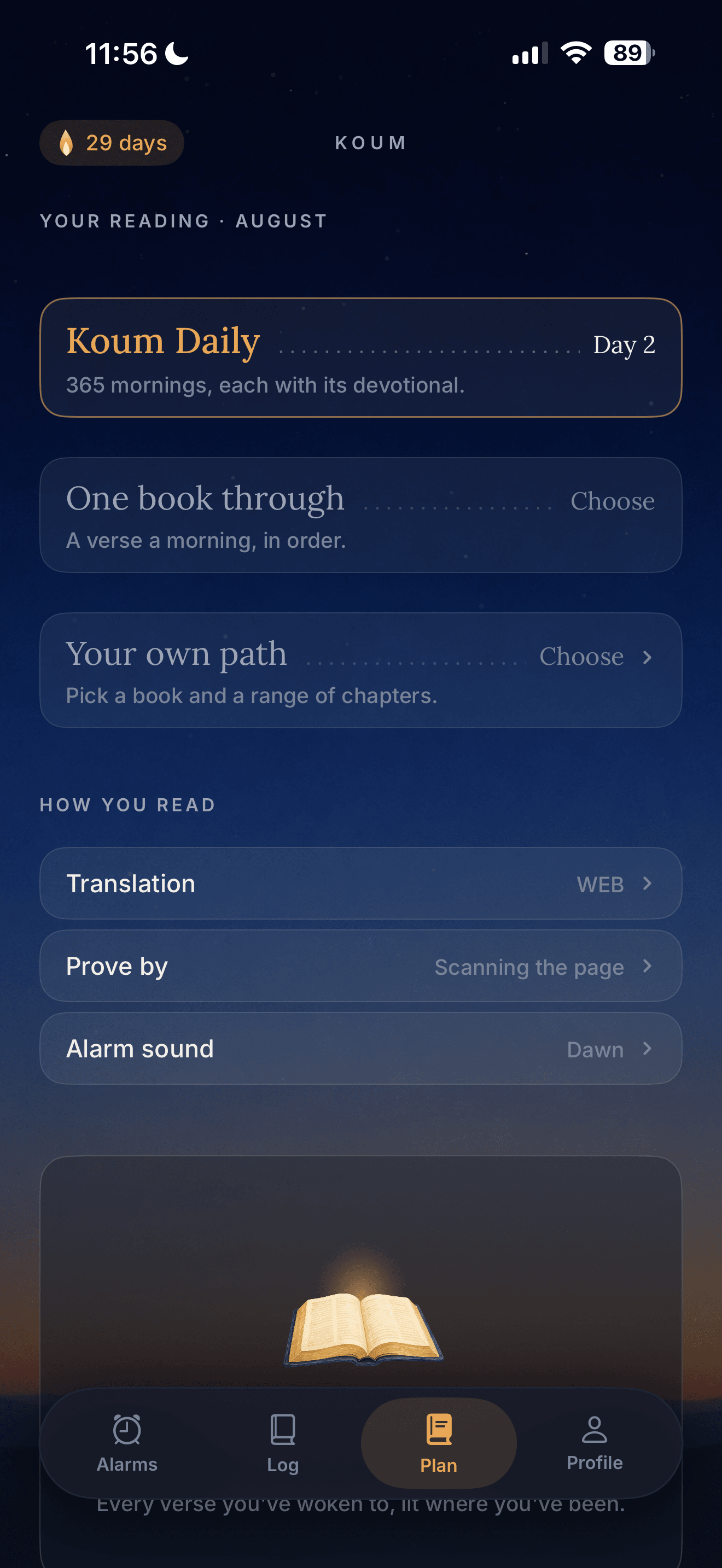
Frequently asked questions
Is Proverbs a good book of the Bible to read first in the morning?
Yes. Proverbs is especially useful for a morning practice because it addresses practical wisdom, speech, relationships, work, choices, and reverence for God. Read it as formation rather than a collection of isolated promises, and ask how one passage should shape your response today.
How long should I read Proverbs each morning?
Use the time you can give with attention. One chapter may fit a quiet morning, while a shorter section may be wiser on a busy or tired day. Keep your place and return the next morning; consistency grows better from a flexible plan than from pressure to finish a fixed amount.
What should I do if I miss a day of a 31-day Proverbs plan?
Continue with the next chapter, or repeat the previous one if you read it hurriedly. You do not need to double the reading or restart as punishment. Adjust the plan around sleep, work, caregiving, travel, or illness so it can support real faithfulness.
Sources and fact checks
- 01BibleProject: Guide to the Book of Proverbs — Supports Proverbs’ structure, practical-wisdom purpose, fear of the Lord, and the distinction between general proverbs and guaranteed formulas.
- 02Proverbs 1:1–7 (WEB) — Supports the stated purposes of Proverbs: wisdom, instruction, guidance, justice, and the fear of the Lord as the beginning of knowledge.
- 03Proverbs 3:5–6 (WEB) — Supports the invitation to trust God rather than treating personal understanding as the final authority.
- 04Proverbs 4:20–27 (WEB) — Supports attentive listening, keeping wisdom in view, guarding the heart, and examining the path of one’s feet.
- 05Proverbs 9:10 (WEB) — Supports the book’s repeated teaching that reverence for the Lord is the beginning of wisdom.
- 06Proverbs 16:3 (WEB) — Supports committing the day’s work and plans to the Lord in prayer.