Prayer
How to Pray the Lord’s Prayer in the Morning: A Simple Guide
Quick answer
To pray the Lord’s Prayer in the morning, read Matthew 6:9–13 or Luke 11:2–4 slowly, pause after each petition, and answer God in your own words. Begin with worship, receive the day’s needs, confess and release forgiveness, ask for help in temptation, and finish by choosing one small way to live the prayer. You do not need a long routine or a special feeling. A few attentive minutes with Jesus’ words can give your morning a Scripture-shaped beginning.
Why the Lord’s Prayer fits a morning routine
The morning often arrives before your attention does. You may wake with a list of tasks, a difficult conversation already in your head, or the reflex to reach for a phone. The Lord’s Prayer gives you words before the day supplies its own demands. It does not ask you to invent an impressive prayer while you are still sleepy. Jesus gives his disciples a pattern that begins with God and then brings ordinary human needs into that relationship.
Matthew records Jesus teaching the prayer in the Sermon on the Mount, after warning against performing prayer for an audience or filling the air with empty repetition. Luke places a shorter form after a disciple asks, “Lord, teach us to pray.” The two Gospel passages make the point clear: this is not a password that earns God’s attention. It is a school for becoming attentive to the Father, the kingdom, daily provision, forgiveness, and protection.
That makes it especially helpful in the morning. You can pray it in a kitchen, beside a hospital bed, on a train, or before the children wake. You can speak it aloud, whisper it, read it from the page, or hold one line in silence. The goal is not to prove that you are disciplined. The goal is to let a prayer Jesus taught reorder your first attention.
Read the prayer before you explain it
Start with the passage itself. Read Matthew 6:9–13, or read Luke 11:2–4 if you prefer the shorter version. Notice the differences without treating them as a problem: Matthew gives a fuller form, while Luke presents the prayer in the setting of a disciple asking to be taught. If you use a particular church tradition’s wording, use that familiar form. Then read it once more slowly, listening for the petition that meets your actual morning.
Try not to rush directly into commentary. First hear the shape of the prayer. It turns your face toward God’s name and kingdom, asks for enough for today, faces the reality of sin and forgiveness, and asks not to be abandoned in testing. This sequence is not a rigid formula for every personal prayer. It is a trustworthy set of doors. Each one opens into a different kind of conversation with God.
You can keep a Bible or printed page open if that helps. Read the surrounding verses in Matthew as well. Jesus connects prayer with secret faithfulness, forgiveness, and freedom from anxious preoccupation with food, clothing, and tomorrow. Context protects the prayer from becoming a collection of inspirational phrases detached from Jesus’ teaching.
Pause over each petition
“Our Father in heaven, hallowed be your name.” Begin by remembering who you are addressing. “Our” keeps prayer from becoming a private self-improvement exercise; it places you among God’s people. “Father” speaks of relationship and trust, while “hallowed be your name” turns your desire toward God’s character and reputation. In the morning, you might pray: Father, let my words, work, and attention honor you today. Help me treat the people I meet as your creatures, not interruptions.
“Your kingdom come, your will be done, on earth as it is in heaven.” This petition loosens your grip on the day’s script. You can name one place where you want God’s good rule to be visible: your workplace, your home, your church, your neighborhood, or your own reactions. Pray for willingness, not just outcomes. You are asking to participate in God’s purposes, even when obedience is less convenient than getting your way.
“Give us this day our daily bread.” Bring real needs into the prayer without shame. Ask for food, strength, wisdom, money for an urgent bill, patience for caregiving, or courage for a medical appointment. “Daily” can keep the request honest and present. You do not have to solve the whole month before breakfast. Receive today as a gift and ask for what faithfulness requires today.
“Forgive us our trespasses, as we forgive those who trespass against us.” Let this line become specific rather than vague. Name a word you regret, a resentment you are protecting, or a responsibility you have avoided. Forgiveness is not pretending harm was harmless, and it does not remove the need for wise boundaries or justice. It is releasing vengeance to God and becoming willing to take the next truthful step. If reconciliation is unsafe or impossible today, you can still ask for a heart that refuses to feed hatred.
“Lead us not into temptation, but deliver us from evil.” Ask for help before the predictable pressure arrives. You might pray about an addictive habit, a pattern of exaggeration, a private resentment, or the temptation to let hurry make you unkind. Be concrete about the doorway you need to close and the good alternative you want to choose. This petition is humble vigilance: you are not claiming that determination alone will carry you.
Turn the words into your own morning prayer
After you pray the familiar words, expand one petition in your own language. If “daily bread” stood out, tell God what provision means today and ask how you can share what you have. If forgiveness felt difficult, speak plainly about the person or event. If “your will be done” met resistance, do not hide that resistance behind polished language. A short honest sentence is a real prayer.
A useful pattern is receive, respond, and release. Receive the line as Jesus’ teaching. Respond with what it reveals about your life. Release the result to God rather than trying to control another person. For example: Your kingdom come. I want my meeting to go my way, and I am afraid of looking foolish. Give me courage to speak truthfully and listen well. I release the outcome to you. This is not a magical script; it is a way to let Scripture give shape to honesty.
You can also pair each petition with a brief posture. Open your hands for daily bread. Breathe slowly while naming a worry. Sit quietly after forgiveness. Write one name under “our.” These physical cues are optional, but they can help a distracted mind stay with the prayer without turning the routine into a performance.
Add a short Scripture reading, not a second burden
The Lord’s Prayer can stand alone, but a short Scripture reading can help you pray it with greater attention. Read a paragraph from a Gospel, a psalm, or the passage already selected for your day. Ask one simple question: Which petition of the Lord’s Prayer does this text help me see? A story about Jesus may deepen your desire for God’s kingdom. A psalm of lament may give truthful language for daily bread or deliverance. A teaching about forgiveness may expose where your prayer needs action.
Keep the reading small enough to receive. Five verses read twice may serve you better than five chapters skimmed while thinking about the day. Look at the context and avoid using a single sentence as a private prediction. Scripture is not a fortune cookie for your schedule. It is a witness to God’s work that can correct, comfort, and train your attention.
If you have more time, write one observation and one response. If you have less time, read one verse and pray one petition. A morning practice becomes durable when it can survive real mornings: late alarms, sick children, travel, night shifts, grief, and ordinary fatigue. Faithfulness sometimes looks like returning for two minutes instead of abandoning the practice because the ideal version was impossible.
Use a simple ten-minute pattern
Try this sequence for a beginning: one minute to become quiet; two minutes to read Matthew 6:9–13 or Luke 11:2–4; five minutes to pause over each petition; one minute to name a specific need or person; and one minute to choose a response for the day. You can shorten every part. The sequence gives you a handrail when your mind is foggy, not a scorecard that measures your spiritual worth.
Your response might be practical: listen without interrupting, apologize before defending yourself, prepare food for someone, put your phone away during a conversation, or ask for help before a temptation grows. The Lord’s Prayer reaches beyond private comfort. “Our,” forgiveness, daily bread, and God’s kingdom all turn you toward other people and the responsibilities you share with them.
At night, you can revisit the same petition for thirty seconds. Where did you receive provision? Where did you resist God’s will? Where do you need forgiveness or protection tomorrow? This review is not a demand to keep a perfect streak. It is a gentle way to notice grace and make the next morning more concrete.
Let Koum mark the first step
If the hardest part is beginning before notifications take over, Koum can give the beginning a physical cue. Its Bible alarm flow lets you choose a Scripture reading ahead of time and use the alarm as a prompt to open it. Depending on the selected flow, Koum can ask you to scan, speak, or type the verse before the alarm turns off. After that first Scripture step, you can pray the Lord’s Prayer, read a short devotional, and write a private reflection in your own words.
Koum does not replace the Bible, a church community, or pastoral care, and it does not interpret the Lord’s Prayer for you. It simply helps protect the appointment from being swallowed by the first rush of the day. A prayer routine remains yours: choose the passage, speak honestly, linger where you need to linger, and decide what faithfulness looks like when you leave the quiet.
Begin with the next morning, not a perfect plan
The Lord’s Prayer is already enough to begin. Read it slowly. Let “our” widen your concern, let “daily” make your requests honest, let forgiveness become specific, and let deliverance make you humble about your vulnerabilities. Then carry one petition into one ordinary action. You do not need to feel inspired before you pray. You can come tired, distracted, grateful, or unsure. Jesus’ words give you a place to stand while the day is still becoming itself.
Put this into practice with Koum.
Koum asks you to open, scan, speak, or type a Bible verse before the alarm ends. Then it gives the morning room for prayer, a devotional, and a private reflection.
Get Koum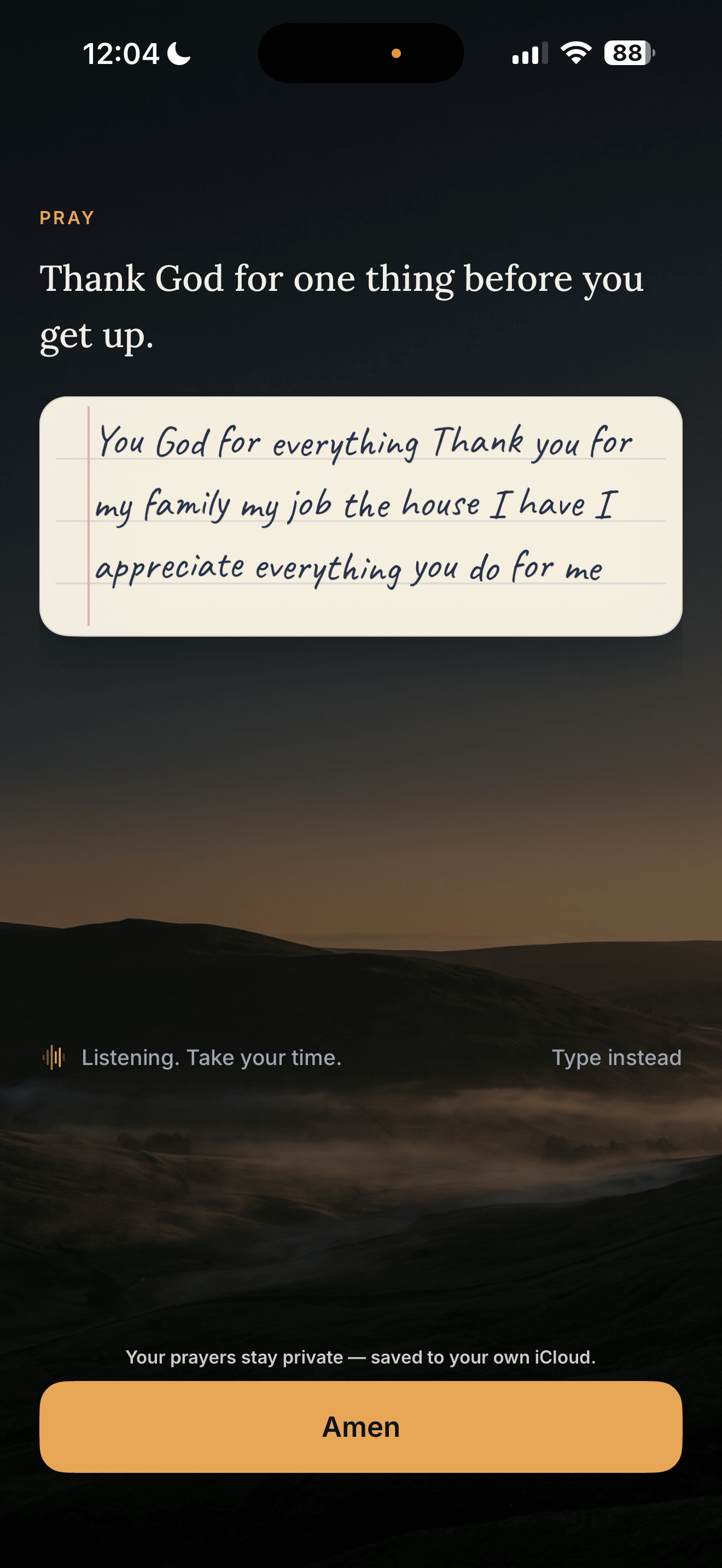
Frequently asked questions
How long should I pray the Lord’s Prayer in the morning?
Start with three to ten attentive minutes. Read the prayer once, pause over the petition that meets your morning, and answer God in your own words. If you have only one minute, pray one line slowly rather than abandoning the practice because you cannot complete an ideal routine.
Should I use Matthew 6 or Luke 11 in the morning?
Either passage is a good place to begin. Matthew 6:9–13 gives the fuller form in the Sermon on the Mount, while Luke 11:2–4 records Jesus answering a disciple who asks to be taught to pray. You can read both occasionally and use the wording familiar in your church tradition.
What if I feel distracted or struggle to forgive?
Name the distraction and the difficulty honestly instead of pretending they are absent. Return to one petition, ask for the next faithful step, and remember that forgiveness does not deny harm or require unsafe reconciliation. A pastor, counselor, or trusted Christian can help when the situation involves serious injury, abuse, or ongoing danger.
Sources and fact checks
- 01USCCB: Matthew 6 — Supports Jesus’ teaching on prayer, the Lord’s Prayer, forgiveness, and freedom from anxious preoccupation with tomorrow.
- 02USCCB: Luke 11 — Supports the setting in which a disciple asks Jesus to teach them to pray and the shorter form of the Lord’s Prayer.
- 03Vatican: Catechism, The Lord’s Prayer — Supports the Lord’s Prayer as fundamental Christian prayer and explains its place in the life of the Church.
- 04Vatican: The Life of Prayer — Supports daily rhythms of prayer and the distinction between vocal, meditative, and contemplative prayer.
- 05Psalm 5:3 (WEB) — Supports the biblical image of bringing a morning voice and requests before God while waiting expectantly.
- 06Matthew 6:25–34 (WEB) — Supports the article’s context about daily provision and Jesus’ teaching not to be consumed by worry about tomorrow.