Bible reading
Should You Pray Before or After Reading the Bible in the Morning?
2026-09-14
Quick answer
There is no required order, but a simple pattern is to pray briefly for an open heart, read a short passage in context, and pray again from what you read. On some mornings prayer first will help you arrive; on others, Scripture first will give you words. The goal is a listening-and-response rhythm you can return to, not a perfect formula.
There is no Christian rule that says every morning Bible reading must begin with prayer, or that prayer must wait until the last page is closed. The better question is what helps you approach Scripture honestly, listen carefully, and answer God with your life. For many people, a brief prayer before reading and a more specific prayer afterward make a simple, balanced pattern.
That answer matters because the order can become another source of pressure. You are not trying to discover a secret sequence that makes a quiet time count. Prayer and reading belong together: you speak to God, attend to the words of Scripture, and speak again in response. On a tired morning, even one sentence before a short passage and one afterward is a real beginning.
The short answer: pray briefly, then respond after reading
If you want one dependable order, pause, ask God for an open and teachable heart, read a short passage in context, sit with one clear observation, and pray in response. The first prayer is an act of attention. The second prayer is shaped by what you actually read. Neither prayer needs to be long, eloquent, or emotionally intense.
This pattern still leaves room for other faithful approaches. Some mornings you need to pour out your worry before you can concentrate. Other mornings a verse is the doorway that helps you pray at all. The point is not to defend prayer-first or reading-first as universal law. Keep prayer from becoming vague and Scripture from becoming detached from relationship with God.
Begin with prayer when you need to become attentive
A short opening prayer can mark the change from consuming information to meeting God. You might say, “Lord, help me receive what is true here,” or “Open my eyes to understand and obey.” Psalm 119:18 gives language for asking God to see wonderful things in his instruction. That is a posture, not a demand for a dramatic feeling: you admit that attention is a gift you need to receive.
Jesus’ morning pattern includes rising early and praying in a quiet place. Mark 1:35 does not prescribe a fixed duration or tell every disciple to copy the same clock time. It does show intentional space before the day’s demands take over. A brief prayer can create that space even when your morning includes children, a commute, illness, or a shift that starts before sunrise.
Keep this first prayer small enough to repeat. Name your presence, ask for understanding, and release the need to control the outcome. If you are distracted, say so. If you are grieving, bring that honestly. If you are grateful, begin there. The prayer is not a password that unlocks the Bible; it is a way of arriving with your whole self.
Let Scripture lead the middle of the morning
After the opening prayer, read less than you think you need to read. Choose a short paragraph, a scene, or a psalm rather than racing through several chapters. Read it twice if you can. Notice who is speaking, what happens before and after, and what the passage actually says before asking what it means for your situation. Context keeps a comforting phrase from becoming a slogan that the text cannot carry.
Ask four simple questions: What do I notice? What does this reveal about God, people, or faithful action? What am I tempted to ignore? What word or image stays with me? These questions do not replace study, community, or wise teaching. They slow you down enough to hear the passage before you rush to apply it.
Official Christian guidance often describes prayerful reading as a dialogue rather than two unrelated tasks. Dei Verbum says prayer should accompany Scripture reading: in prayer we speak to God, and in reading we hear the divine word. The USCCB describes lectio divina as reading, meditation, prayer, and contemplation. The order can move, but the center is a receptive relationship with God through the text.
Pray after reading so your response has direction
The prayer after reading can be more specific because the passage has given you something to answer. If the text reveals God’s patience, thank him and ask where you need to practice patience. If it names fear, bring your fear without pretending it has disappeared. If it calls for mercy, ask for one concrete opportunity to show mercy today.
Not every passage must produce a personal lesson immediately. Sometimes your response is, “I do not understand this yet; help me keep seeking.” You may need to write down a question for later. Prayer is not a way to force certainty out of a difficult text; it is a way to remain truthful before God while continuing to learn.
James 1:22–25 connects hearing the word with doing it. That does not turn morning reading into a performance review. It gives the response a direction. End by naming one small act that would honor what you saw: tell the truth, apologize, ask for help, refuse a cynical thought, or make room for a neighbor. Keep it concrete and possible.
Use a ten-minute order when mornings are full
For the first minute, sit up, breathe, and pray one or two sentences. For the next four minutes, read a short passage twice and check its immediate context. Spend two minutes writing one observation and one question. Use the last three minutes to pray from the passage and choose one response for the day. This is enough structure to begin without making the morning feel like an exam.
On a five-minute morning, remove the writing rather than removing the relationship: pray briefly, read a paragraph, and answer with one sentence. On a thirty-minute morning, add context, a trusted commentary, journaling, or silence. A flexible pattern protects you from the all-or-nothing cycle in which a missed hour becomes a missed week.
You can reverse the order without abandoning the purpose. If anxiety is loud, name it before God and ask for help. Then read until one phrase gives you a faithful next step. If your thoughts are scattered, open the passage first and let the words gather your attention. In both cases, finish by responding rather than closing the Bible and immediately moving on.
Choose the order for the day you actually have
Prayer first may serve you when you are carrying grief, anger, fear, or a decision that needs to be placed before God. It can also help when Bible reading has become a box to check. A short confession or request can make your reading more honest. You are not asking Scripture to confirm your preferred answer; you are becoming willing to be corrected and comforted.
Reading first may serve you when prayer has become repetitive or you do not know what to say. Let a psalm, Gospel scene, or epistle paragraph supply the vocabulary. Read attentively, then borrow the passage’s movement: praise, lament, confession, thanksgiving, petition, or surrender. Scripture can give shape to a prayer that felt unavailable a few minutes earlier.
Do not turn this choice into a test of spiritual maturity. A faithful morning is not measured by selecting the superior order. It is measured more honestly by whether you made room for God, attended to Scripture, and allowed your response to reach beyond the page. Some days the sequence will be prayer, reading, silence, prayer. Other days it will be reading, prayer, and one small act of obedience.
Make the sequence easy to return to
The most helpful order is the one you can remember when you are sleepy. Put your Bible or reading plan where you will see it. Decide the passage before the alarm if choosing in the morning delays you. Keep a one-line prompt nearby: “What does this say, and how will I answer?” These small decisions lower friction without making devotion mechanical.
Koum can make the first transition concrete by opening a Scripture-first alarm. The app asks you to open a Bible verse and lets you scan the page, say the verse aloud, or type it before the alarm ends. Afterward, the morning flow leaves room for prayer, a devotional, and a private reflection. Koum does not replace a Bible, church, pastoral care, or the work of understanding a passage; it can simply help the first Scripture step happen before the day pulls you away.
If you use an alarm, choose a passage short enough to approach while you are still waking up. The aim is not to make the alarm stressful. It is to give your first attention a direction. Once the verse is open, continue with the order that fits the day: pray what you read, read after the prayer you needed, or do both in a few unhurried minutes.
Return to the purpose, not a perfect formula
Prayer before or after Bible reading is not an either-or debate you have to win. It is a practical question about how to listen and respond. Begin with a brief prayer when you need to arrive. Read carefully enough to hear the passage in context. Pray afterward in the language the text has given you. Then carry one faithful response into the day.
If you miss the order tomorrow, do not start over from zero. Open the passage, say what is true, and take the next small step. A Christian morning practice grows through return: return to Scripture, return to prayer, and return to God’s patient invitation to begin again.
Put this into practice with Koum.
Koum asks you to open, scan, speak, or type a Bible verse before the alarm ends. Then it gives the morning room for prayer, a devotional, and a private reflection.
Get Koum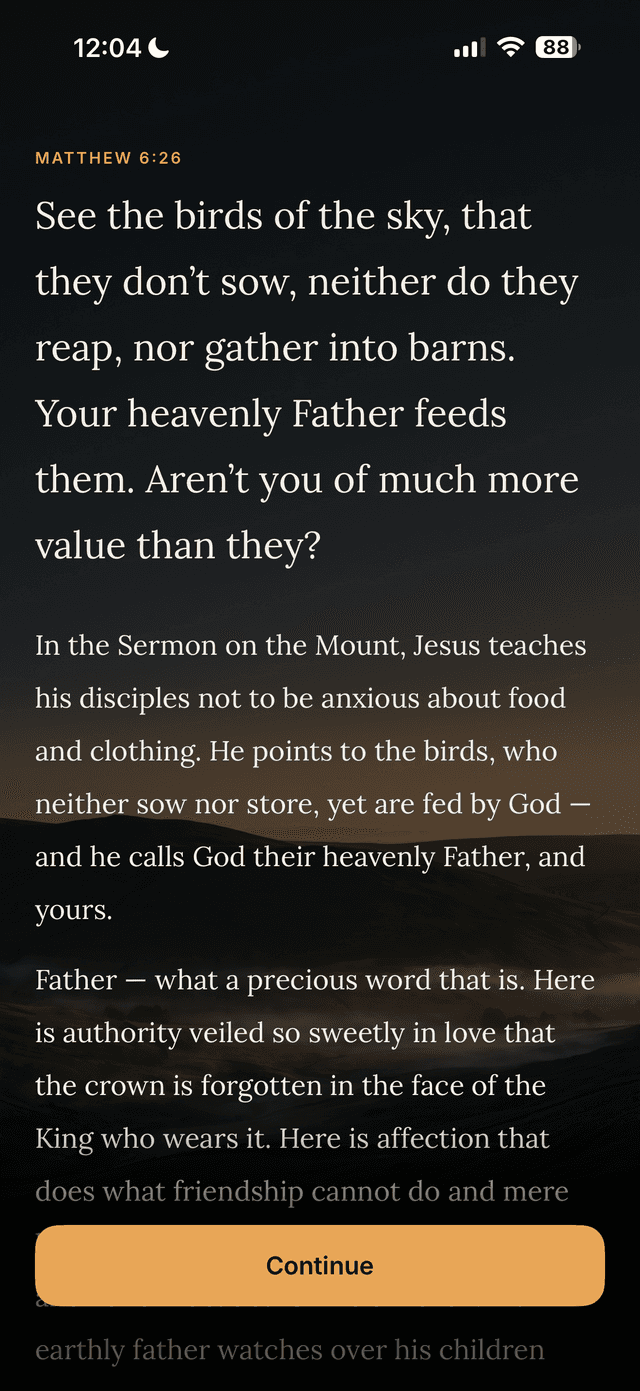
Frequently asked questions
Is it better to pray before or after reading the Bible?
Neither order is required for every Christian or every morning. A brief prayer before reading can help you become attentive, while prayer after reading lets the passage shape your response. Try both and keep the order that helps you listen to Scripture and answer God honestly.
What should I pray before reading the Bible in the morning?
Ask God for an open, teachable heart and patience to understand the passage in context. You can say one sentence such as, “Open my eyes to what is true here, and help me live it.” The prayer does not need to be long or impressive.
How long should a morning Bible reading and prayer time be?
There is no required length. Five focused minutes can include a short prayer, a paragraph read twice, and one sentence of response. If you have more time, add context, journaling, silence, or a trusted study aid. A repeatable rhythm is more useful than an ideal plan you cannot sustain.
Sources and fact checks
- Dei Verbum 25 (Vatican): Supports prayer accompanying Scripture reading as a dialogue in which we speak to God and hear the divine word.
- Verbum Domini 86–87 (Vatican): Supports prayerful reading, context, and the movement from reading and meditation into prayer.
- Meditations: What is lectio divina? (USCCB): Describes lectio divina as reading, meditation, prayer, and contemplation with a short passage.
- Luke 11:1–4 (Bible Gateway): Records Jesus teaching his disciples how to pray when they ask him to teach them.
- Psalm 119:18 (Bible Gateway): Supports asking God for opened eyes and understanding while approaching his instruction.
- Mark 1:35 (Bible Gateway): Shows Jesus making intentional space for prayer early in the morning.
- James 1:22–25 (Bible Gateway): Supports moving from hearing the word toward faithful action.