Bible reading
How to Journal After Reading the Bible in the Morning
Quick answer
After reading, write the reference, summarize one thing the passage says, name what stood out, respond to God honestly, and choose one small action for today. Keep the entry short enough to repeat, and let the passage—not a formula—lead your prayer and next step.
A morning Bible journal does not need to become another assignment. After you read a passage, write down the reference, one sentence about what you noticed, an honest response to God, and one small way you can live it today. The point is not to produce impressive pages. It is to slow down long enough to receive Scripture and remember what you received.
This practice works whether you have five minutes before work or a quiet half hour. Keep your Bible open, write in a notebook or app, and let the passage set the direction. If your entry is short, it can still be faithful. If your thoughts are unsettled, write that honestly instead of pretending that every morning felt peaceful.
Why journal after reading the Bible in the morning?
Reading gives you contact with the words of Scripture. Journaling gives you a place to notice, question, remember, and respond. Those are different activities. You may understand a verse while reading it and still forget its shape before breakfast. Writing one or two sentences creates a pause between hearing the passage and moving into the rest of the day.
Psalm 1 describes a person who meditates on God’s law day and night, using the picture of a tree planted near water. That is a picture of an ongoing posture, not a demand to fill pages every morning. A journal can support that posture by carrying one observation with you. It is a small container for attention, not a scorecard for spiritual performance.
Luke 2:19 gives another helpful image. After the shepherds told Mary what they had heard, she kept those things and pondered them in her heart. A journal is not a way to imitate Mary’s unique story; it is simply a practical way to practice the kind of remembering and consideration the verse describes. You can write what you are trying to understand without forcing a conclusion.
Use four questions to turn reading into reflection
Begin with the passage itself. Before asking what it means for your schedule, ask what it actually says. Read the selected verses slowly a second time, then use these four questions. You do not need a long answer to each one; a phrase may be enough.
- What does this passage say? Record the reference and summarize the main movement in your own words. Notice who is speaking, what is happening, and any repeated idea.
- What stands out to me? Write a word, image, command, promise, tension, or question that caught your attention. Do not assume the most familiar line is the only important one.
- What is this showing me about God, people, or faithful living? Keep the answer connected to the passage rather than turning the verse into a general slogan.
- What will I remember or practice today? Choose one concrete response: a conversation to enter with patience, a truth to repeat when worried, a person to pray for, or a task to do with integrity.
These questions protect your journal from becoming either a bare transcript or a stream of disconnected thoughts. They also give you permission to ask a real question. “I do not understand why this command feels difficult today” is a more useful entry than a sentence written only because it sounds spiritual.
Let the passage lead your prayer
A good morning entry does not stop at analysis. After you write what you noticed, answer God in your own words. You might thank him for something the passage reveals, confess the gap between what you read and how you are living, ask for help with a specific situation, or pray for another person named by the passage. Let the prayer be shaped by the text, but do not make it artificial.
James 1:22–25 warns against hearing the word and then forgetting it, comparing that pattern to looking in a mirror and walking away without remembering what you saw. The passage is not a formula for earning God’s favor through journaling. It is a reminder that attention should move toward faithful action. Your written response can end with a small next step that you could actually take before the day is over.
For example, if you read about speaking gently, your action might be to pause before answering a tense message. If you read about God’s care, you might write the fear you are carrying and pray over it before checking the news. If you read a passage of lament, your response may be to name grief without trying to make it sound resolved. The action should come from the passage and fit the circumstances you really have.
Keep a morning Bible journal small enough to repeat
The most useful journal is one you can return to. Decide on a minimum version for crowded mornings: reference, one sentence, one prayer, and one next step. That may take three minutes. On a slower day, expand the entry with context, cross-references, or a longer prayer. A flexible practice is more honest than a rigid promise that collapses the first time sleep, children, illness, or work interrupts it.
- Use one passage rather than trying to summarize an entire chapter. Depth usually begins with attention, not volume.
- Date each entry and write the reference. Later, you can see what God was teaching you without relying on memory alone.
- Leave room for unfinished thoughts. A question can remain a question while you continue reading, praying, and talking with mature believers.
Do not measure the practice by how emotional the entry sounds. Some mornings will produce gratitude; others will produce a plain sentence such as, “I am tired, and I need help to trust this today.” Honest writing can become honest prayer. The goal is not to manufacture a feeling but to meet Scripture truthfully.
Set up tomorrow’s reading before today ends
A morning journal begins more easily when the first decision has already been made. Before bed, choose the passage or reading plan, put your Bible where you will see it, and decide what “enough” means for tomorrow. If you use an alarm, give yourself a realistic wake time that does not treat lost sleep as a spiritual failure. The morning should make room for Scripture, not turn Scripture into a reason to ignore your body’s needs.
Koum can support that sequence as a Scripture-first alarm for iPhone. It asks you to open, scan, speak, or type a Bible verse before the alarm ends; after verification, the app leaves room for prayer, a short devotional, and a private reflection. Its support documentation says that prayers and journal entries live on the iPhone and in the private iCloud connected to your Apple Account. That can give your written response a consistent place, but it cannot replace your Bible, church, pastoral care, or the work of responding to God.
Whether you write in a paper notebook or in Koum, finish by looking at the one line you want to carry. A morning Bible journal is successful when the passage remains present in the next faithful choice—not when the page looks perfect.
Put this into practice with Koum.
Koum asks you to open, scan, speak, or type a Bible verse before the alarm ends. Then it gives the morning room for prayer, a devotional, and a private reflection.
Get Koum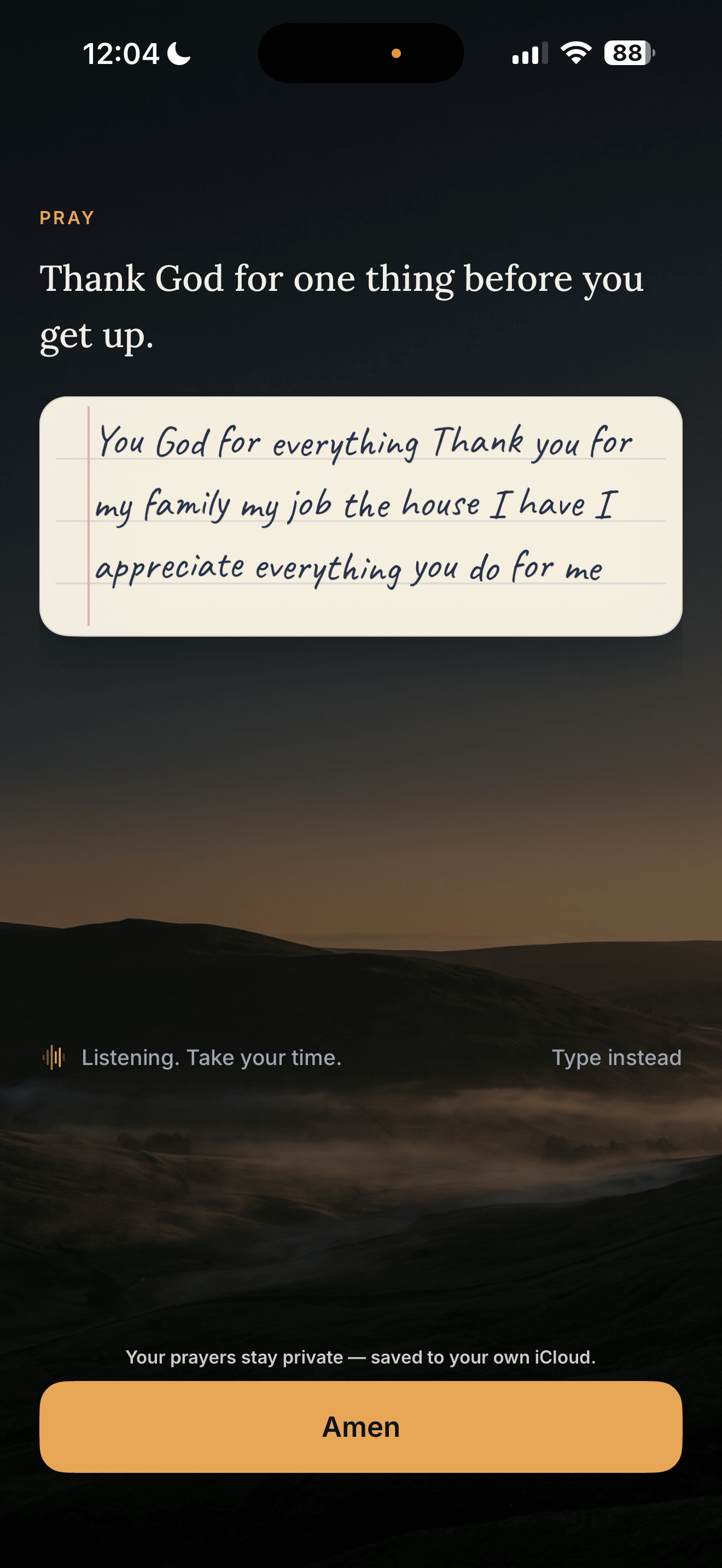
Frequently asked questions
How long should a morning Bible journal entry be?
Start with three to five minutes: write the reference, one observation, a short prayer, and one next step. Add more only when you have time and attention. A short entry you can repeat is more useful than a demanding format you abandon.
What should I write when I do not understand the passage?
Write the question plainly, include the verses that raised it, and avoid forcing an answer. You can return to it with a trusted study resource, pastor, or mature Christian friend. Honest uncertainty is a valid starting point for further reading and prayer.
Can I use a phone for a Bible journal?
Yes. A paper notebook, notes app, or a dedicated tool can all hold your response. Koum supports a Scripture-first alarm followed by prayer, a short devotional, and private reflection; choose the format that helps you stay present to Scripture rather than distracted by the device.
Sources and fact checks
- 01Psalm 1:2–3 (NIV) — Supports the picture of meditating on God’s instruction as an ongoing practice.
- 02Luke 2:19 (NIV) — Supports remembering and pondering what has been heard.
- 03James 1:22–25 (NIV) — Supports moving from hearing the word toward faithful action.
- 04Psalm 119:105 (NIV) — Supports Scripture as guidance for the path ahead.
- 05Koum Support — Verifies Koum’s prayer and journal flow and its private iCloud behavior.