Morning routine
A simple Christian morning routine to begin with prayer
Quick answer
A Christian morning routine does not need to be long. Pause before your phone takes over, read one passage slowly, answer God in prayer, and choose one faithful next step for the day.
Start with the real morning in front of you
A Christian morning routine is not a test of how early you can wake up or how much you can fit into ten minutes. It is a small act of attention. Before messages, tasks, headlines, and other people’s needs start asking for your mind, you choose to notice God. Psalm 5:3 pictures a person bringing a request to God in the morning and watching expectantly. Mark 1:35 shows Jesus seeking a solitary place to pray, but it does not turn a particular hour into a command for every believer. The point is not to copy someone else’s schedule. The point is to make a real beginning. If your morning is quiet, sit with a Bible and a cup of coffee. If children are calling or a commute begins immediately, take two honest minutes at the edge of the bed, in the bathroom, or in the car before a podcast starts. A routine becomes sustainable when it fits your actual life. Start by naming the moment: ‘God, this day is yours.’ That sentence does not solve the day. It does put the day in its right relationship. You are not entering it alone, and you are not required to carry every outcome by yourself.
Make the practice small enough to keep
The next step is one passage, not an ambitious reading plan you resent by Thursday. Read a short section such as Psalm 143:8, then ask three plain questions: What does this say about God? What does it expose in me? What response might be faithful today? Let the text set the agenda before you make it a quotation for your own agenda. You may notice an invitation to trust, a reminder of mercy, or a call to love someone difficult. Write one phrase in a notebook if it helps, but do not confuse collecting notes with receiving the Word. The useful outcome is not a perfect insight. It is a little more honesty. If you miss a morning, do not turn the next morning into a punishment. Return to the next available moment. Grace is not opposed to practice; it is what makes practice possible after inconsistency. A small passage read with attention can give shape to the next hour better than a long reading completed only to check a box. Try a fourteen-day experiment instead of making a lifelong vow. For the first week, keep only the same opening sentence, passage length, and prayer shape. For the second, notice the obstacles without treating them as excuses: late bedtime, a phone within reach, a changing work schedule, a shared room, or uncertainty about where to read. Remove one obstacle rather than adding five new rules. A Bible beside the bed, a prepared reading list, or an alarm placed away from the feed may be enough. At the end, ask whether the practice helps you become more available to God through the day. If the answer is no, change the practice, not your worth. Some seasons call for reading; others call for listening to Scripture, praying a psalm, or sitting quietly. Let the form serve the relationship. A routine is a trellis, not the vine itself. It gives ordinary life somewhere to grow, but it cannot manufacture life by force.
Pray honestly and carry Scripture into the day
Prayer can be equally simple. Begin with gratitude for one specific gift: rest, a person, a meal, a new day, or God’s patience. Then name what is actually in front of you. Ask for wisdom in a conversation, steadiness in work, courage to apologize, or help with the fear you are carrying. Add one person who needs care, and finish with surrender: ‘Guide what I can do, and hold what I cannot control.’ This is not a formula that secures a preferred outcome. Prayer is a relationship of dependence, confession, praise, and request. When words are scarce, use the Lord’s Prayer slowly or pray a line of Scripture back to God. When you are distracted, say so rather than pretending to be focused. Honest prayer is better than spiritual performance. A routine is doing its job when it teaches you to return, not when it makes you feel impressive. Keep the routine from becoming private self-improvement by letting it shape the way you meet people. Before you finish, ask whom you are being called to love today and what love may require. It could require attention instead of a rushed answer, patience instead of a sharp reply, or a willingness to confess when you are wrong. A morning with God is not an escape from the world; it prepares you to inhabit the world truthfully. If you live with others, explain your practice with gentleness rather than demanding silence or resenting interruptions. If you live alone, consider sending one encouraging message when the passage brings someone to mind. Community makes a routine less about protecting your image and more about receiving grace together. Over time, revisit the routine. If it has become mechanical, change the passage, simplify the steps, or pray with a psalm. If it has become burdensome, shorten it. The measure is not intensity but whether it helps you return to God and neighbor with greater faith, hope, and love.
Put this into practice with Koum
Finally, choose one faithful next step before you stand up. It may be sending the message you have avoided, turning your phone face down for breakfast, forgiving before rehearsing an argument, or beginning work without carrying panic into it. This is where a Scripture-first alarm can help. Koum asks you to open, scan, speak, or type a Bible verse before an alarm ends; afterward, it makes room for prayer, a short devotional, and a private reflection. It cannot make you spiritually mature or replace a church, a pastor, or wise friends. It can make the first cue of the day more intentional. Set one alarm for the time you can realistically keep, choose a passage you want to return to, and let the end of your alarm become the beginning of a conversation with God. Tomorrow, begin again with the same small freedom. Before sleep, make tomorrow’s beginning easy: choose the passage, put the Bible where you will see it, and decide the first prayer. Then release the result. You do not need to wake up with a special feeling for the practice to be worthwhile. Read, pray, and let God meet you in the ordinary attention you can offer.
Put this into practice with Koum.
Koum asks you to open, scan, speak, or type a Bible verse before the alarm ends. Then it gives the morning room for prayer, a devotional, and a private reflection.
Get Koum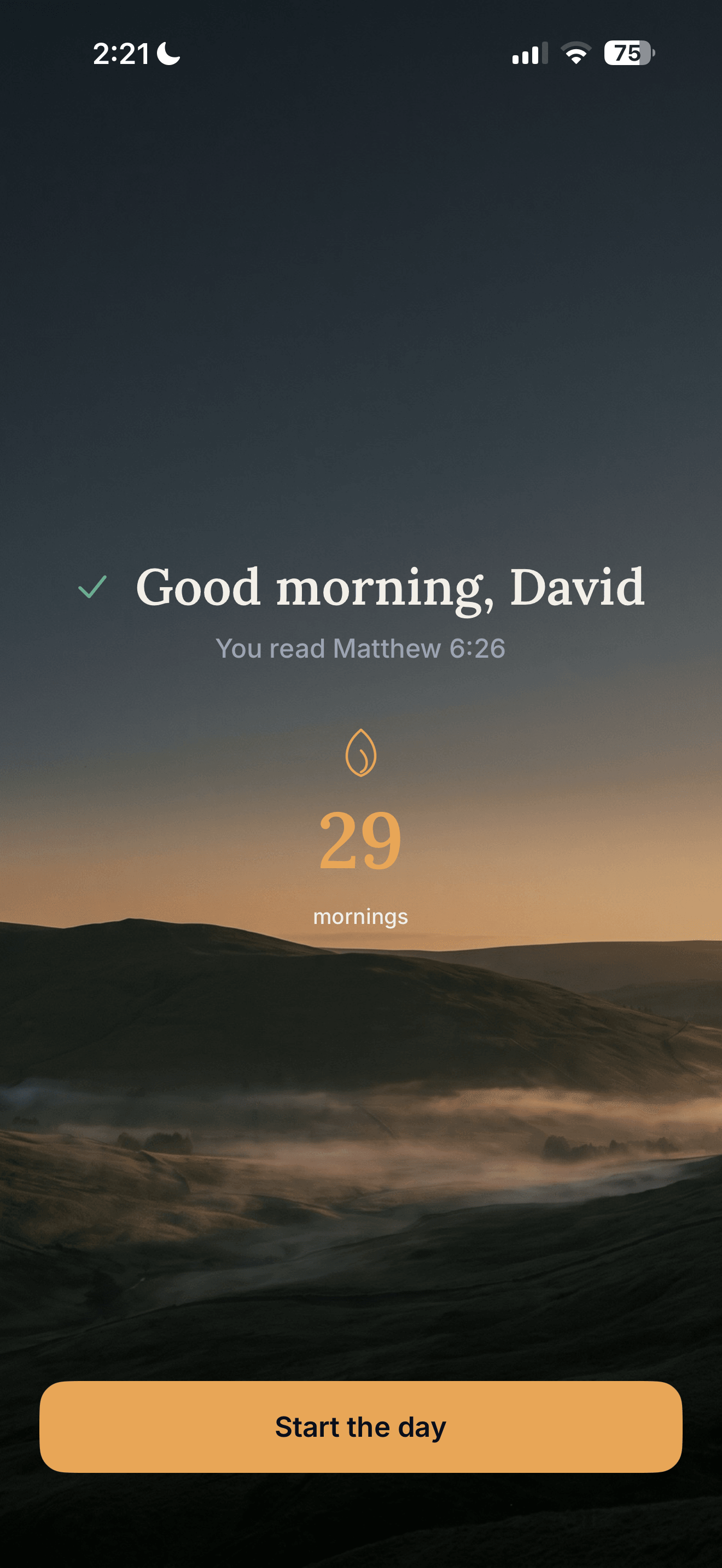
Frequently asked questions
How long should a Christian morning routine be?
Start with the amount of time you can keep without resentment. Five attentive minutes can be more honest and sustainable than a complicated hour you abandon.
What if I miss several mornings?
Do not try to earn your way back with an extreme plan. Open one passage at the next available moment and restart with a small, realistic cue.
Sources and fact checks
- 01Psalm 5:3, NIV — A biblical picture of bringing a request to God in the morning.
- 02Mark 1:35, NIV — Jesus seeking a solitary place to pray.
- 03Psalm 143:8, NIV — A morning prayer for God’s unfailing love and guidance.
- 04Koum support — Verified Koum alarm, Scripture verification, prayer, devotional, and reflection features.