Bible reading
Should You Read the Bible on Your Phone or on Paper in the Morning?
Quick answer
Read on paper if it helps you become still and protects the passage from phone distractions. Read on your phone if it makes Scripture available, searchable, and realistic for your morning. The right format is the one that helps you stay with the text and take one faithful next step.
There is no universally holier screen or more faithful kind of paper. The better morning Bible format is the one that helps you stay with the passage, notice what it says, and respond to God without turning the tool into the main event. For some people, a printed Bible creates a welcome distance from notifications. For others, a phone keeps the text available when the morning is dark, crowded, or already moving. Both can serve a Scripture-first practice.
So should you read the Bible on your phone or on paper in the morning? Choose paper when it removes distraction and makes you want to linger. Choose your phone when it gives you reliable access, useful search, or a realistic way to begin. Then judge the choice by what happens after the format decision: do you read in context, pray honestly, and carry one faithful response into the day?
Start with the purpose, not the device
The purpose of morning Bible reading is not to win a debate about paper and pixels. Scripture is meant to be received with attention and lived with integrity. Second Timothy 3:16–17 describes Scripture as useful for teaching, correction, and training, while James 1:22–25 warns against hearing without doing. Those passages point to a simple test: the format should help you listen and respond. If a beautiful paper Bible stays closed, it is not serving your actual morning. If a Bible app keeps sending you into unrelated tabs, it may be time to simplify.
This also keeps the comparison honest. A phone is not automatically shallow, and paper is not automatically prayerful. A person can scroll past a printed page mentally, just as a person can read carefully from a small screen. The question is whether the environment around the text supports the kind of reading you hope to do. Pick the medium that lowers the next faithful step.
When paper is the better morning choice
Paper often fits when your phone is already crowded with work, messages, news, or entertainment. Opening a physical Bible can create a visible boundary: this is the page I came to read, and I do not need to answer everything else yet. A paper bookmark can also make a small reading plan tangible. You can leave the Bible open beside a chair, mark a verse, and return without needing to remember which app or tab contained it.
Choose paper if you read better with a wide view of the page, if a roommate is asleep and a glowing screen would be irritating, or if your eyes feel tired before the day begins. You might read one paragraph, underline a repeated word, and write a one-sentence prayer in a notebook. The limitation is practical: a printed Bible may be in another room, hard to read in low light, or difficult to search when you are trying to find a passage before work. Notice those constraints without treating them as spiritual failures.
When your phone can serve the reading
A phone can be the more faithful choice when it is the tool you will actually open. It can give you a Bible in a small apartment, on a commute, during travel, or beside a sleeping child. Search can help you find a reference, compare a translation, or return to the passage you meant to read. Accessibility settings may make the text easier to enlarge or hear. None of those conveniences make the reading less real; they simply remove barriers for a particular reader.
The phone needs a boundary, though. Put it in a reading mode, silence nonessential notifications, and decide the passage before you tap into it. Keep only the Bible and the notes you actually need in view. If you use a devotional, let it point you back to the biblical text rather than replacing it. BibleProject’s reading resources emphasize learning how different kinds of biblical writing work; that is a useful reminder not to flatten every passage into a stand-alone quote. Read the words in their paragraph, chapter, and larger story.
A simple four-step morning practice
First, prepare one clear passage. Choose a paragraph, a short section, or the next part of a book instead of opening the Bible with an undefined promise to read more. Second, read slowly enough to notice repeated words, commands, questions, and changes in tone. Psalm 119:15–16 describes meditating on God’s precepts and not forgetting his word; that is a posture of attention, not a demand to finish a large number of pages.
Third, answer the passage before you search for an answer elsewhere. What does this text say about God, people, wisdom, sin, mercy, or faithful action? What should you resist, receive, confess, or practice today? Fourth, pray one honest sentence and choose one small response. If the passage calls you to speak gently, send the message without the sharp edge. If it calls you to trust God, name the worry you are carrying. The point is not to manufacture a dramatic feeling before breakfast. It is to let reading become a real encounter with a real next step.
Keep a phone-based reading practice Scripture-first
If your phone is also your alarm, create a clean handoff from waking to reading. Decide what you want the first screen to ask of you, and do not make the Bible compete with every other purpose of the device. Koum is built around that transition: its Scripture-first alarm asks you to open, scan, say, or type a verse before the alarm ends, then leaves room for prayer, a devotional, and private reflection. That is a cue to begin, not a replacement for the Bible or a guarantee that you will never be distracted.
A current Bible-reader screen can be the place you continue after the alarm. You can read a passage on the phone, then put the phone down and pray or write on paper. Or you can keep a printed Bible beside the bed and use the phone only to give the morning a starting point. The strongest setup may be hybrid: paper for the main reading, phone for access and a deliberate alarm, notebook for response. Let the tools serve the practice in that order.
Run a seven-day format experiment
Instead of asking which medium is best in theory, try paper for seven mornings and phone for seven mornings, or alternate them according to your schedule. Keep the passage length similar. Write down four observations: Did you begin when you intended? Did you stay with the text? Did the tool pull you toward something else? Did one idea become a concrete response? Do not score your holiness. You are learning which conditions help you pay attention.
If paper wins, prepare the page and a light before bed. If the phone wins, remove the friction that makes you wander: preselect the passage, use a focused setting, and keep the reading time modest. If both work, assign them different mornings. A travel day may need the phone; a quiet Saturday may invite paper. Consistency does not require identical circumstances. It requires returning to Scripture with enough honesty to adjust the practice.
Let attention lead to obedience
The Bible is not more powerful because it is printed, and it is not less holy because it appears on a screen. The question is whether you are allowing the words to teach, correct, encourage, and train you. Jesus’ early prayer in Mark 1:35 shows intentional space before the demands of the day, but it does not give every Christian one required wake-up time or device. Make a place you can keep.
For many readers, the right answer will change. Use paper when it helps you become still. Use your phone when it makes Scripture available and focused. Use both when each handles a different part of the morning. Then close the comparison and read the passage in front of you. A faithful morning begins less with the perfect format than with a willing attention that hears the word and takes one next step.
Put this into practice with Koum.
Koum asks you to open, scan, speak, or type a Bible verse before the alarm ends. Then it gives the morning room for prayer, a devotional, and a private reflection.
Get Koum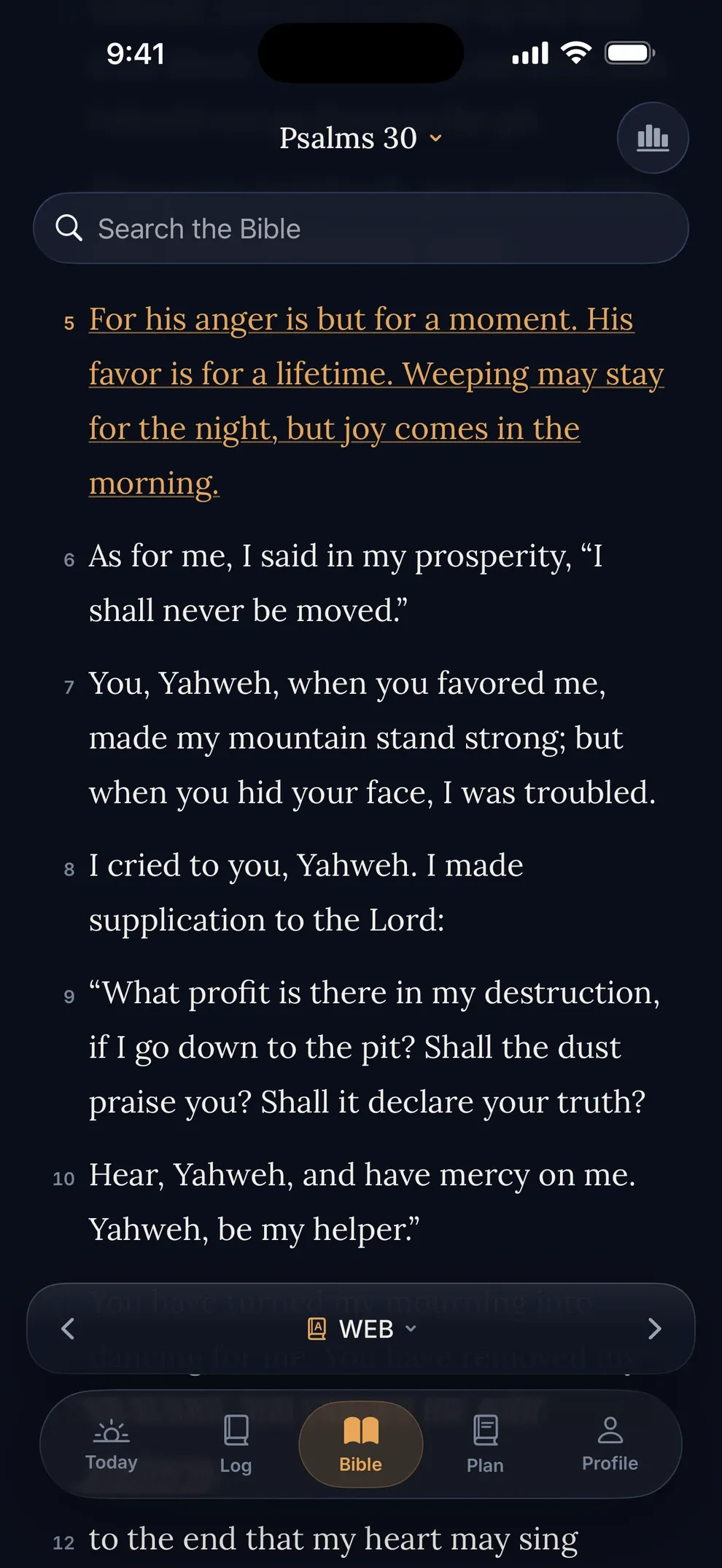
Frequently asked questions
Is it better to read the Bible on paper or on a phone?
Neither format is automatically better. Choose paper when it reduces distraction and helps you linger. Choose a phone when it gives you reliable access, search, accessibility, or a realistic way to begin. Judge the format by whether it helps you read in context and respond faithfully.
Can reading the Bible on a phone still be Scripture-first?
Yes. Decide the passage before opening the phone, silence unrelated notifications, keep only the Bible and needed notes in view, and let the text—not the device—set the direction of the morning.
Can I use both a printed Bible and a Bible app?
Yes. A hybrid routine can use a phone for access or a deliberate alarm, paper for the main reading, and a notebook for prayer or response. Give each tool a clear job so the tools support the practice instead of competing for attention.
Sources and fact checks
- 01How to Read the Bible — BibleProject — Supports reading biblical writing according to its literary form and larger story.
- 022 Timothy 3:16–17 — Bible Gateway — Supports describing Scripture as useful for teaching, correction, and training.
- 03James 1:22–25 — Bible Gateway — Supports moving from hearing the word to putting it into practice.
- 04Psalm 119:15–16 — Bible Gateway — Supports attentive meditation and remembering God’s word.
- 05Mark 1:35 — Bible Gateway — Supports describing Jesus making early space for prayer without prescribing one required schedule.
- 06Koum — Christian Bible Alarm — Supports the first-party description of Koum’s Scripture-first alarm and morning flow.