Bible reading
How to Read Scripture on Sunday Morning Before Church
2026-09-25
Quick answer
The best Sunday morning Scripture routine is small enough to keep when the morning is busy: choose one passage on Saturday, set your alarm with enough margin, read it once for context and once for response, pray briefly, and leave before-church time for getting ready and traveling. A Bible alarm can prompt the first step, but it should serve the practice rather than turn it into a race.
A good Sunday morning Scripture reading routine does not need to be long or impressive. Choose one passage before bed, set a wake-up cue with enough margin, read the text slowly, pray in response, and protect the time you need to arrive at church calmly. If you use a Bible alarm such as Koum, let it mark the beginning of that practice: the alarm can ask you to scan, say, or type a verse, and then you can continue with your physical Bible, prayer, and reflection. The tool is useful when it helps you start; it should never become the whole point.
Why begin before the Sunday rush?
Sunday mornings often carry more decisions than an ordinary morning. You may need to wake children, make breakfast, find clothes, gather what you need, and travel. That is exactly why a small plan helps. It gives Scripture a real place on the calendar instead of leaving it to the few minutes that survive every other task. Mark 1:35 describes Jesus rising early, going to a solitary place, and praying. The passage is not a command to copy one exact schedule. It is a picture of intentional space before the demands of the day take over.
Psalm 5:3 also gives morning prayer the shape of bringing a voice before God and watching with expectation. You can carry that posture into Sunday without pretending that your house is silent or your attention is perfect. The aim is not to perform a more religious version of waking up. It is to offer the first protected minutes you have, whether that is fifteen minutes at dawn or a quieter window after everyone else is moving.
Choose one passage you can actually read
The easiest way to make Sunday reading feel impossible is to choose a passage without deciding what “finished” means. Pick a short section with a clear beginning and end: a psalm, a paragraph from a Gospel, a short epistle passage, or the text your church will discuss. A passage you can complete and revisit is more useful than an ambitious reading list that remains unopened. On Saturday night, place the Bible where you will sit and write down the reference if that helps you begin without searching.
Read once for the shape of the passage. Notice who is speaking, what changes, what is repeated, and what question the text seems to raise. Then read it again more slowly. Psalm 119:105 uses the image of God’s word as a lamp and light. That image invites guidance, not frantic information collection. Ask one grounded question: What does this show me about God, and what response is fitting today? Keep the answer modest and specific.
Set the Sunday Bible alarm on Saturday
Prepare the alarm before you are tired. Choose the time you truly need to get up, not the earliest time you wish you could manage. Count backward from leaving for church and include reading, prayer, breakfast, getting ready, and travel. Add a little margin for the ordinary delays that make a real morning different from a plan on paper. Apple’s iPhone guidance distinguishes alarms that repeat on chosen days from a one-time alarm, and Apple’s AlarmKit documentation describes the authorization and scheduling context apps use for prominent alarms.
In Koum, the repository-supported flow is built around a Scripture-first alarm: you can prepare a reading and choose how the alarm’s verification step will work. The Daily plan and alarm settings are designed to keep the next morning’s reading and alarm preferences together. Set Sunday as one of the days you actually want, confirm the alarm is enabled, and test the path while you are awake. A test is not a lack of faith; it is simple respect for your time and for the people expecting you at church.
Choose scan, speak, or type for your real room
A Bible alarm works best when the verification task matches your surroundings. Scanning makes sense when your Bible is open, the page is well lit, and you can hold the phone over it. Speaking may be natural in a private room but awkward if someone else is sleeping. Typing can be the quietest option, especially when you have already chosen a short reference or verse. Koum’s product copy and support flow describe these three routes, including a way to switch if scanning does not work. Choose the option you can complete without turning the first minute of the day into troubleshooting.
Do not treat the task as a test of holiness or memory. It is a cue that brings your attention to a passage. Keep the Bible, glasses, and any notes you need within reach. If you use a translation that Koum does not include, remember the supported verification is based on the passage reference rather than requiring the exact wording; confirm the current app behavior and permissions before relying on it. The reading itself can remain in your preferred physical Bible.
Read, notice, respond, and pray
After the alarm, use a simple four-part rhythm. First, read the selected passage without trying to solve every question. Second, notice one phrase, action, promise, warning, or contrast that stands out. Third, respond in a sentence: confess something, give thanks, ask for help, or name one obedient next step. Fourth, pray that response back to God. This order keeps the morning anchored in Scripture while leaving room for a personal voice. It also gives you a stopping point when the schedule is short.
If the passage is difficult, do not force a dramatic conclusion before church. Write down the question and carry it into the sermon, a trusted conversation, or later study. A Sunday routine can include uncertainty. The goal is not to manufacture an emotion before worship begins; it is to arrive attentive, honest, and ready to hear. A few quiet minutes of rereading can be more formative than racing through several chapters while watching the clock.
Leave a buffer before you leave home
Build the routine backward from the door. If you need to leave at 9:15, do not set the Bible alarm for 8:55 and call the rest of the morning a plan. Give the passage its own time, then allow room for showering, dressing, eating, packing, and helping someone else. Your Scripture reading is not improved by making your family absorb the cost of your schedule. A calm ending is part of the practice.
A practical Sunday sequence might be: wake and complete the Scripture cue, read the passage, pray for five minutes, write one sentence, eat and get ready, then leave. Adjust it for your household. If your church meeting is online or your travel is short, use the saved time for deeper reading rather than moving the alarm earlier by default. The point is a repeatable pattern that respects the actual morning you have.
When the morning goes wrong
A sick child, a late night, a dead phone, or a missed alarm can interrupt the plan. Treat the interruption as information, not condemnation. If you wake late, read the passage in the car only if someone else is driving, listen to it later, or choose one verse to revisit after the service. Never use a phone-based alarm as your only safeguard for a flight, exam, medication, work shift, or other time-critical obligation. Koum’s terms and support guidance are clear that permissions, battery, device state, and setup still matter.
Then make one small adjustment for next Sunday. Shorten the passage, move the alarm fifteen minutes earlier, prepare the Bible more visibly, or choose a quieter verification mode. A routine becomes dependable through honest adjustment. It does not become dependable because you punish yourself for the version of Sunday you could not control.
Use one Sunday as a gentle experiment
You do not need to promise a perfect weekly streak. Try the routine once and ask three questions afterward: Did the passage fit the time? Did the alarm help me begin or create friction? What would make next Sunday easier? Keep the answers practical. Maybe the best choice is a short psalm, a later reading window, or a regular alarm plus a physical Bible. Maybe a Scripture-first alarm gives you the transition you have been missing. The right choice is the one that helps you meet God’s word in the life you actually live.
Koum can be part of that experiment because it connects the wake-up moment to a concrete Scripture action and leaves room for prayer, devotional reading, and reflection. It does not replace your Bible, your church, or the people who help you grow. It simply helps make the first next step visible. Set one passage tonight, protect enough margin, and let Sunday morning begin with attention rather than hurry.
Put this into practice with Koum.
Koum asks you to open, scan, speak, or type a Bible verse before the alarm ends. Then it gives the morning room for prayer, a devotional, and a private reflection.
Get Koum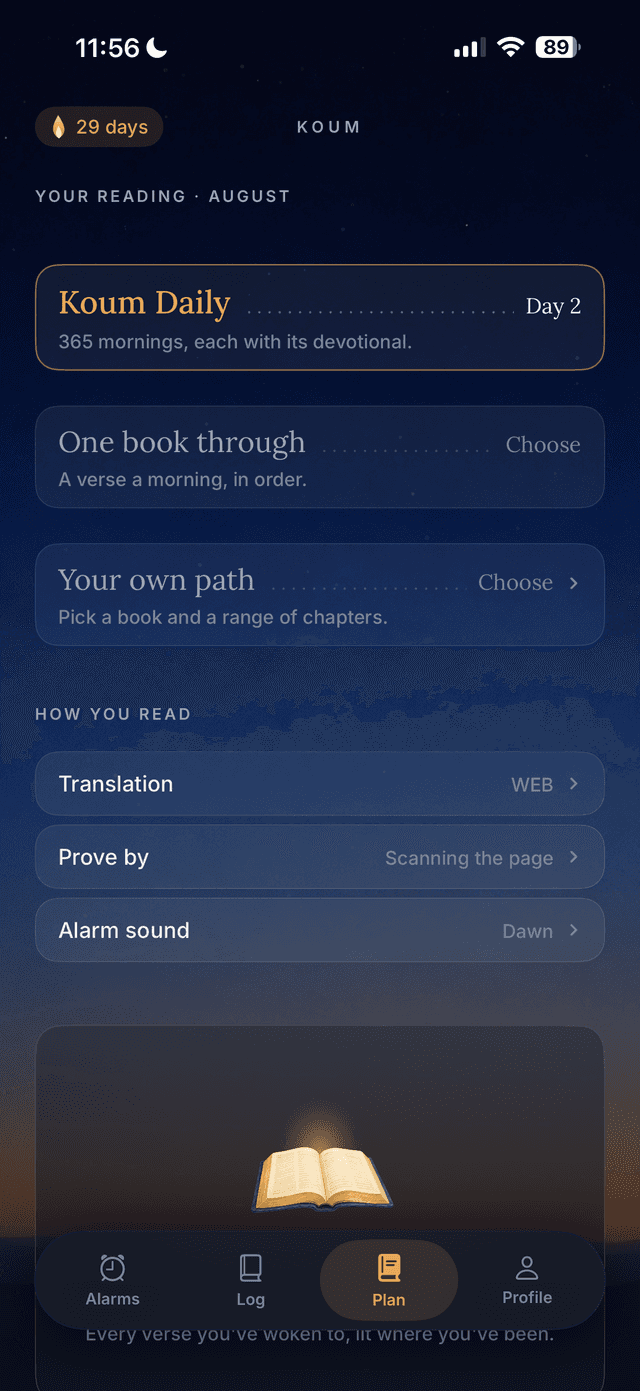
Frequently asked questions
How long should Sunday morning Scripture reading take?
Start with a passage you can read attentively in ten to fifteen minutes, then add whatever time you genuinely have for prayer. The goal is not to hit a spiritual number; it is to meet the text without making the rest of the morning frantic.
Should I set a Bible alarm before church?
You can if a clear wake-up cue helps you begin. Set it early enough for reading, prayer, breakfast, getting dressed, and travel, and test the alarm while awake. Keep a backup alarm whenever being late would have serious consequences.
What if I miss my Sunday Scripture reading?
Do not turn a missed morning into a verdict about your faith. Read the passage later, listen during the service, or begin again the next morning. A routine is meant to return you to Scripture, not shame you for being human.
Sources and fact checks
- Mark 1:35 — Bible Gateway: Supports the biblical example of Jesus rising early and praying in a solitary place.
- Psalm 5:3 — Bible Gateway: Supports bringing prayer to God in the morning and waiting attentively.
- Psalm 119:105 — Bible Gateway: Supports describing God’s word as guidance for the path.
- Set an alarm in Clock on iPhone — Apple Support: Supports the practical distinction between one-time and repeated iPhone alarms.
- AlarmKit — Apple Developer Documentation: Supports the platform context for apps that create one-time or repeating alarms with authorization.