Bible reading
How to Read the Bible in the Morning When You’re Not a Morning Person
2026-09-23
Quick answer
You do not need to become a morning person first. Choose a realistic morning cue, start with one short passage and an honest prayer, remove one obstacle the night before, and use a Scripture-first alarm only if it helps you return consistently.
You do not need to become a morning person first
You can read the Bible in the morning without loving early mornings. The goal is not to prove that you can wake before sunrise, copy another person’s discipline, or create a powerful devotional feeling on demand. The goal is to give God the first honest attention you can offer. If that attention begins at 8:15 instead of 5:15, it is still a real beginning. Your routine should serve your relationship with God and the responsibilities of your life, not become another way to measure your worth.
Scripture gives examples of morning prayer, not one required alarm time for every Christian. Psalm 5:3 pictures bringing a voice to God in the morning; Mark 1:35 describes Jesus seeking a solitary place to pray while it was still dark. Let those passages encourage you without turning dawn into a universal test. Ask a better question: “When can I be present enough to read and respond?” The answer may be after you wake, after coffee, during breakfast, or at the first quiet pause before work.
Choose a morning cue you can keep
Pick a time or event that is stable on most days. It might be ten minutes after your alarm, after washing your face, or after the children leave for school. When schedules change, an event can be more dependable than a clock. Write the cue simply: “After I wash my face, I will read one short passage at the table.” Your first version should feel almost too easy. That is a strength. A practice that you can repeat has somewhere to grow.
Do not borrow a schedule that requires you to cut sleep carelessly. Begin with the margin you already have instead of moving your alarm dramatically earlier. Define a minimum and a fuller option: one paragraph, one verse, and one sentence of prayer on a hard day; a longer reading or devotional when time allows. Missing the ambitious version should never mean abandoning the small version. The small version is the door that stays open.
Use a short Scripture-first routine
A five-step routine is enough. Put the phone down or turn off notifications. Read a short passage slowly. Repeat one phrase that deserves attention. Answer with gratitude, confession, a request, or surrender. Then choose one way to carry the passage into the day. You are not completing a performance. You are making room to hear, respond, and remember. If your mind wanders, return to the verse without scolding yourself.
When you do not know what to read, choose a passage with a clear next step. Psalm 143:8 asks to hear of God’s steadfast love in the morning and to know the way to walk. Read it twice, name where you need guidance, and ask for help with the next faithful action. Other mornings may call for a Gospel paragraph, a psalm, or a reading-plan section. The right passage is one you can attend to, not the one that makes your plan look impressive.
Remove friction the night before
The morning is not the only place to build the habit. Before bed, choose the passage and put the Bible where you will sit. Leave a bookmark in the text and write the first prayer on a card if words are difficult before breakfast. If your phone is the alarm, place it where you can hear it without making the feed the first thing you see. Preparation turns a vague intention into a visible path.
Name the obstacle most likely to win: a late bedtime, a shared room, a commute, a child who wakes early, or the urge to check messages. Solve only that obstacle first. Use a lamp, a printed plan, an audio Bible, or a chair away from the bed if helpful. Prepare a gracious recovery plan too. If you oversleep, read one verse at the next pause. If the house is loud, pray while walking. Durable routines include a way back.
Let prayer follow reading, not performance
Reading the Bible is not a way to earn God’s attention before you may begin the day. Matthew 6:6 presents prayer as turning toward the Father in secret, not performing for an audience. You can pray from what you read, ask for help with what you do not understand, or sit quietly when words are thin. A short prayer offered honestly is better than a long prayer written to impress an imaginary evaluator.
Ask three questions after the passage: What does this show me about God? What does it reveal about my posture or need? What is one response I can practice today? Make the response concrete: listen before answering, apologize, encourage someone, or face a difficult task with courage. If you use a devotional, let it return you to Scripture rather than replace it. The morning is a place to be truthful before it is a place to be polished.
Use a Scripture-first alarm only if it serves the practice
An alarm can help when remembering is the main problem, but it should not turn the morning into punishment. Set it for a time you can realistically keep and give it one clear purpose: open Scripture before the day takes over. If a gentle reminder works better, use that. Tools serve attention; they are not proof that God is more pleased because you chose a particular method.
Koum is designed for this kind of intentional cue on iPhone. Its alarm can ask you to open Scripture and use a Bible passage before the alarm ends; the app supports scanning, speaking, or typing the verse, then makes room for prayer and reflection. The Daily plan can show the reading and alarm preferences prepared for the next morning. It does not replace a Bible, church, pastor, or wise friends. It simply makes the first decision of the day more deliberate.
When the morning goes badly, begin again
Some mornings will be rushed, distracted, or late. You may read the same sentence three times, or pray only “Help me” before leaving. That is not a counterfeit morning. It is a real morning in which you brought real limits to God. If you return for one minute tomorrow, you have not lost the whole practice. One imperfect day does not prove that you are too undisciplined to begin.
Review the routine once a week with curiosity. Was the cue too early? Was the passage too long? Did the phone add friction? Did prayer become a checklist? Change one part and try again. You are not trying to become a different person overnight. You are learning to offer the person you are—sleepy, busy, hopeful, or uncertain—to God in the first available attention of the day.
Put this into practice with Koum.
Koum asks you to open, scan, speak, or type a Bible verse before the alarm ends. Then it gives the morning room for prayer, a devotional, and a private reflection.
Get Koum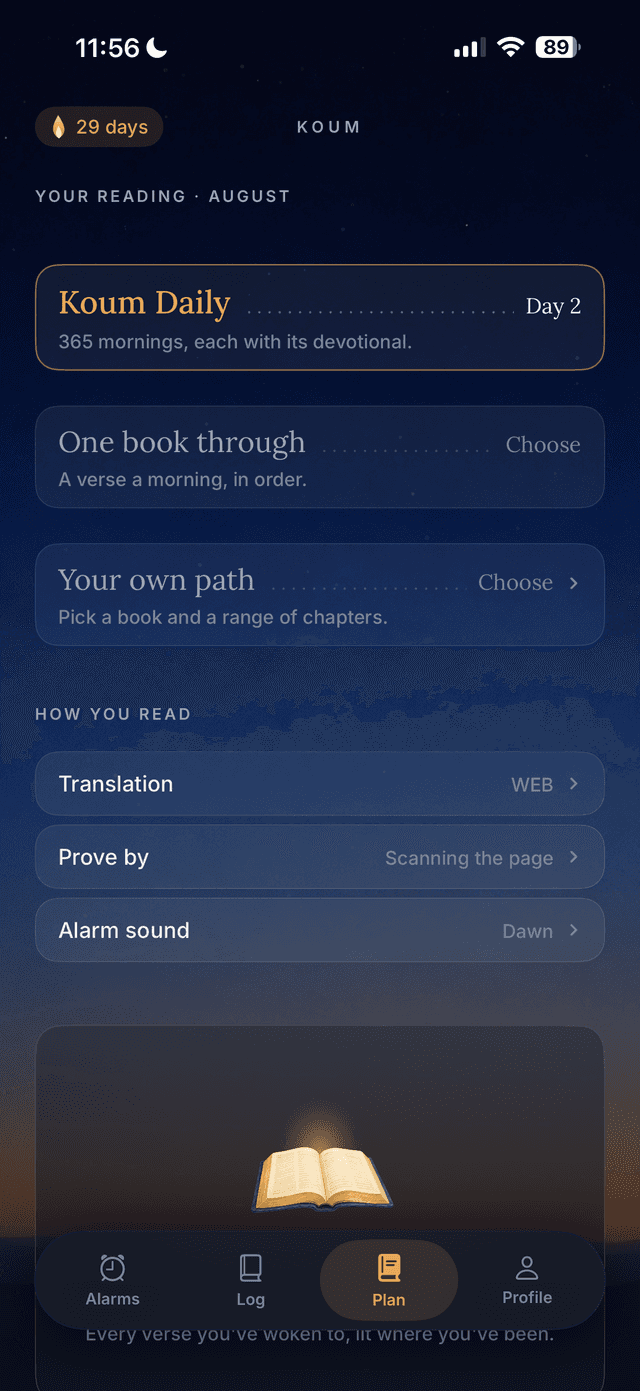
Frequently asked questions
Do I have to wake up before sunrise to read the Bible?
No. Mark 1:35 gives an example of Jesus praying early, while Psalm 5:3 gives a picture of morning prayer, but neither passage sets one required clock time for every Christian. Choose the earliest realistic point at which you can give God honest attention without treating sleep or your responsibilities as enemies.
How long should I read the Bible if mornings are difficult?
Start with five minutes or one short passage. Read slowly, repeat one phrase, and pray one honest sentence. Keep a fuller option for days when you have more time, but make the minimum easy enough to practice after a late or distracted morning.
Can a Bible alarm replace prayer or a church community?
No. A Bible alarm can provide a reminder and a Scripture-first cue, but it cannot replace Scripture itself, prayer, a church, a pastor, or wise friends. Use a tool only when it helps you turn toward those practices with greater intention.
Sources and fact checks
- Psalm 5:3, NIV: A picture of bringing a voice and prayer to God in the morning.
- Mark 1:35, NIV: An example of Jesus seeking a solitary place to pray early in the day.
- Psalm 143:8, NIV: A morning request to hear God’s steadfast love and know the way to walk.
- Matthew 6:6, NIV: Jesus teaches prayer as turning toward the Father in secret rather than performing for others.
- Koum Support: Repository-supported product claims about alarms, Scripture verification paths, and private reflection.