Bible alarms
Which Bible alarm method should you choose?
Quick answer
Choose the Bible alarm method that fits your real environment and helps you move from waking to Scripture without unnecessary friction. Scan if a physical Bible is ready, Say it if speaking is practical, Type it for slower attention, or choose a puzzle when play helps you wake; test one method while awake before relying on it.
The best Bible alarm method is the one that fits your actual first minutes—not the one that sounds most impressive. If you share a room, speaking may be awkward. If your Bible is already open, scanning may feel natural. If you wake slowly, typing, rebuilding, or completing a verse may give your attention somewhere steady to land. Choose one method you can use without resentment, test it while awake, and let the alarm become a doorway into Scripture rather than a test of your faith.
Koum currently offers six Scripture-first ways to end the alarm: Scan, Say it, Type it, Bible trivia, Rebuild the verse, and Complete the verse. They all keep the first action connected to a Bible verse, but they ask for different kinds of attention. This guide compares the tradeoffs so you can choose thoughtfully and make room afterward for prayer, reading, or a short written response.
Start with the morning you actually have
A good choice begins with your environment. Look at the room, the people who may still be sleeping, the light available, and where your Bible will be. A method that sounds easy in theory can become a daily irritation if it requires a camera when your Bible is across the room or a spoken response when you need quiet. Your goal is not to prove that you are disciplined. Your goal is to create a small, repeatable transition from sleep to attention.
It also helps to name the problem you are trying to solve. Do you forget to open Scripture after dismissing a normal alarm? Do you need a quiet way to engage your mind before you reach for messages? Do you want one verse to become a prayer instead of another item to check off? Psalm 119:105 describes God's word as a lamp for the next step, not as a stopwatch. Let that image keep the decision practical and gracious.
What the six Scripture-first methods ask of you
Scan asks you to point the camera at an open Bible page. It can suit you if you like beginning with a physical Bible in your hands and want the page itself to be part of the wake-up cue. It is less convenient if your room is dark, your Bible is packed away, or you do not want to use the camera first thing. Koum's privacy page explains how scanning works, including the distinction between on-device reading and the limited fallback described there; read it before choosing the method that feels right for your privacy preferences.
Say it asks you to read the verse aloud. This can make the first minute embodied and prayerful, especially if you wake alone and speaking helps you become present. It may not fit a shared bedroom, a sleeping family, or a morning when your voice is not ready. Type it asks you to enter the verse word by word. It is a strong option for a quiet room and for anyone who wants slower visual attention, but it may feel too demanding on a rushed morning.
Bible trivia, Rebuild the verse, and Complete the verse turn the same Scripture-first intention into a small puzzle. Trivia asks a question about the Word; Rebuild asks you to put words back in order; Complete asks you to find a missing word. Choose these when play helps you wake up and you can hold the difference between a game and a measure of spiritual maturity. The point is to open attention toward Scripture, not to earn God's approval by getting a perfect score.
Choose Scan when the page is part of the invitation
Scan is a natural fit when you already keep a print Bible beside your bed or plan to read from a physical page. It joins the alarm to an action you can see: pick up the Bible, find the passage, and point the camera at the page. That physical movement can be useful when your hardest moment is not understanding Scripture but remembering where you put it after the alarm sounds.
Before you depend on it, test the exact setup you will use tomorrow. Put the Bible where you expect it to be, check the light, grant only the permissions you understand, and see whether the page is easy to present. If the camera feels like a barrier, move to Say it or Type it. A faithful routine can be simple; it does not need the most elaborate method every day.
Choose Say it when your voice can make room for prayer
Say it is the most direct choice if reading aloud helps you wake up and your environment allows it. Speaking a verse gives the morning a sound other than the alarm and can slow the impulse to open a feed. It can also connect naturally to a short prayer: after the verse, name one thing you noticed, one need you are carrying, or one way you want to practice what you read.
Do not choose it because you think louder or more confident speech makes the practice more spiritual. Choose it because it is workable in your real home. Koum describes speech recognition as running on the iPhone, but the practical question is still whether you can speak without disturbing someone or feeling self-conscious. If the answer changes from day to day, keep a quiet backup method ready.
Choose Type it when slower attention serves you
Type it asks for more deliberate focus. Word by word, the verse becomes something you notice rather than something you hear once and leave behind. That can be helpful when your mind is scattered, when a short passage deserves patience, or when you want the act of writing to expose which words you usually skim. It is not a replacement for understanding the context, but it can keep you with the sentence long enough to ask what it is saying.
The tradeoff is time. If you have ten minutes before a train, child-care handoff, or shift, typing a long passage may create pressure instead of attention. Use a shorter verse, choose a different method, or set the alarm earlier only if that protects sleep rather than stealing it. James 1:22–25 points beyond merely hearing toward doing; a method is useful when it helps you carry one clear response into the day, not when it makes the longest morning ritual.
Choose a puzzle when play helps you wake up
Rebuild the verse and Complete the verse are good candidates when you want a small challenge without speaking or holding a camera. Rebuilding asks you to recognize the order of the words. Completing asks you to notice the missing word. Bible trivia adds a question about a biblical detail. These methods can wake up a tired mind while keeping the content anchored to Scripture rather than to a stream of unrelated notifications.
Treat the puzzle as a doorway, not a scoreboard. If you miss an answer, pause, look again, and continue. A difficult morning is not evidence that you are failing spiritually. Psalm 1 presents meditation as a rooted, ongoing pattern, not a single performance. If a puzzle makes you impatient every day, switch to a quieter method. The best choice is the one that makes returning tomorrow more believable.
Test one method before you make it your routine
Run a daytime rehearsal before your first real morning. Prepare one passage, select the method, and complete the entire flow while you are awake. Notice how long it takes, whether the room makes sense for it, and what you want to do next. If you are using Scan, test the page and light. If you are using Say it, test your volume. If you are using Type it or a puzzle, test whether the interaction feels focused or merely frustrating.
Then make one small adjustment: move the Bible, shorten the verse, change the alarm time, or choose a different method for weekdays and weekends. Keep a normal backup alarm when waking on time has serious consequences. Koum is a first-party tool, not a promise that any app will guarantee sleep, wakefulness, habit formation, or spiritual growth. A test protects you from turning a helpful cue into a source of anxiety.
Let the alarm end somewhere meaningful
The method matters because of what it makes possible afterward. Once the alarm is quiet, read the passage in context instead of stopping at the one verse. Ask what the text reveals about God, what it exposes in you, and what one faithful response could look like before breakfast. Second Timothy 3:16–17 describes Scripture as useful for teaching, correction, and training; the goal is not simply to complete a screen but to receive and practice what you have read.
Mark 1:35 shows Jesus withdrawing early to pray, but it does not turn one clock time into a law for every Christian. Your morning may begin before sunrise, after a night shift, or during a child's first nap. Choose the Scripture-first alarm method that respects that reality. Whether you scan, speak, type, rebuild, complete, or answer a question, let the small interaction lead to a real passage, an honest prayer, and a next step you can carry.
Put this into practice with Koum.
Koum asks you to open, scan, speak, or type a Bible verse before the alarm ends. Then it gives the morning room for prayer, a devotional, and a private reflection.
Get Koum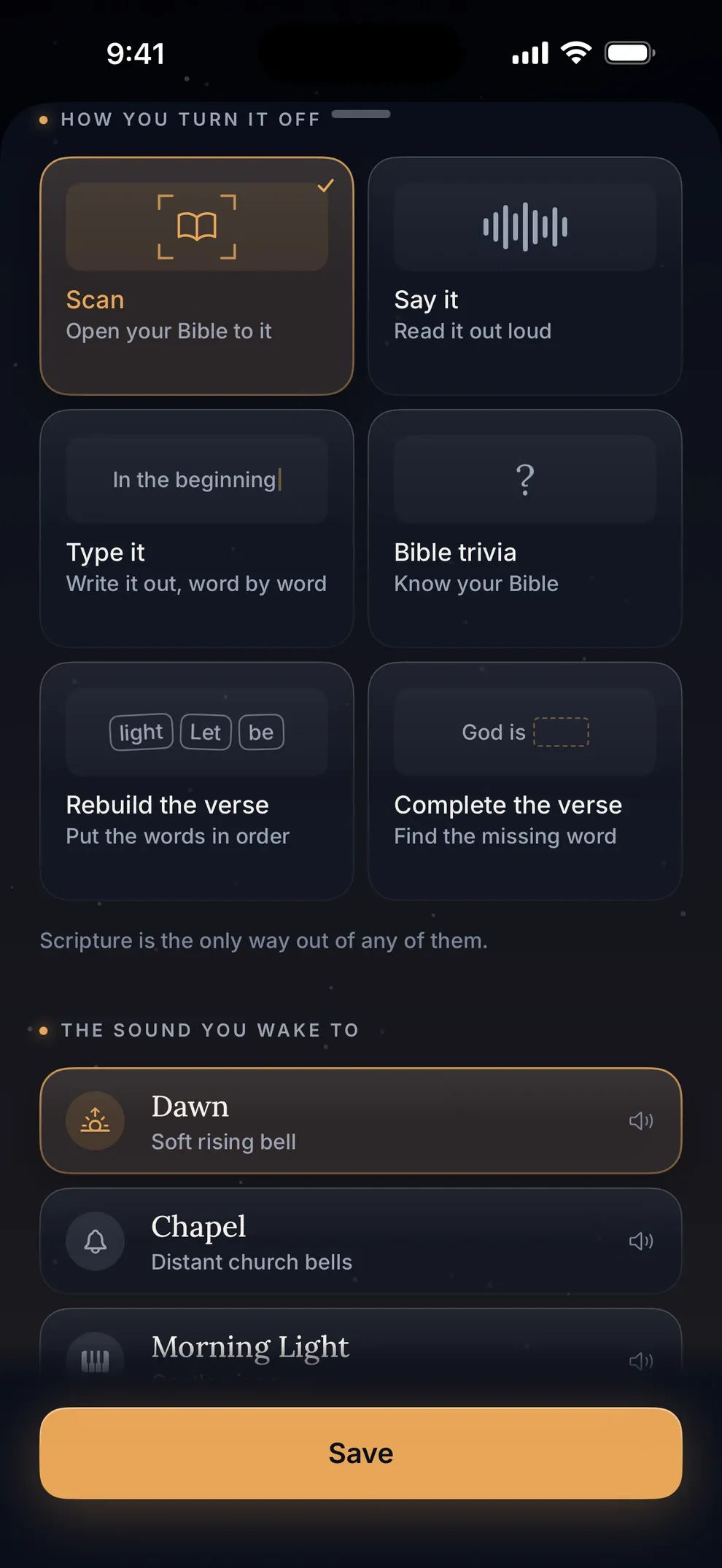
Frequently asked questions
Which Bible alarm method is best for a shared bedroom?
A quiet method such as Type it, Rebuild the verse, or Complete the verse may fit better than Say it. Test the method in the actual room, keep the screen brightness comfortable, and choose the option you can use without disturbing your roommate.
Does a Bible alarm replace reading the Bible?
No. A Bible alarm can create a first step connected to Scripture, but it does not replace reading a passage in context, prayer, a physical Bible, church community, or wise pastoral care. Use the alarm as a cue, then stay with the text.
Can I change my Bible alarm method later?
Yes. Your schedule, room, and energy change. Rehearse a different method during the day, then switch when it better fits your morning. A small, repeatable cue is more useful than forcing a method that creates daily frustration.
Sources and fact checks
- 01Psalm 119:105 — Bible Gateway — Supports the image of God's word as guidance for a next step.
- 02Psalm 1:1–3 — Bible Gateway — Supports a steady pattern of delighting in and meditating on Scripture.
- 03James 1:22–25 — Bible Gateway — Supports moving from hearing the word to putting it into practice.
- 04Mark 1:35 — Bible Gateway — Supports describing Jesus withdrawing early to pray without prescribing one required schedule.
- 052 Timothy 3:16–17 — Bible Gateway — Supports the article's explanation of Scripture as useful for teaching, correction, and training.
- 06Koum privacy and data handling — Supports the first-party description of scan, speech recognition, and device-side handling.