Bible reading
Is It Better to Read the Bible in the Morning or at Night?
Quick answer
Neither morning nor night is a universal test of faithfulness. Morning can protect your first attention, while night may offer the quietest space after responsibilities are done. Choose the time when you can read, pray, and respond with some regularity without sacrificing sleep or resenting your responsibilities. A small, repeatable practice is better than an ideal schedule you cannot keep.
There is no single biblical clock time
If you are asking whether it is better to read the Bible in the morning or at night, choose the time when you can return to God with attention and some regularity. Morning places Scripture before the noise of the day for many people. Night can be just as wise when work, family, health, or your natural rhythm makes the evening your quietest space. The goal is not to win a contest against the clock. The goal is to meet God in his word and let that meeting shape how you live.
The Bible gives meaningful examples of morning prayer, but it does not give every believer one required appointment. Mark 1:35 shows Jesus praying very early, and Psalm 5:3 describes bringing a voice and requests to God in the morning. Those passages can encourage a morning practice without turning a particular wake-up time into a test of spiritual maturity. A faithful habit helps you attend to Scripture, pray honestly, and respond with obedience instead of filling you with shame before the day begins.
Why morning can be a wise choice
Morning can give Scripture the first deliberate attention of the day. Before messages, errands, meetings, and other people’s needs take over, a short passage can establish a direction for your mind. Psalm 5:3 pictures morning prayer as bringing requests before God and waiting expectantly. That is not a promise that every morning will feel peaceful. It is a picture of beginning with dependence rather than reacting to everything that arrives.
Jesus’ early prayer in Mark 1:35 shows the value of creating a protected place. The important detail is not simply that the sun had not risen; he went somewhere solitary and prayed. For you, that may be a chair, a kitchen corner, a quiet commute, or a few minutes after the children leave. Morning is useful when it creates a boundary around attention. It is not useful when you steal sleep, ignore your body, or resent the people who share your home.
Why night can also be a faithful choice
Nighttime Bible reading can offer a different kind of attention. The urgent tasks may be finished, the house may be quieter, and the day’s experiences may give you honest questions to bring to Scripture. You might read a psalm after work, revisit a Gospel scene before bed, or sit with one sentence that helps you release the day. The point is not to make nighttime impressive. It is to give God a real portion of your attention when you are able to receive it.
Psalm 1 describes meditating on God’s law day and night. Luke 5:16 likewise says that Jesus withdrew to pray; it emphasizes making space, not a universal schedule. These passages resist a false choice in which morning readers are faithful and night readers are second-best. Night reading does require wisdom: if you are too tired to understand, shorten the plan, move it earlier, or try the morning for a week. A sustainable practice serves love better than a punishing one.
Choose the time that fits your real life
Compare the conditions around each option. When are you least interrupted? When can you read without borrowing time from sleep? When can you pray without immediately switching into another responsibility? When is your mind alert enough to notice what the passage says? These questions are practical, but they are also spiritual because they help you tell the truth about your limits and responsibilities.
Consider work, children, caregiving, health, and household rhythms. Someone who works nights may call the first hour after waking “morning” even if the clock says two in the afternoon. The habit is about the beginning of your day and your available attention, not about performing a culturally approved sunrise routine. Make the smallest honest promise: one passage, one question, and one prayer for seven days. If the schedule keeps failing, move the practice. You are protecting the purpose, not changing the subject.
A simple morning plan
If morning seems right, prepare before bed. Choose the book and passage, put the Bible where you will see it, and decide how long you will read. Try ten minutes: two minutes to become quiet, five to read slowly, and three to pray or write one response. A short plan is easier to repeat and easier to expand later.
Read for understanding before searching for a feeling. Notice who is speaking, what is happening, and what the passage asks you to trust or do. Write one sentence in your own words, then pray from that sentence. Carry one phrase or action into the day: patience in a difficult conversation, honesty, forgiveness, or remembering God’s presence during a commute. The morning has done its work when Scripture continues beyond the checklist.
A simple evening plan
If night fits better, give the practice a clear beginning and ending. Put your phone away, choose a modest passage, and set a stopping point that protects sleep. Spend fifteen minutes with a Psalm or Gospel paragraph, then ask: What did I notice? What does this invite me to trust? What do I need to place in God’s hands before I sleep?
Evening reading can help you review the day without turning the Bible into a self-criticism tool. Bring gratitude, regret, anger, and unanswered questions into prayer. If your evening is unpredictable, use “after dinner” or “before I plug in my phone” instead of an exact minute. Keep a shorter version ready for hard days: read five verses, say one honest prayer, and return tomorrow.
Where a Bible alarm can help—and where it cannot
A Bible alarm can help when the main problem is remembering to begin. Koum is an iPhone app built around a Scripture-first wake-up: its alarm can ask you to open, scan, speak, or type a Bible verse before the alarm ends, and the surrounding experience makes room for prayer, devotional reading, and private reflection. The app is a cue and a structure; it is not the source of your desire to know God.
For a morning routine, that structure can reduce the distance between waking and opening Scripture. You can choose the passage and test the task while awake, then use the alarm as a prompt. Koum also includes alarms, Selah pauses, and Watch hours across the day, so you can think about a whole rhythm rather than treating one moment as the entirety of spiritual life. If nighttime is your best reading time, a normal reminder, paper bookmark, or open Bible may be enough. Never let a tool replace sleep, a backup for an important appointment, or honest flexibility.
A seven-day way to decide
Run a simple experiment instead of trying to settle the question forever. Read at the same approximate time for four days, then try the other window for three days. Keep the passage length similar. After each session, record only three things: Did I show up? Could I pay attention? Did the reading lead to prayer or a concrete response? You are looking for a faithful pattern, not a perfect mood.
At the end of the week, choose the window with the clearest combination of presence and repeatability. If both work, keep morning as an anchor and night as a second opportunity. If neither works, make the passage shorter or place it beside an existing habit. The best time is the one that helps you receive Scripture, speak honestly with God, and live what you have read. Morning can be a beautiful beginning; night can be a gentle return.
Put this into practice with Koum.
Koum asks you to open, scan, speak, or type a Bible verse before the alarm ends. Then it gives the morning room for prayer, a devotional, and a private reflection.
Get Koum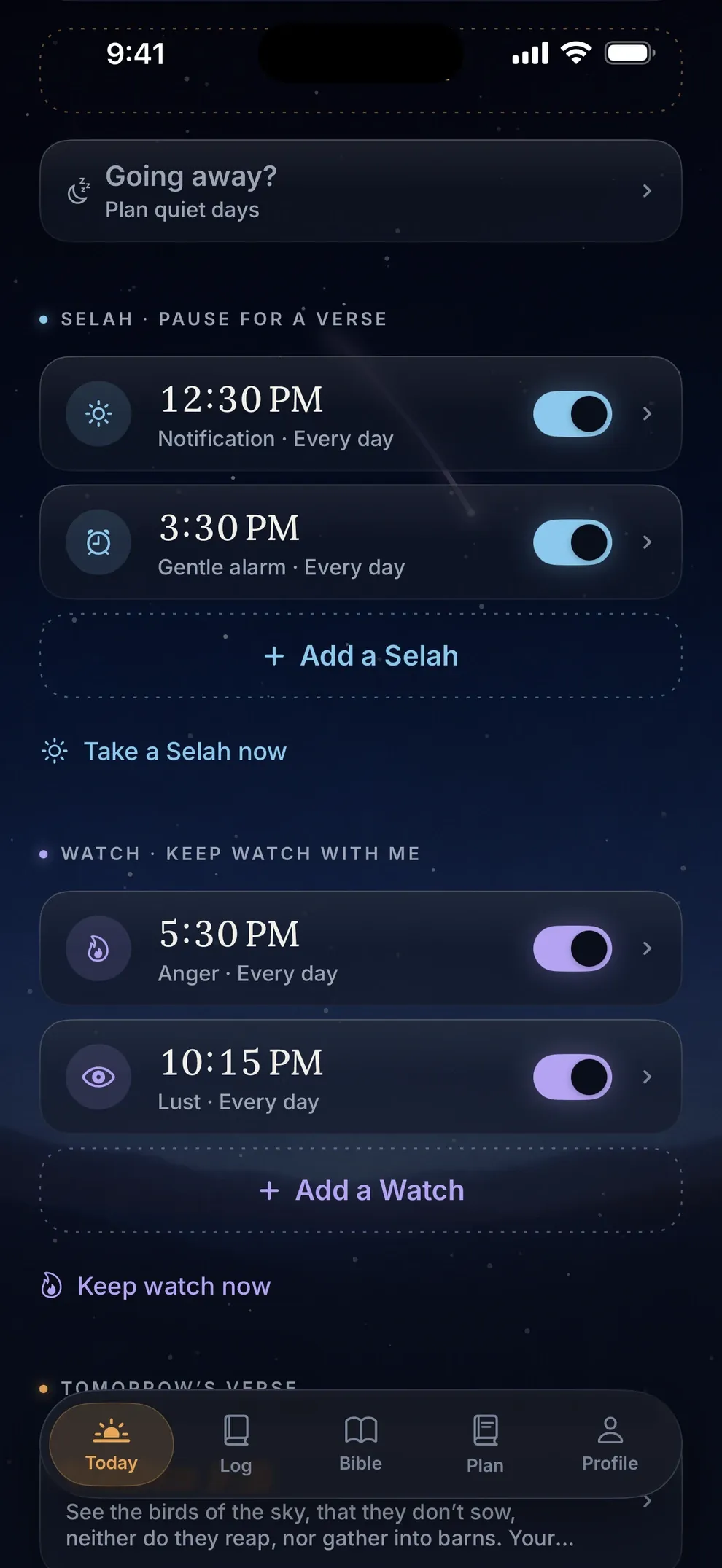
Frequently asked questions
Is it better to read the Bible in the morning than at night?
Not for everyone. Morning may help you give Scripture your first deliberate attention, while night may be more realistic and peaceful for someone whose mornings are full. Choose the window in which you can return regularly, stay awake enough to understand the passage, and respond in prayer. The Bible gives examples of morning prayer and of meditating day and night, not a universal clock rule.
What should I do if I keep missing my morning Bible reading?
Treat the missed mornings as information, not a spiritual verdict. Shorten the reading, prepare the passage the night before, move it to a calmer part of the day, or try a seven-day evening experiment. Keep a small version ready for hard days: a few verses, one observation, and one honest prayer. The purpose is to meet God in Scripture, not to protect an ideal schedule.
Can a Bible alarm help me read at night?
A Bible alarm is most naturally suited to a Scripture-first wake-up. For nighttime reading, a normal reminder, a bookmark, or an alarm on your existing phone may be enough. If you use Koum for your morning, test its verse task while awake and keep a backup for important appointments. Let the tool support your practice without replacing sleep, prayer, or judgment.
Sources and fact checks
- 01Mark 1:35 — Supports the biblical example of Jesus praying early in a solitary place, without making early morning a universal command.
- 02Psalm 5:3 — Supports bringing requests to God in the morning and waiting expectantly.
- 03Psalm 63:1 — Supports the psalmist’s image of earnestly seeking God, including the KJV morning wording.
- 04Psalm 1:1–3 — Supports meditating on God’s law day and night rather than treating one hour as the only faithful option.
- 05Luke 5:16 — Supports Jesus withdrawing to pray at a time that served communion with God, without a stated clock rule.
- 061 Thessalonians 5:17 — Supports a life of ongoing prayer rather than limiting prayer to a single daily slot.