Morning Bible reading
Should You Read the Bible Before Checking Your Phone in the Morning?
2026-09-18
Quick answer
If your phone is the alarm, you do not need to pretend it is not there. The helpful question is what you do next. When possible, move from the alarm to a short Bible passage before messages, news, or social feeds. That order can give your first attention to God without making the practice a test of spiritual worth. If work, caregiving, safety, or accessibility requires your phone first, use it for that purpose and return to Scripture when you can.
Start with the honest answer
Yes, reading the Bible before checking your phone can be a wise morning practice. It is not a command that makes you more accepted by God, and it is not a contest for people who wake up unusually focused. The simpler purpose is to give yourself a deliberate space to hear Scripture and answer God before other voices begin directing your attention.
Your phone may be your alarm, your Bible app, your way to reach a sleeping child, or the tool you need for work. So “before my phone” does not have to mean “before I touch the device.” It can mean “before I hand my attention to messages, headlines, and feeds.” That distinction makes the practice honest and sustainable.
Try this order tomorrow: silence the alarm, take one breath, read a short passage, answer with a sentence of prayer, and then check what needs your attention. Ten unhurried minutes are valuable, but one paragraph can also be a faithful beginning.
Why the first minutes matter
The Bible does not give everyone one correct morning schedule. It does show people bringing their first attention to God. Psalm 5:3 describes presenting requests in the morning and watching expectantly. Mark 1:35 shows Jesus rising while it was still dark to pray in a deserted place. These passages invite you to consider the direction of your attention; they do not pressure you to copy someone else’s clock.
Checking a phone can be a rapid change of subject. One notification can become a conversation, a news story, a work problem, or a comparison spiral before you have chosen what kind of morning you want. Research summarized by the American Psychological Association describes attention and stress costs associated with unmanaged notification systems. That does not prove every phone check is harmful, but it does explain why a quiet first action can be protective.
Starting with Scripture is therefore less about declaring the phone evil and more about refusing to let the loudest available voice choose your first thought. Matthew 6:33 calls Jesus’ followers to seek God’s kingdom first. In a morning routine, that can become a small embodied choice: Scripture before the stream of updates.
Choose a passage small enough to finish
Do not begin with a plan so ambitious that you need a perfect morning to keep it. Choose one psalm, a paragraph from a Gospel, or a short section you can read aloud. A small passage gives you room to notice a phrase instead of racing to complete a chapter. If you are new to morning Bible reading, Mark, Philippians, and the Psalms are approachable places to start.
Read once for the shape of the passage. Read again and remember one phrase. Then ask three plain questions: What does this show me about God? What does it reveal about the way I am living? What is one response I can carry into today? You are not trying to resolve every interpretation question before breakfast. You are practicing attention, understanding, and obedience in that order.
Psalm 1 describes the person who meditates on God’s instruction as someone who returns to it steadily. BibleProject’s overview of Psalms explains how the collection works as poetry and as a school of prayer. Let that shape your morning without turning a psalm into a charm: read carefully, pray honestly, and note what you need to revisit later.
Let the phone serve the routine
If your Bible is on paper, place it beside the bed and keep the phone far enough away that you must stand to reach it. If your Bible is on the phone, decide the exact app and passage before sleep. Turn on Do Not Disturb or a focus mode, open only the reading, and put the device face down when you finish. The goal is not a dramatic digital detox; it is fewer decisions between waking and reading.
A Scripture-first alarm can support that transition when you need a physical cue. Koum lets you prepare a morning reading and choose an alarm experience that asks you to engage with the passage before it goes quiet. Its Daily Plan screen brings the next reading and morning alarm into one preparation step. That feature can support a habit, but it cannot create desire or replace prayer. You still bring the attention and honesty.
Do not make notifications the reward for finishing. You do not have to rush through Scripture to reach your inbox. Let the reading have its own ending: a prayer, a written sentence, or a moment of silence. Then check the phone with a clearer sense of what matters, including messages that genuinely need a response.
When the phone really must come first
There are mornings when checking the phone first is responsible. You may be on call, caring for someone, waiting for an urgent message, navigating a health need, or coordinating transportation. A faithful practice has room for real love and real duties. Check the necessary information, handle the need, and set a later cue for Scripture. “First” can mean the first unhurried attention you offer, not an inflexible rule about the first object you touch.
The same is true when you wake anxious, exhausted, or distracted. Do not add shame to the difficulty. Put both feet on the floor, drink water, and read a single verse if that is all you can do. If you miss the morning, begin at the next available moment. Christian hope is not that you never fail at a routine; grace keeps inviting you back.
Try a seven-day experiment
For one week, do not promise yourself a flawless devotional life. Test one small sequence. Choose the passage at night, silence nonessential notifications, read for five minutes when the alarm ends, and write one sentence beginning “Today I want to remember…” Then decide when you will check messages. At the end of the week, ask what helped you stay present and what created friction. Adjust the routine instead of judging yourself.
On one day, read a psalm. On another, read a Gospel scene. On a third, return to the paragraph you did not understand. The point is continuity, not novelty. If a passage gives you a question, write it down and bring it to a trusted study resource or church community later. Morning reading is not meant to make you self-sufficient; it is meant to make you more attentive to God and more ready to love your neighbor.
You can end by praying Philippians 4:8 as a filter for the day: notice what is true, honorable, just, pure, lovely, commendable, excellent, and worthy of praise. The verse is not a demand to ignore suffering. It is a way of choosing what deserves sustained attention after you have opened Scripture.
The goal is a first response, not a perfect streak
Read the Bible before checking your phone when that order helps you receive the morning with intention. Do not turn it into a badge, superstition, or measure of whether God is pleased with you. If the phone has to come first, use it faithfully and return to Scripture. If you can begin with a passage, let it speak before the day starts shouting. Over time, the practice can become less about winning a battle with your device and more about remembering whom you are seeking.
Put this into practice with Koum.
Koum asks you to open, scan, speak, or type a Bible verse before the alarm ends. Then it gives the morning room for prayer, a devotional, and a private reflection.
Get Koum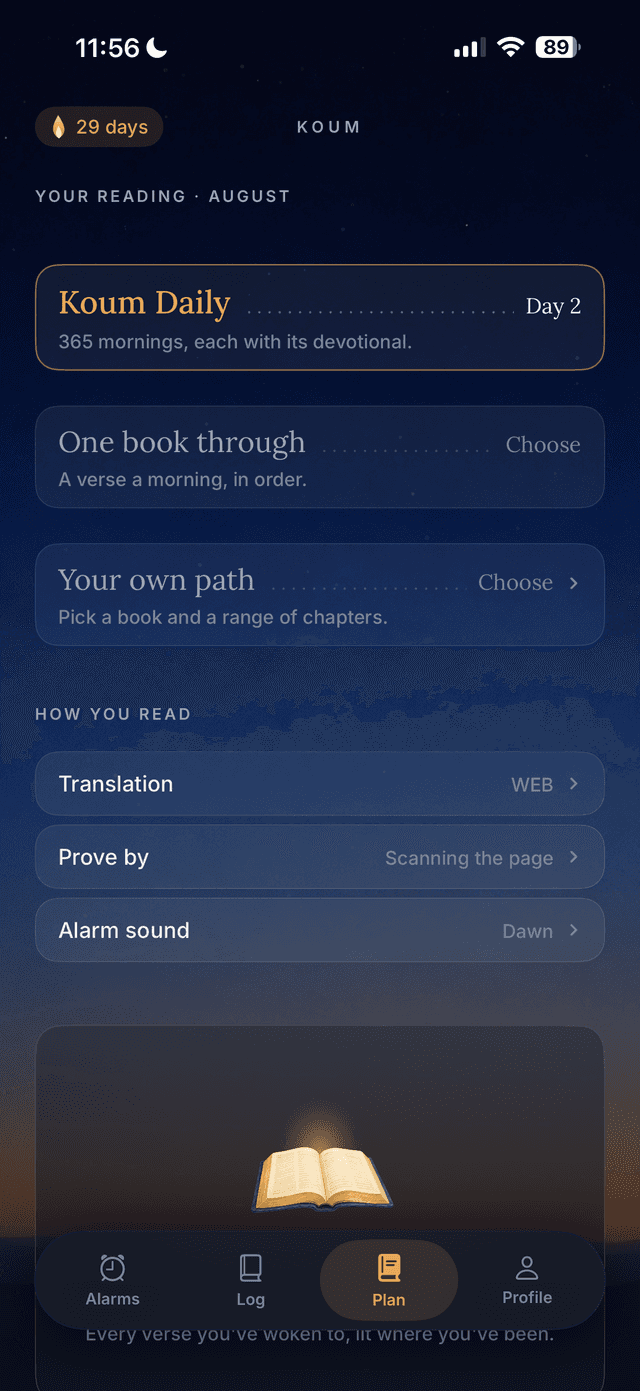
Frequently asked questions
Is it wrong to check your phone before reading the Bible?
No. The Bible does not give a rule that touching a phone before Scripture is sinful. If the phone is needed for an urgent responsibility, use it. The practice is about directing your attention toward God, not earning approval through a perfect sequence.
How long should I read the Bible before checking my phone?
Start with five to ten minutes or one short passage. Finish something small enough to complete with care, then increase the time only if it helps you understand and respond rather than rush.
What if my Bible is on my phone?
Prepare the passage before bed, silence nonessential notifications, open only the Bible app, and read before opening messages or social media. The goal is Scripture before distraction, not paper before a screen.
Sources and fact checks
- Mark 1:35 — Jesus prays early in the morning: Supports the biblical example of making room for prayer before the day’s demands.
- Matthew 6:33 — Seek first God’s kingdom: Supports the spiritual framing of first attention and priorities.
- Psalm 5:3 — Morning prayer and expectation: Supports morning prayer and bringing requests to God.
- Philippians 4:8 — A pattern for sustained attention: Supports the closing reflection on choosing worthy attention.
- BibleProject: Book of Psalms: Provides background on Psalms as poetry and prayer.
- American Psychological Association: Technology and Mind & Society: Supports the cautious explanation of notification-related attention and stress costs.