Bible reading
What Time Should You Set a Bible Alarm for Morning Scripture Reading?
Quick answer
Set a Bible alarm for the earliest time you can consistently be awake, rested enough to pay attention, and free from the next immediate demand. For many people, that means 10 to 30 minutes before the first fixed obligation—not necessarily before sunrise. Start with a short passage and adjust after practicing the time for a week.
Set a Bible alarm for the earliest time you can consistently be awake, rested enough to pay attention, and free from the next immediate demand. For many people, that means 10 to 30 minutes before the first fixed obligation of the day, not necessarily before sunrise. Begin with a short reading window—about 10 or 15 minutes—and move the alarm only after you have practiced the time for a week. The right hour is the one that makes Scripture a repeatable first direction, not another promise you cannot keep.
The Bible does not give every Christian one required clock time for Bible reading. Mark 1:35 describes Jesus praying early while it was still dark, and Psalm 5:3 describes bringing requests to God in the morning. Those passages give us a pattern of seeking God early, but they do not turn 5:00 a.m. into a measure of faithfulness. Your alarm should serve a real life of sleep, work, family, and worship.
Let Scripture shape the purpose, not the pressure
A morning alarm is useful when it helps you arrive before the day becomes noisy. It becomes unhelpful when the time itself becomes a spiritual scoreboard. Psalm 143:8 asks to hear God’s loving kindness in the morning and to know the way to walk. That is a prayer for relationship and direction, not a demand to imitate someone else’s schedule.
So start by naming what you want the alarm to protect. Do you want five quiet minutes before the children wake up? A passage before commuting? A prayer before opening work messages? A slower beginning on days off? A clear purpose helps you choose a time and a passage without treating the alarm as the source of your devotion. The clock is a servant; attention to God is the aim.
Use three tests to choose your alarm time
First, test sleep. Do not move your wake-up time earlier unless you can still get the sleep your body needs. A Bible habit that depends on chronic exhaustion will eventually turn Scripture into a source of guilt. If you are already tired, keep the reading time later in the morning or attach it to the first stable pause after waking. Faithfulness can include receiving the rest you need.
Second, test margin. Give yourself enough space to wake, drink water, use the bathroom, and become present. If the alarm rings at the exact minute you must leave the house, the routine has no room for an honest response. A 15-minute reading plan may need a 25-minute appointment. If you have only five minutes, choose one short passage and one sentence of prayer rather than pretending you have a full hour.
Third, test repeatability. Choose the time you can keep on ordinary weekdays, not the ideal time you manage once a month. A parent may need a different alarm on school days and weekends. A shift worker may need a “morning” that begins in the afternoon. A student may read before a first lecture rather than at dawn. Consistency means returning to Scripture in the rhythm God has actually given you.
Build a simple Scripture-first window
Once you choose the hour, give the alarm a small, concrete plan. In the first two minutes, wake up and open the selected passage without browsing for something new. Spend the next five to ten minutes reading slowly enough to notice repeated words, a command, a promise, or a question. Finish with one or two minutes of prayer: thank God for what you saw, ask for help with what challenged you, and name one response you can carry into the day.
The plan can be shorter or longer, but it should be visible before the alarm rings. Decide the passage the night before, keep a paper Bible or reading location ready, and put the alarm where you can hear it without making the entire room chaotic. The less negotiating you do at the moment you wake, the more energy you have for the text itself.
Koum can serve as the cue in this window. Its current Today screen shows the day’s Morning, Selah, and Watch rhythm together with the next alarm. That kind of cue is helpful when you want the alarm to point somewhere specific: open Scripture, read, pray, and begin. It is not a replacement for reading or prayer, and the app does not make an inconvenient time wise. Use the tool to support the practice you have chosen.
Adjust the time for the season you are actually in
A good Bible alarm time is allowed to change. During a demanding work season, a 6:30 alarm may be unrealistic while a 7:15 reading after breakfast is sustainable. With a newborn, the best window may be a quiet pause after the first feeding rather than a fixed morning promise. When traveling, preserve the sequence—wake, Scripture, prayer—even if the clock and location change.
Night-shift workers can define morning by the beginning of their waking day. Someone who sleeps from 8:00 a.m. to 4:00 p.m. does not need to force a sunrise devotional to be faithful. Set the alarm for a time when you are awake enough to listen. If your schedule changes daily, create a small rule such as “within 30 minutes of waking” and use the first stable opportunity rather than chasing a perfect hour.
Review the alarm after seven mornings
After a week, ask three questions. Did I sleep enough? Did the time give me real attention or only panic? Did the reading lead to one faithful response? If the answer is no, adjust the time before judging yourself. Move it later, shorten the passage, add margin, or choose a quieter day-specific plan. A small change that makes the practice livable is better than an impressive schedule that disappears.
Also notice what happens after the reading. Second Timothy 3:16–17 describes Scripture as useful for teaching, correction, and training, while James 1:22–25 warns against hearing without doing. The goal of the alarm is therefore not merely to produce a checked box. It is to help you receive the Word and respond with patience, honesty, courage, forgiveness, or obedience in the next part of the day.
If you want a starting point, set tomorrow’s alarm for 15 minutes before the first non-negotiable part of your day, provided that time protects adequate sleep. Read a short passage, pray one honest sentence, and write one response. Keep that time for seven mornings. Then let the results—not shame and not someone else’s schedule—tell you what to change.
Put this into practice with Koum.
Koum asks you to open, scan, speak, or type a Bible verse before the alarm ends. Then it gives the morning room for prayer, a devotional, and a private reflection.
Get Koum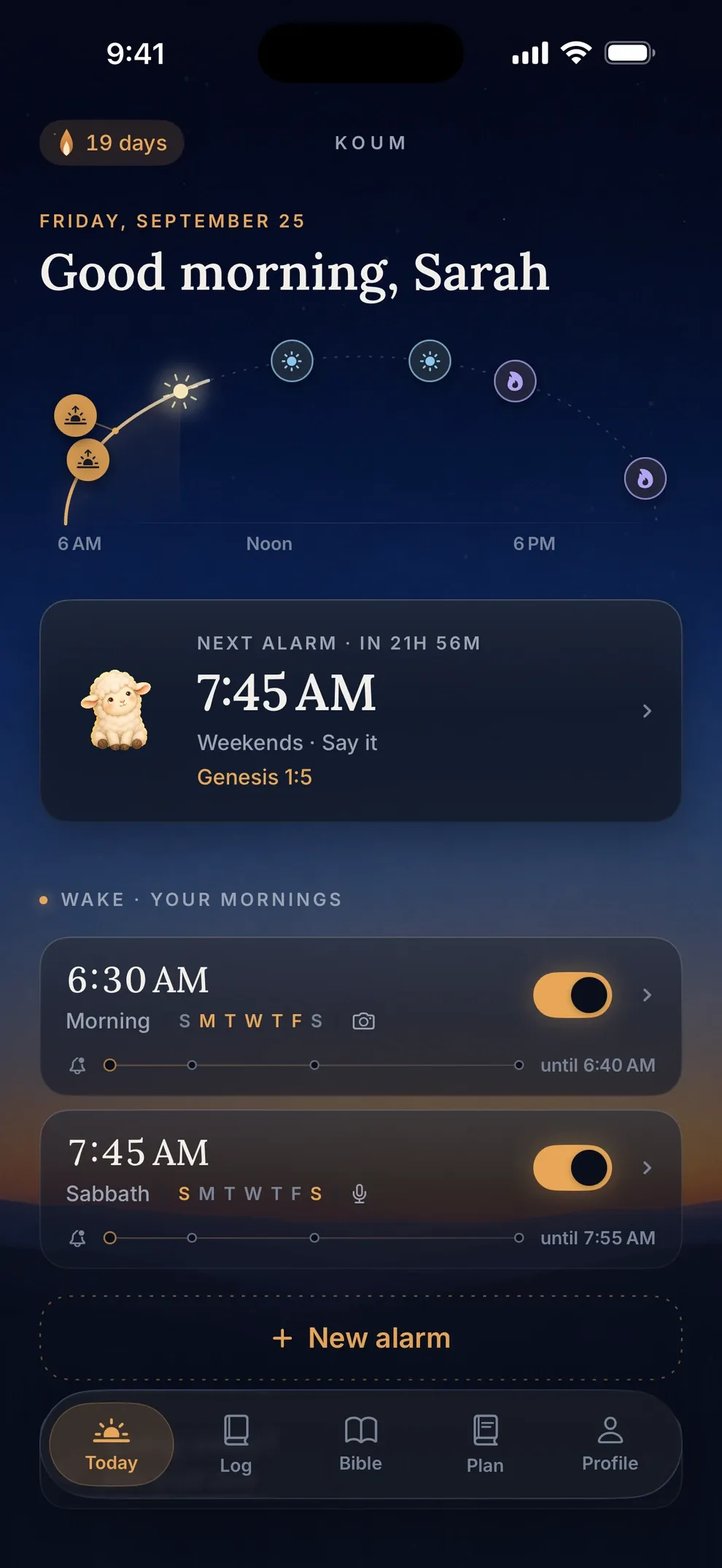
Frequently asked questions
Is there a biblically correct time to set a Bible alarm?
No single clock time is required for every Christian. Mark 1:35 and Psalm 5:3 show the value of seeking God in the morning, but choose a time that protects adequate sleep and gives you real attention for Scripture and prayer.
How early should I set a Bible alarm before work?
Start with 10 to 30 minutes before your first fixed obligation, with extra margin for waking up and getting ready. If that creates exhaustion or panic, move the alarm later or attach reading to the first stable pause after waking.
Can a Bible alarm work if my schedule changes?
Yes. Shift workers, parents, and students can define morning by the start of their waking day or use a rule such as reading within 30 minutes of waking. Preserve the sequence of Scripture and prayer even when the clock changes.
Sources and fact checks
- 01Mark 1:35 — Bible Gateway — Supports Jesus making early space for prayer without prescribing one universal clock time.
- 02Psalm 5:3 — Bible Gateway — Supports bringing requests to God in the morning and waiting with expectation.
- 03Psalm 143:8 — Bible Gateway — Supports asking to hear God’s loving kindness in the morning and asking for direction.
- 042 Timothy 3:16–17 — Bible Gateway — Supports Scripture’s role in teaching, correction, and preparation for faithful action.
- 05James 1:22–25 — Bible Gateway — Supports responding to Scripture with practice rather than only hearing it.
- 06Koum — Christian Bible Alarm — First-party source for Koum’s Scripture-first alarm and Christian morning product context.