Bible reading
How Long Should You Read the Bible in the Morning?
2026-09-21
Quick answer
There is no universal number of minutes for morning Bible reading. Start with five focused minutes if your schedule is tight, or choose fifteen or thirty minutes when you can read in context and respond without rushing. The faithful length is the one you can repeat honestly and carry into the day as prayer, understanding, and action.
Start with the honest answer
There is no single Christian number of minutes that makes a morning Bible reading time faithful. For many people, five focused minutes is a better beginning than a rushed promise of an hour. For others, fifteen or thirty minutes gives enough room to read a passage in context and pray. The right length is the one that helps you receive Scripture attentively and carry a response into the day.
Think of time as a container, not a score. A longer session is not automatically a deeper one, and a short session is not automatically careless. Ask two questions: Can I understand what I am reading, and can I respond without hurrying? If the answer is yes, you have enough time for today.
The Bible gives direction, not a stopwatch
Several biblical scenes point toward morning prayer and Scripture-shaped attention, but they do not prescribe a universal schedule. Mark 1:35 describes Jesus rising early to pray. Psalm 5:3 gives language for bringing a voice to God in the morning and waiting expectantly. These passages offer direction for a relationship, not a requirement to copy someone else’s alarm time or quiet-time length.
That distinction matters when a morning is crowded by work, caregiving, health needs, school, or a night shift. You can honor the invitation to seek God without treating the clock as a test of spiritual worth. Start where your actual life is, then make the practice as repeatable as possible.
Choose a window you can repeat
Pick a time that exists on ordinary mornings, not only on your best days. If you usually have seven quiet minutes before the children wake up, plan for seven. If your schedule changes daily, choose an anchor instead: after coffee, before leaving the bedroom, or immediately after the alarm. A reliable cue often serves a habit better than an ambitious duration.
Prepare one small decision the night before. Choose the passage, put a paper Bible within reach, or open the reading plan you intend to use. Fewer choices in the first minutes of the day make it easier to begin without reaching for whatever notification is loudest.
Match the time to the passage
Your reading length should fit the kind of reading you are doing. A short Psalm can be read twice, noticed line by line, and answered in prayer in five or ten minutes. A Gospel scene may deserve fifteen minutes because you need to read the surrounding paragraphs to understand who is speaking and what is happening. A longer study can wait for a later block when your mind and schedule can support it.
Do not measure a morning by chapter count. Reading one paragraph carefully can be more formative than racing through several chapters while thinking about the next task. If a passage raises a question, write it down and keep moving; you can return to it with a commentary, a trusted teacher, or your church community later.
A useful rule is to stop when attention turns into performance. If you are skipping sentences just to finish a target, the target is now competing with the purpose of reading. Close with a sentence of prayer and let the unfinished portion become tomorrow’s starting point.
Try a five-minute morning
Five minutes is enough for a real beginning. Spend the first minute becoming present: put both feet on the floor, take a breath, and ask God for attention. Read a short passage for two minutes. Use the final two minutes to name one truth you noticed and one response you want to practice. This is not a miniature version of a “real” devotional; it is a complete rhythm at a small scale.
A five-minute pattern is especially useful when you are rebuilding after missed mornings. It lowers the emotional cost of starting and gives you evidence that returning is possible. If you have more time, continue. If you do not, you have still opened Scripture and answered it honestly.
Try a fifteen-minute morning
Fifteen minutes gives you room for context and a slower response. Read the passage once without stopping, then read it again while marking a repeated word, a movement, a command, or a promise. Spend three minutes praying from what you saw. End by writing one sentence that begins, “Today I will remember…” or “Today I will practice…”.
This length works well for a Gospel paragraph, a Psalm, or a short section of a Bible reading plan. It also leaves room to notice when your first impression was incomplete. Scripture is not a set of inspirational fragments; context protects you from making one sentence carry more than the passage is saying.
Try a thirty-minute morning
Thirty minutes can support reading, observation, prayer, and a little study, but it still needs a boundary. Spend ten minutes reading the passage in context, five minutes noting what you do not understand, ten minutes praying and connecting the text to your life, and five minutes choosing a faithful next step. If study expands beyond the time, record the question instead of letting research swallow the whole morning.
A longer session should make you more available to God and neighbor, not more impressed with your own discipline. If thirty minutes is sustainable only when you sleep poorly or neglect a responsibility, it is not the right daily length. You can reserve longer study for a weekly block and keep the morning practice simple.
Let the morning change without abandoning the practice
A good routine has a smaller version. Decide in advance what you will do when you wake late: read one paragraph, pray one sentence, or listen to the passage while getting ready. If you are caring for someone, respond to that person first. If you work nights, your “morning” may begin in the afternoon. The point is not a particular sunrise; it is a deliberate return to God’s word and presence.
When you miss a day, do not spend the next morning paying a shame tax. Resume with the next passage or repeat the one you missed. A missed session is information about your schedule, not a verdict about your faith. Adjust the length, the cue, or the preparation, then begin again.
Let reading become a response
The purpose of time in Scripture is not to accumulate a streak or a folder of notes. Second Timothy 3:16–17 describes Scripture as useful for teaching, correction, and training for good work. James 1:22 warns against hearing without doing. A morning reading is therefore complete when it helps you see truly and take one faithful step, even if that step is small.
Your response might be an apology, a boundary, a conversation, an act of service, or a decision to wait before speaking. Keep it concrete enough to recognize at lunch. “Be more loving” is hard to practice; “listen without interrupting during the first conversation” gives the morning a direction.
Use an alarm as a cue, not a demand
If waking up is the main obstacle, attach Bible reading to an existing cue. Put the passage beside the bed, set a gentle alarm, or prepare the reading before you sleep. Koum’s Daily plan brings the day’s reading and alarm preferences into one preparation screen, which can help you decide what you will read before the morning begins. The app can support a cue; it cannot choose your attention or replace prayer.
Aim for a transition you can repeat: wake, sit up, read, respond, then move into the day. You do not need to make the alarm dramatic or turn the practice into a test. The quieter the first step feels, the more likely it is to remain available when life is loud.
Run a seven-day experiment
For the next seven mornings, try one length instead of changing the target every day. Choose five, fifteen, or thirty minutes based on your real schedule. Record only three things: whether you began, what kind of passage you read, and one response you carried forward. At the end of the week, ask whether the time helped you understand, pray, and act. If not, change the container rather than blaming yourself.
The best morning Bible reading time is not the longest one you can survive once. It is the length that makes Scripture a trustworthy meeting place: long enough for attention, short enough for honesty, and flexible enough for love of the people and responsibilities already in front of you.
Put this into practice with Koum.
Koum asks you to open, scan, speak, or type a Bible verse before the alarm ends. Then it gives the morning room for prayer, a devotional, and a private reflection.
Get Koum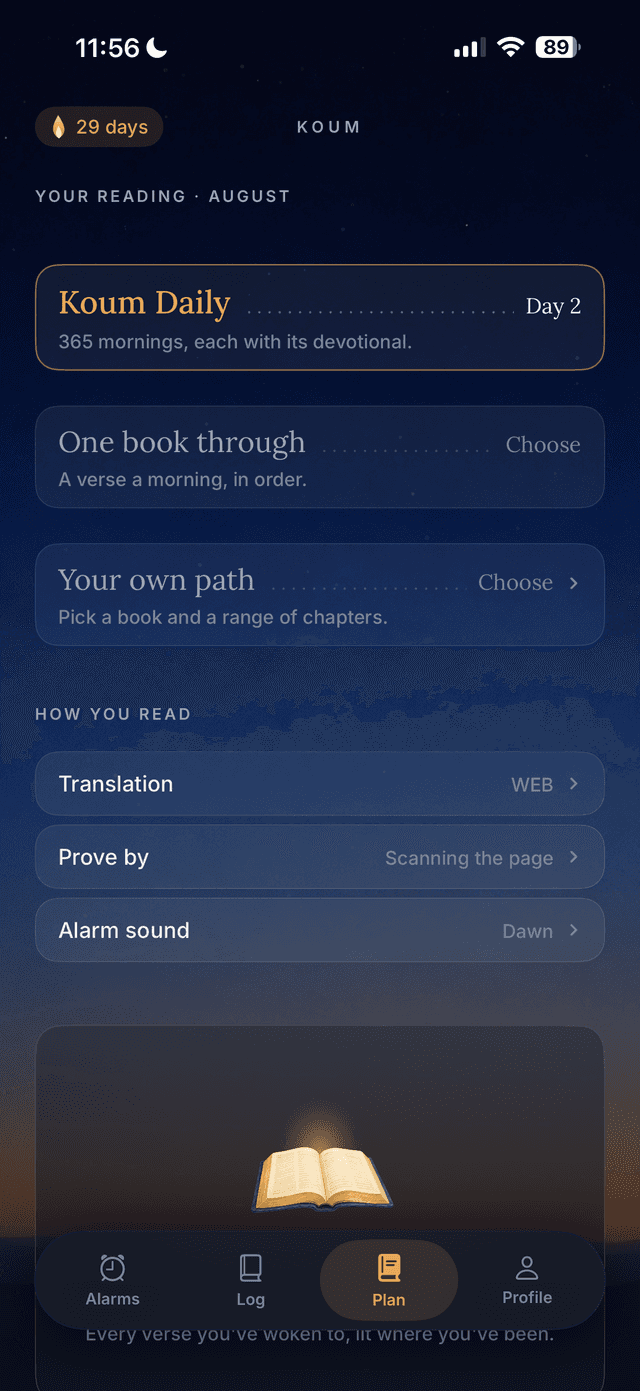
Frequently asked questions
Is five minutes enough for morning Bible reading?
Yes. Five attentive minutes can include a short passage, one observation, and a brief prayer. A small practice you can repeat is more useful than a long plan that regularly makes you quit.
Should I read a whole chapter every morning?
Not necessarily. Read enough to understand the passage in context. Sometimes that is a paragraph or a Psalm; sometimes it is a chapter. Careful attention matters more than a fixed chapter count.
What should I do if I miss my planned reading time?
Use the next available moment without adding shame. Read one paragraph, pray one sentence, or resume the next day. Adjust the length or cue if your plan repeatedly does not fit your real schedule.
Sources and fact checks
- Mark 1:35 — Jesus prays early in the morning: Supports the example of Jesus making space for prayer before the day’s demands.
- Psalm 5:3 — Morning prayer and expectation: Supports bringing a morning voice and prayer to God while waiting with intention.
- 2 Timothy 3:16–17 — Scripture equips God’s people: Supports reading Scripture for formation, correction, and preparation for faithful work.
- James 1:22 — Be doers of the word: Supports ending Bible reading with a concrete response rather than collecting information.
- Deuteronomy 6:6–7 — Keep God’s words near throughout the day: Supports carrying Scripture beyond a single quiet-time slot into ordinary life.