Bible reading
What to Do When You Don’t Understand a Bible Passage in the Morning
2026-09-16
Quick answer
When a Bible passage is hard to understand in the morning, do not force a private meaning or abandon the reading. Read the surrounding context, identify what is actually unclear, pray for wisdom, consult a trustworthy guide or mature Christian, and write down one truth you can carry into the day. Understanding often grows through patient returning, not a rushed answer.
Begin by naming what you do not understand
A difficult passage does not mean you are failing at Bible reading. Sometimes the sentence is unfamiliar, the situation is ancient, or the writer is using poetry, prophecy, a story, or an argument that takes time to follow. Start by being precise. Is the problem a word, a background detail, the connection between two paragraphs, or the way the passage applies to your life? A specific question is easier to carry than the vague feeling that the whole Bible is closed.
Write the question in one sentence. You might write, “I do not understand who is speaking,” “I am not sure what this command means here,” or “I can see the words, but I do not know how the conclusion follows.” This small act keeps confusion from becoming shame. You are not required to pretend that a familiar verse is clear simply because other people quote it often. Then read the passage once more without trying to solve everything. Notice what you can say with confidence: who is present, what happens first, what changes, and which words repeat. Understanding begins with receiving the text as it is, not filling its silence with whatever idea you brought to the chair.
Read the paragraph before the isolated verse
Many morning misunderstandings begin when a single sentence is pulled away from the conversation around it. Before searching for a quotation or a quick explanation, read the paragraph before and after the verse. If the passage is a story, read the whole scene. If it is a letter, locate the argument. If it is a psalm, notice the movement from complaint to trust, request to praise, or fear to hope. The surrounding words may answer the first question you thought required a specialist.
Pay attention to ordinary details: who is speaking, who is listening, what problem has been raised, and what response is expected. Do not assume every line is a direct instruction to you in the same way. A command, a proverb, a lament, a promise, and a description each work differently. Dei Verbum encourages readers to consider literary forms and historical circumstances. Choose a small section you can read in context rather than chasing a large number of chapters. Ten careful verses can be more useful than a page of disconnected highlights. If you still do not understand, keep the reference and the question; you have refused to make the text say less or more than you can support.
Ask questions that let the text speak
Questions are not a sign of unbelief. They are a way to slow down enough to listen. Ask what the passage says before asking how it makes you feel. What does the writer emphasize? What contrast appears? Is there a reason given? What does the next sentence add? If a person acts, what does the narrative actually tell you about the result? Keep your first observations close to the words in front of you.
Then ask one theological question and one practical question. The theological question might be, “What does this show about God, people, sin, mercy, wisdom, or hope?” The practical question might be, “What response does this passage invite, correct, or caution me toward today?” Do not demand a dramatic application. Luke 24:45 describes Jesus helping his disciples understand the Scriptures, while Acts 8:30–31 shows a reader openly asking for guidance. The goal is to become a reader who observes carefully, receives correction, and remains willing to learn.
Pray for wisdom without forcing an answer
A short prayer can keep a hard passage from becoming a purely technical problem. Ask God to help you see what is true, to guard you from careless assumptions, and to give you patience for what needs more study. Psalm 119:18 gives language for this posture: asking for eyes to see the wonders in God’s instruction. James 1:5 also directs people who lack wisdom to ask God. Prayer is not a shortcut around reading; it is a way of reading with humility.
Prayer does not mean every uncertainty will disappear before breakfast. Do not force a “personal message” from an unclear line, and do not treat the first thought that appears as automatically authoritative. A good question can remain a good question. Write it down, thank God for what is clear, and return after you have slept, studied, or spoken with someone wise. You can pray the passage back in simple words: if it speaks about fear, ask for courage; if it exposes pride, ask for a willing heart; if it gives comfort, receive it without manufacturing a new insight.
Use trustworthy help and patient study
When the question matters, use more than one kind of help. Compare a reliable translation, read an introduction to the biblical book, check cross-references, or consult a commentary that explains its method and sources. Ask a pastor, teacher, or mature Christian who is willing to say, “I am not sure,” rather than someone who turns every verse into a confident slogan. The aim is not to collect opinions; it is to hear the passage more accurately.
Dei Verbum describes interpretation as a careful search for what the sacred writers intended, with attention to language, literary form, historical setting, and the unity of Scripture. You do not have to complete that task in a fifteen-minute morning. Mark the question and choose a later study window if it needs attention. Be careful with answers that depend on a single English word, an isolated promise, or a claim that no faithful reader could ever disagree. Healthy help makes the text clearer and invites further reading.
Carry one clear truth into the day
You do not need to leave every morning with a complete interpretation. Leave with one honest sentence that the passage supports. It might be, “God is not absent from this lament,” “Jesus notices the person everyone else overlooks,” or “I need to listen before I answer.” Include the reference so the sentence stays attached to the text instead of becoming a free-floating inspirational thought.
Turn that sentence into a small response before the day becomes crowded. Send the apology you have delayed, pause before correcting someone, ask for counsel, or return to prayer at lunch. The action does not prove that you understood everything; it is a modest way to let what is clear begin to shape your life. Second Timothy 3:16–17 presents Scripture as useful for teaching, correction, and training in right living. If you finish with more humility and one faithful next step, the reading has already done meaningful work.
Put the morning into practice with Koum
Koum can support the transition from waking to opening Scripture, but it cannot interpret a passage for you. Its Bible alarm can ask you to open, scan, speak, or type a verse before the alarm ends. That creates a concrete first step: the Bible is in front of you before the day’s notifications take over. Once the alarm is quiet, you can read the surrounding context and write down the question that needs more time.
After the Scripture-first step, Koum leaves room for prayer, a devotional, and private reflection. The devotional-reading screen can help you pause with a passage and a reflection prompt; treat it as a companion to Scripture, not a replacement for context or wise study. Prepare the reference the night before, open it in the morning, notice what is clear, name what is not, pray for wisdom, and choose one response. Koum may shorten the distance between the alarm and the text; patient reading, trusted community, and continued return help understanding grow.
Put this into practice with Koum.
Koum asks you to open, scan, speak, or type a Bible verse before the alarm ends. Then it gives the morning room for prayer, a devotional, and a private reflection.
Get Koum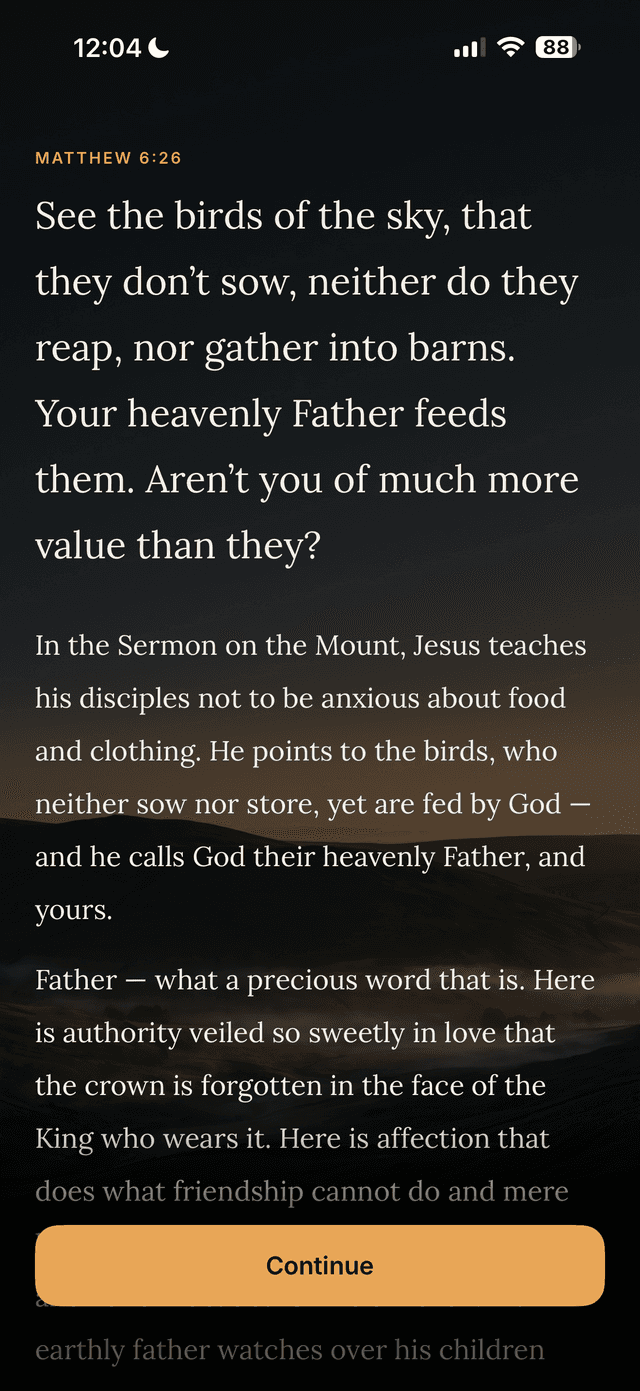
Frequently asked questions
What should I do first when a Bible passage is confusing?
Read the paragraph before and after it, then name the exact question. Identify who is speaking, what situation is being addressed, and what the surrounding sentences emphasize. Do not begin by forcing a personal message from one isolated verse.
Is it wrong to leave a morning Bible question unanswered?
No. Write down what is unclear, pray for wisdom, and return later with a reliable study resource or a trusted Christian. Patiently carrying a question is better than inventing certainty or giving up on the passage.
Can Koum explain a difficult Bible passage for me?
No. Koum can help you open Scripture before distractions and then make room for prayer, a devotional, and private reflection. Interpretation still requires reading the context, studying carefully, and seeking wise help when needed.
Sources and fact checks
- Dei Verbum — Vatican: Guidance to read Scripture with attention to literary form, context, the unity of Scripture, and prayer.
- Verbum Domini — Vatican: Prayerful reading and lectio divina as a way to encounter Christ and let Scripture shape life.
- Luke 24:45 — Bible Gateway: Jesus opens the disciples’ minds to understand the Scriptures.
- Acts 8:30–31 — Bible Gateway: The Ethiopian official welcomes help when he asks how he can understand what he is reading.
- James 1:5 — Bible Gateway: James directs people who lack wisdom to ask God, who gives generously.
- Psalm 119:18 — Bible Gateway: The psalmist prays for eyes to see the wondrous things in God’s instruction.
- 2 Timothy 3:16–17 — Bible Gateway: Scripture is described as useful for teaching, correction, and training in right living.