Bible reading
How to Read a Gospel in the Morning: A Simple Plan for Beginners
Quick answer
To read a Gospel in the morning, choose one book and read a short, connected section rather than collecting isolated verses. Begin with a few quiet minutes, notice what the passage says about Jesus and the people around him, respond in prayer, and write one question or faithful action for the day. A simple plan you can return to is better than a demanding schedule you cannot keep.
Start with one Gospel, not an impossible plan
If you want to read a Gospel in the morning, begin with one book and a small enough section that you can read it with attention. You do not need to finish a Gospel in a week, understand every historical detail before you begin, or wake at a heroic hour. Choose a realistic time in the first part of your waking day, open the text, and let the account of Jesus set the direction of the morning. The point is not to win a Bible-reading challenge. It is to meet Scripture honestly and make room to respond.
For many beginners, Mark is a helpful place to start because its account moves quickly through the actions, teaching, compassion, conflict, death, and resurrection of Jesus. A BibleProject overview describes Mark as a carefully designed story in three broad movements, with a repeated focus on who Jesus is and how people respond to him. That kind of shape gives you something to look for as you read. You are not opening a bag of disconnected sayings; you are following a story.
Try this first-week rhythm: read Mark 1:1–20 on the first morning, then continue with a section that can be read in one sitting each day. If a section is long, stop at a natural scene break. If you have only five minutes, read a paragraph and keep your place. The plan should create continuity, not anxiety. You can always read more when you have more attention.
Prepare the night before so the morning begins clearly
Morning reading is easier when the first decision has already been made. Before bed, choose the book, mark the next section, and place your Bible or reading device where you will use it. Decide what enough means for tomorrow: perhaps one scene, ten minutes, and one written sentence. This removes the vague question What should I read? that can turn a willing reader into a tired browser of reading plans.
Protect sleep while you prepare. Reading the Bible before the day begins does not require treating rest as an enemy. If your alarm would leave you consistently exhausted, move the reading to the first calm part of your waking period or shorten the section. Parents, caregivers, students, and shift workers may have different mornings. Faithfulness is not measured by copying someone else’s clock.
If your phone is also your Bible, make the path simple: open the passage before opening messages, news, or social feeds. If notifications regularly take the morning first, a Scripture-first alarm can provide a deliberate cue. Koum can ask you to open Scripture and verify a selected passage by scanning, speaking, or typing, then leave room for a devotional, prayer, and reflection. It is a reminder and a structure, not a replacement for the Bible or your church community.
Read the passage as a connected story
When you begin, read the whole section once without stopping to solve every question. Notice the setting, the people, the problem, and what changes. Ask who speaks and who acts. In a Gospel, watch how Jesus responds to interruption, suffering, misunderstanding, faith, opposition, and ordinary need. These observations keep you from lifting one attractive sentence out of the scene and making it say whatever the morning requires.
Read the surrounding paragraphs when a verse seems especially inspiring or difficult. A healing story includes more than the healing. A command sits within a conversation. A parable has a setting and listeners. A promise belongs to a speaker and a moment. Context does not make Scripture colder; it helps you receive the passage on its own terms before deciding how it meets your life.
Luke 24:27 gives a picture of Jesus explaining the Scriptures as a unified story that points toward him. You do not need to force a clever connection in every sentence. Instead, read with a patient question: what does this passage reveal about Jesus, his kingdom, his mercy, his authority, or the kind of life he calls people to receive? Let the text supply the emphasis.
Use four gentle questions after you read
After the first reading, pause for a second pass or reread the line that held your attention. Then use four questions. First, what is happening in this passage? Answer with a plain summary before offering an interpretation. Second, what does it show about Jesus or about the people who meet him? Third, what response does it invite from me today—trust, repentance, gratitude, courage, patience, service, or honest lament? Fourth, what question should I carry to a trusted teacher, pastor, study resource, or tomorrow’s reading?
These questions are deliberately modest. They help you listen without turning a morning devotional into an examination you can fail. Second Timothy 3:16–17 describes Scripture as useful for teaching, correction, and training for a life equipped for good work. That points beyond collecting information. The reading can shape how you speak, decide, forgive, work, rest, and love, but you do not need to manufacture a dramatic application every morning.
Write one or two sentences if writing helps you remember. You could record Jesus notices the person everyone else is rushing past, I am confused about why the disciples respond that way, or Today I will listen before defending myself. A question is a valid result. So is a quiet prayer with no polished insight. The practice is meant to make you attentive, not impressive.
Turn the reading into prayer without forcing emotion
Prayer can begin with the passage’s own emphasis. Thank God for something you saw. Admit where you resist it. Ask for help with one concrete situation. Pray for a person named in your day. If the scene contains mercy, ask to receive and offer mercy. If it contains a hard saying, ask for humility and wisdom. If you feel distracted, say so plainly rather than pretending to feel inspired.
A simple prayer might be: Jesus, help me receive what I read and live one honest response today. Give me patience with the person I will meet, and bring me back to your words tomorrow. The prayer does not need to become a performance or a second essay. Scripture gives you material for speaking with God, and God is not grading the elegance of your sentences.
The Gospel can also correct the way you measure a morning. You may finish a full scene and feel very little. You may read slowly because you are grieving. You may notice a practical instruction but no sudden peace. None of those experiences makes the reading worthless. A tree in Psalm 1 is pictured as rooted through steady meditation over time, not as a plant that proves its health through one spectacular day.
Choose one response to carry into the day
Before you close the Bible, name one response small enough to practice. I will apologize before lunch. I will ask one curious question instead of assuming. I will receive today’s work as a place to serve. I will rest rather than use exhaustion as proof that I am devoted. The action should grow out of the passage, but it does not need to be grand. A faithful response is usually specific enough to recognize when the opportunity appears.
Keep the response connected to love of God and neighbor rather than self-improvement alone. Reading about Jesus is not a way to build a more impressive religious identity. It is an invitation to trust him and participate in a life shaped by his teaching and compassion. If the passage raises a concern you cannot resolve, write it down and seek wise help instead of using a quick answer to silence it.
At the end of the week, review your notes. Do not only count how many mornings you completed. Notice which questions returned, which words you remembered in ordinary situations, and where your plan created unnecessary pressure. Continue in the same Gospel if it is serving you. Adjust the time or section size if it is not. A plan is a servant of attention.
What to do when you miss a morning
If you miss a morning, continue without turning the missed day into a verdict. Read the next meaningful section when you can, or return to the last scene for a shorter reread. Do not punish yourself with extra chapters or assume you must restart the entire book. Name the practical reason—sleep, illness, caregiving, distraction, or an unrealistic plan—and change one detail if it would help.
You can also use a three-level version of the plan: a full reading for an open morning, a short scene for a crowded morning, and a few verses with one prayer for a very tired morning. The subject remains Scripture while the amount of reading changes. This protects continuity without pretending every day has the same capacity.
Koum can help you set the next reading as a deliberate morning cue through its Daily Plan and Bible alarm flow. Choose the passage ahead of time, set a wake-up time that respects your responsibilities, and use the reading, devotional, prayer, or journal afterward as space to stay with what you opened. The app cannot give you faith, interpret every passage, or replace pastoral care. It can help make the first step visible.
Reading one Gospel in the morning is a long obedience made of ordinary returns. Open the next section. Read it in context. Notice Jesus. Pray honestly. Carry one response into the day. Then leave a clear place to begin again tomorrow.
Put this into practice with Koum.
Koum asks you to open, scan, speak, or type a Bible verse before the alarm ends. Then it gives the morning room for prayer, a devotional, and a private reflection.
Get Koum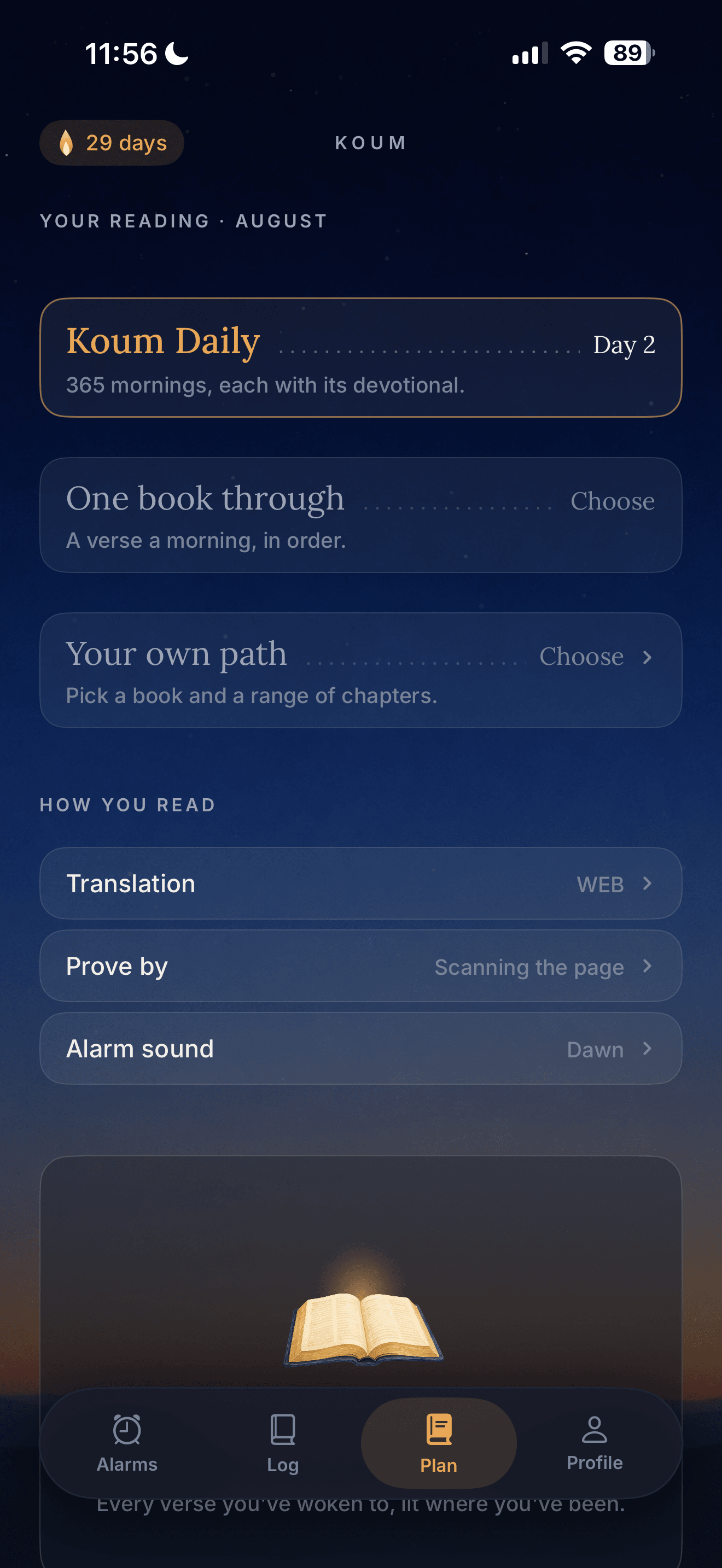
Frequently asked questions
Which Gospel should a beginner read first in the morning?
Mark is a practical starting point because it is a focused account of Jesus’ actions, teaching, compassion, conflict, death, and resurrection, and its narrative moves at a manageable pace. Matthew, Luke, and John are also good choices. The best first Gospel is one you can read with attention and continue returning to.
How much of a Gospel should I read each morning?
Read one connected scene or a section you can finish without rushing. Ten minutes may be enough, while a quiet morning may allow more. Keep a full, short, and very-tired version of the plan so the practice can bend without becoming random.
Can I read a Gospel on my phone in the morning?
Yes. Prepare the passage before bed and open it before messages or social feeds. A Scripture-first alarm such as Koum can cue the selected reading and then make room for prayer and reflection, but it does not replace a Bible, Christian community, or pastoral guidance.
Sources and fact checks
- 01BibleProject: Guide to the Gospel of Mark — Supports the overview of Mark’s structure, themes, and focus on Jesus and the responses of people who encounter him.
- 02Mark 1:1–20 (WEB) — Provides the opening of Mark’s Gospel and its introduction of Jesus, his message, and his call to follow.
- 03Luke 24:27 (WEB) — Supports reading Scripture as a connected story that Jesus explains in relation to himself.
- 042 Timothy 3:16–17 (WEB) — Supports Scripture’s formative purpose for teaching, correction, and a life equipped for good work.
- 05Psalm 1:1–3 (WEB) — Supports the patient, rooted picture of meditating on God’s instruction over time.