Bible reading
How to Stay Focused When Reading the Bible in the Morning
Quick answer
To stay focused when reading the Bible in the morning, choose a small passage the night before, remove your phone and other decisions, read twice, answer a few questions, and return gently whenever your mind wanders. End with one prayer and one practical response. A focused morning is built through faithful returning, not a perfect attention span.
Start with a smaller promise
A focused morning Bible reading does not begin by proving how disciplined you are. It begins with choosing a promise you can keep. Read one paragraph, one scene, or a short section you can actually attend to. If you have fifteen minutes, you do not have to fill all fifteen with chapters. Let the time shape the reading instead of turning it into a race.
Psalm 1 pictures a person who delights in God’s instruction and meditates on it day and night. Meditation is not the same as rushing through a large amount of text. It is staying with what you have received long enough for it to become familiar. A small passage read with care can give you more to carry than a long passage skimmed while your mind is already at work.
Choose ten to fifteen verses or one Gospel scene. Read it once to notice what happens and again to notice what stands out. Stop before the desire to “finish enough” takes over. Your aim is not to complete a performance; it is to meet the text honestly and give it enough space to speak.
Remove the morning decisions tonight
Distraction often enters before the Bible is open. In the morning you may be deciding what to read, where the book is, whether you have enough time, and whether you should check a message first. Make those decisions the night before. Put the Bible, a pen, and a small piece of paper where you will sit, and mark the passage in advance.
Choose one physical boundary for your first minutes. Keep your phone across the room, on airplane mode, or outside the room until reading is complete. The point is not that a phone is evil or that every Christian morning must look identical. The point is to make the first action obvious, so you spend less attention negotiating with yourself.
If you use Koum, its Daily Plan can hold the day’s reading and alarm preferences together, giving you another way to decide before you are tired. The tool supports the appointment; it does not replace the Bible. Keep the passage in front of you and let the app serve that simple intention.
Read for attention, not volume
Read at a pace that lets you hear the words, silently or aloud. If a sentence feels unclear, read the surrounding verses before searching for an answer. Ask what the passage actually says before asking what you want it to say. In a Gospel, notice who is present, what Jesus does, how people respond, and what changes by the end.
Luke 8:18 records Jesus saying to consider carefully how you listen. That does not give a stopwatch target; it gives a posture. You may slow down, reread, notice a word you would normally skip, or leave a question unanswered for the day. Focus is remaining present long enough to receive the passage accurately.
Try a two-pass rhythm. On the first pass, follow the movement without stopping at every detail. On the second, mark one repeated word, surprising action, question, promise, or command. If you underline everything, nothing has priority. One clear observation is enough to begin a faithful response.
Use four questions to give your mind somewhere to go
A wandering mind needs a gentle next step. After reading, answer four questions: What does this show me about God? What does it show me about people? Is there something to believe, resist, receive, or practice? What is one honest response I can make today? These questions are not a formula controlling the Bible; they are a rail keeping unrelated thoughts from replacing the passage.
You do not need a polished devotional paragraph. Write, “God is patient with the person I am tempted to dismiss,” or, “I need wisdom before answering that message.” Keep the sentence close to what you read. If the application could have been written without opening the Bible, return to the text and make it more specific.
Second Timothy 3:16–17 describes Scripture as useful for teaching, correction, and training. Your reading can therefore move beyond collecting information toward truth that forms how you see, speak, decide, and love. A focused morning is not only quiet; it is receptive and ready to change.
When you get distracted, return without shame
You will lose focus sometimes. The distraction may be a task, worry, memory, or notification you remembered but did not receive. Do not turn it into a verdict about your faith. Name it briefly, write one word on the paper if needed, and return to the last sentence you remember. You do not have to punish yourself by restarting from the beginning.
If the same thought keeps returning, ask whether it needs a concrete next step. Write “email Sam,” “buy groceries,” or “call the doctor,” then return to the passage. This does not promise the concern will disappear. It tells your mind that the concern has been acknowledged and does not need to interrupt you to be remembered.
Some mornings the right response is to read less. If a child needs you, work begins early, or your body is exhausted, take the next faithful step you can. One paragraph and a short prayer are not a failed longer quiet time. Grace does not depend on a perfect streak; a durable practice leaves room for real life.
End with one response you can carry
Close the Bible by turning attention into response. Pray one or two sentences using the passage’s language, asking for help with the specific obedience or trust it brought to light. Then choose one small action: apologize, tell the truth, encourage someone, refuse a familiar temptation, or make time to listen.
James 1:22 warns against becoming hearers who never put the word into practice. The action does not earn God’s favor; it gives the reading a place to live. If writing helps, keep a line with the date, reference, what you noticed, and what you are trusting God with today.
Koum’s prayer, devotional, and private reflection flow can support that next step after Scripture has been opened. You can take the time you need. A repeatable pattern is simple: prepare one passage, protect the first minutes, read twice, ask honest questions, return gently, and carry one response into the day.
Put this into practice with Koum.
Koum asks you to open, scan, speak, or type a Bible verse before the alarm ends. Then it gives the morning room for prayer, a devotional, and a private reflection.
Get Koum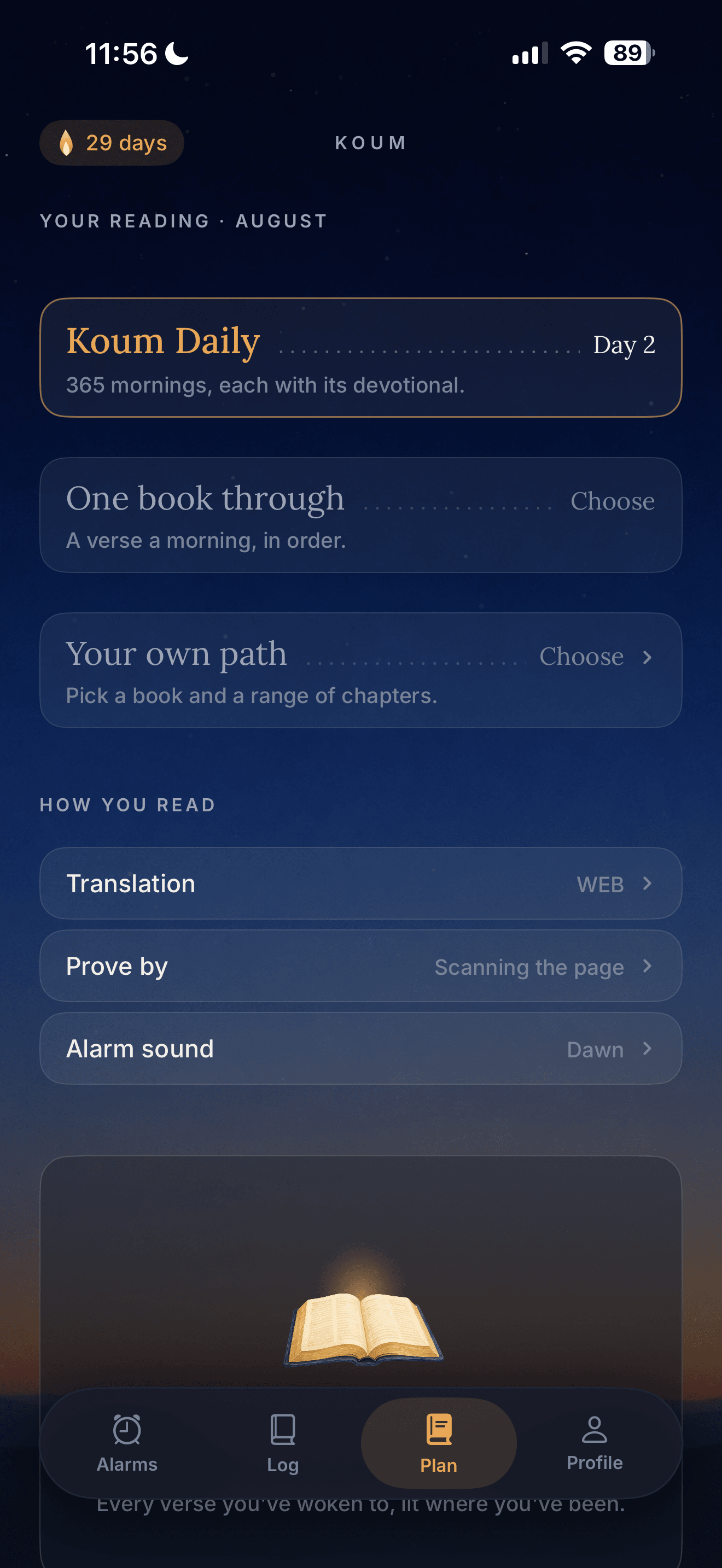
Frequently asked questions
How long should I read the Bible in the morning?
Choose a length you can repeat with attention. One paragraph or ten to fifteen verses is enough for many mornings. Read it twice, notice one clear truth, and respond in prayer rather than measuring the morning by chapter count.
What should I do when my mind will not stay focused?
Name the distraction, write a short reminder if it needs action, and return to the last sentence you remember. Shorten the passage or read aloud. Losing focus is a reason to return gently, not proof that your morning failed.
Can Koum help me stay focused on Bible reading?
Koum can make the first step concrete by placing a Bible reading in Daily Plan and asking you to open, scan, speak, or type a verse before the alarm ends. It then leaves room for prayer, a devotional, and private reflection.
Sources and fact checks
- 01Mark 1:35 — Bible Gateway — Jesus rises early and goes to a quiet place to pray.
- 02Luke 8:18 — Bible Gateway — Jesus tells his hearers to consider carefully how they listen.
- 03Psalm 1:1–3 — Bible Gateway — The psalm pictures delighting in and meditating on God’s instruction.
- 04James 1:22 — Bible Gateway — Hearing the word is joined to putting it into practice.
- 052 Timothy 3:16–17 — Bible Gateway — Scripture is useful for teaching, correction, and training.
- 06Mark — BibleProject — Background on Mark’s action-shaped account of Jesus.