Bible alarm setup
How to Schedule a Bible Alarm for Weekdays and Weekends
Quick answer
Schedule the alarm around the mornings you can genuinely protect, not an idealized version of your week. Give weekdays and weekends their own realistic times, choose a short passage, and leave enough room to pray after the alarm instead of treating the alarm as the whole devotion.
Why use different days for a Bible alarm?
A Bible alarm is meant to help a real morning begin with Scripture. Real mornings do not all begin the same way. A school day may require you to leave by 7:30. A workday may start earlier, while Saturday gives you room to read slowly. If one alarm is forced onto every day, it can become either too late for the busy days or unnecessarily early for the days when your household can rest.
That is why a weekday-and-weekend pattern can be more faithful than a single rigid time. The goal is not to prove that you wake at the same minute seven days in a row. The goal is to make opening Scripture an available first step in the mornings you have chosen. Deuteronomy 6:6–7 describes God’s words entering ordinary life, including getting up, but it does not give every household one identical timetable. Let the rhythm serve the practice.
Start by naming the mornings you actually want to keep. You might choose Monday through Friday because your commute makes the transition difficult. You might include Saturday and leave Sunday flexible because church, family, or travel changes that morning. You might choose every day but give the weekend alarm a later time. All of these can be thoughtful choices. An enabled alarm is not a spiritual grade, and a disabled day is not a failure.
Choose the rhythm before you choose the time
Before opening an alarm editor, ask three simple questions. What time must I be ready to leave or begin work? How much quiet can I realistically protect after I wake? Which days change enough that the same alarm would become annoying or unusable? Your answers will tell you whether you need one schedule, a weekday schedule and a weekend schedule, or a small number of separate alarms.
Give the alarm enough lead time for the part that matters after waking. If the only available window is ten minutes, choose one verse and a short prayer rather than planning a forty-minute study you will repeatedly postpone. If you have more room on Saturday, keep the first action familiar and let the reading grow afterward. A consistent opening is often easier to keep than a different elaborate plan for every day.
Do not set the time by copying someone else’s morning. Mark 6:35 gives a picture of Jesus praying early, but the passage is an example, not a command that every Christian must wake before dawn. Sleep, caregiving, health, work, and transportation all belong in the decision. A Scripture-first routine should make room for faithfulness, not encourage you to ignore the responsibilities that make your morning possible.
How to set up weekday and weekend alarms
First, choose the passage or reference you want to meet in the morning. Put the Bible where you can open it, and decide whether the first task will be scanning the page, saying the verse, typing it, or using another available method. Preparing this before bed turns the alarm into a clear invitation instead of a question you must solve while half awake.
Next, create the weekday pattern. Pick a time that leaves a modest buffer before work, school, or your first obligation. Select only the weekdays that belong to this pattern, then check the summary before saving. If your week includes a rotating shift or one regular day off, do not pretend it is a normal weekday. Give that day its own plan or leave it off until you know what will work.
Then create the weekend pattern. A later time may be appropriate, but keep it close enough to your normal rhythm that Saturday does not feel like a different life. Select Saturday, Sunday, or both according to your actual plan. A weekend alarm can use a different passage, a gentler first action, or more time for prayer, but it should still begin with something simple enough to do.
Finally, test the arrangement once while you are awake. Confirm the correct days, the on/off state, the reference, and the verification method. Koum’s support guidance also recommends checking alarm permission and keeping a backup when waking on time has serious consequences. An app can support the transition to Scripture; it should not be your only safeguard for a flight, exam, medication, or shift.
Build the Scripture-first part after the alarm
The alarm is the doorway, not the entire room. Once you have opened or verified the passage, take one minute to notice what it says before reaching for another app. You could ask: What does this show me about God? What does it reveal about my posture today? Is there one sentence I want to carry into work, school, or conversation?
Keep the weekday version small. Read a paragraph, pray in your own words, and write one line if you have time. On a weekend, continue into a longer passage or journal entry only after the first step is complete. This makes the two schedules different in length without making them different in purpose.
Use the passage as Scripture, not as a lucky phrase for the day. Psalm 90:14 is a prayer for God’s mercy in the morning, while Lamentations 3:22–23 points to renewed mercy each morning. You can let those themes shape your prayer without claiming that a particular alarm time guarantees a particular spiritual result. The point is attention: beginning with what you have received, asking for help, and responding honestly.
If you miss the weekday alarm, do not turn the next morning into punishment. Read the passage at the next available time, adjust the schedule if the pattern keeps failing, and let a fresh morning be fresh. A schedule is a servant of the practice. It is allowed to change when your responsibilities change.
Review the schedule when your week changes
A weekday-and-weekend plan is useful because it is adjustable. Review it when school starts, a work shift changes, daylight saving time changes your sleep, or a new caregiving responsibility arrives. Keep the questions practical: Did the alarm give me enough time? Was the selected day correct? Did the first task lead naturally into prayer and reading? Did the schedule wake someone else or make the routine harder to keep?
Change one variable at a time when possible. Move the time by fifteen minutes before changing the passage, the method, and the number of days all at once. If a scan is difficult in the dark, prepare better lighting or choose a different verification method. If the alarm is not helping you begin, remove days you cannot realistically protect and rebuild from the mornings that are working.
The best schedule is not the most impressive one. It is the one that places Scripture within reach and leaves you able to respond with attention. Let weekdays carry the structure your responsibilities require. Let weekends offer breathing room without abandoning the invitation. Then keep returning to the simple first step: wake, open the Word, and meet the morning honestly.
Put this into practice with Koum.
Koum asks you to open, scan, speak, or type a Bible verse before the alarm ends. Then it gives the morning room for prayer, a devotional, and a private reflection.
Get Koum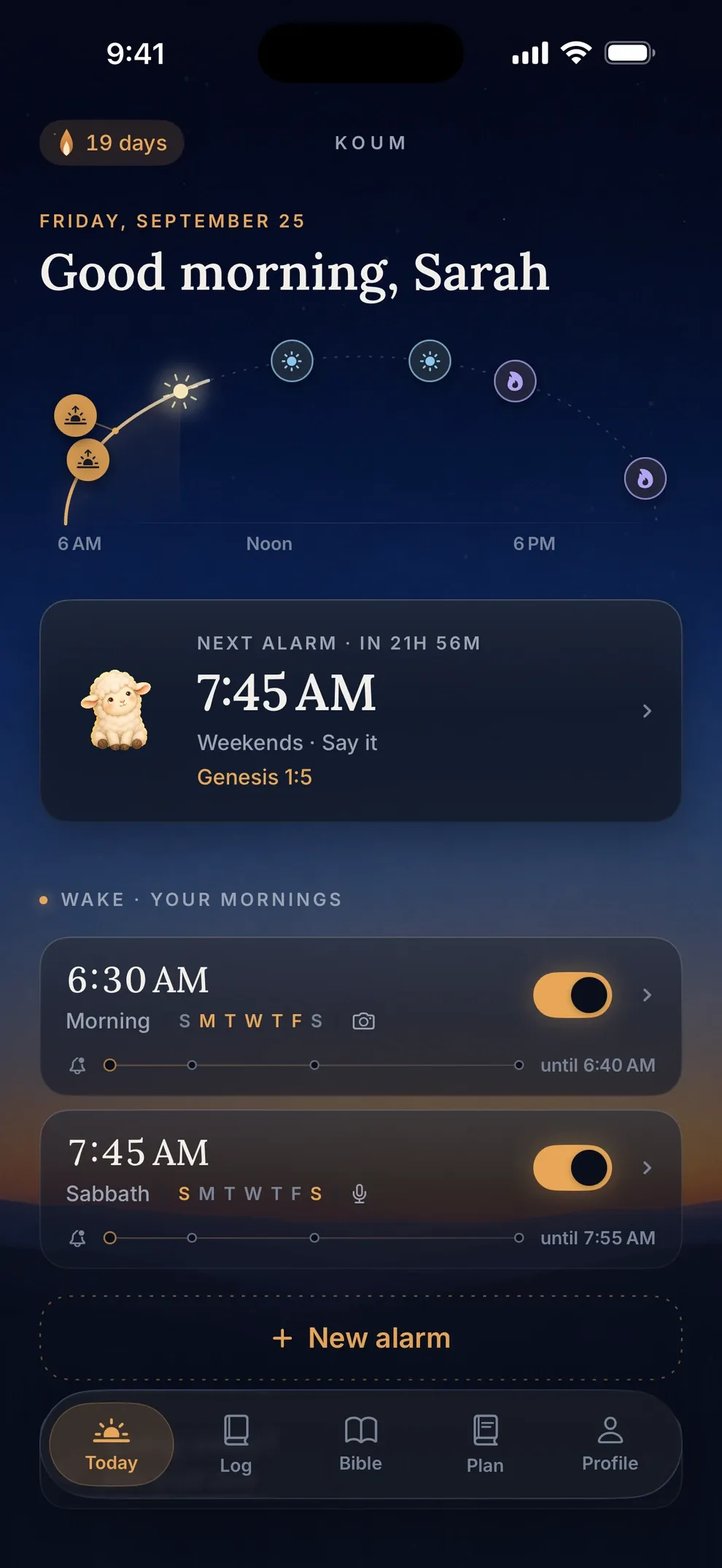
Frequently asked questions
Should my Bible alarm be set for every day?
No. Choose the days that fit your actual responsibilities and spiritual aim. You can use weekdays, weekends, every day, or separate patterns. A smaller schedule you can follow is more useful than an ambitious schedule that repeatedly frustrates you.
What if my weekend wake-up time is different?
Create a separate weekend pattern with a realistic later time, or leave a day flexible if family, church, or travel changes often. Keep the first Scripture action simple so the later start still opens into prayer and reading.
Can I use Koum as my only alarm?
Koum can support a Scripture-first wake-up routine, but its support guidance says to keep an appropriate backup for time-critical mornings. Check permissions, test the alarm, and use a second alarm when being late would have serious consequences.
Sources and fact checks
- 01Mark 1:35 — Bible Gateway — Supports the biblical example of seeking prayer in the morning without turning one time into a universal rule.
- 02Psalm 90:14 — Bible Gateway — Supports asking for God’s mercy in the morning and approaching the day with joy.
- 03Lamentations 3:22–23 — Bible Gateway — Supports treating each morning as a fresh opportunity rather than a test of perfect consistency.
- 04Deuteronomy 6:6–7 — Bible Gateway — Supports carrying God’s words into ordinary rhythms, including getting up, rather than restricting faith to one schedule.
- 05Koum Support: Alarms, Subscriptions, and Privacy Help — Verifies that Koum alarms can be enabled for selected days and documents the iPhone permission and backup-alarm limits.