Bible reading
How to Choose a Bible Passage for Morning Prayer
Quick answer
Start with the real need you are bringing to God, choose a short passage through a reliable reading path, read it in context, and let one observation shape a specific prayer and next step. The right passage is not the one that matches a perfect mood; it is the one you can receive honestly and carry faithfully.
Choose a Bible passage for morning prayer by starting with a real spiritual or practical need, then selecting a short passage you can read in context. A psalm can give you words for trust, praise, grief, or guidance; a Gospel scene can turn your attention toward Jesus; a letter can give you a truth to receive and practice. Read the surrounding verses, ask what the passage is actually saying, and let your prayer answer that text. You do not need a perfect verse for a perfect mood. You need a faithful place to begin.
Let the need name the kind of passage you need
Before opening a search result, name what is in front of you. Are you grateful, worried, tired, angry, confused, or facing a decision? This is not a reason to force the Bible to agree with your feelings. It is a way to choose a doorway into prayer without pretending that every morning is the same. A person carrying fear may begin with a passage about God’s presence or wisdom. A person who feels numb may begin with a psalm that gives language to longing. Someone preparing for a difficult conversation may read a passage about patience, truth, or love and ask how it should shape their conduct.
Psalm 143:8 is a useful example because it holds more than one request together: the worshiper asks to hear God’s steadfast love in the morning, confesses trust, and asks to know the way to walk. That makes it more than a decorative morning quote. It gives you three movements for prayer: receive love, name trust, and ask for direction. You can choose a passage because it meets your need, while still allowing the passage to correct and enlarge your need.
Write one sentence before you read: “Today I am bringing God…” Finish it with a fear, a person, a decision, a thank-you, or a question. Then choose Scripture that can address that sentence without promising an instant outcome. The goal is not to use the Bible as a prediction machine or a way to confirm every impulse. It is to arrive honestly and listen carefully.
Choose a reliable path instead of chasing the perfect verse
There are several good ways to choose a morning passage. You can continue reading the next section of a biblical book, follow a church or study-group plan, use a lectionary, return to a psalm, or select a passage connected to the question you are carrying. American Bible Society notes that people use all of these approaches and that the selection method should not consume the reading time. The best method is the one that helps you open Scripture consistently and read it attentively.
For a simple starting rhythm, keep three lists. The first is a book you are reading in order. The second is a small set of passages you return to in prayer. The third is a list of questions you want to study slowly. On a normal morning, use the first list. On a disrupted or emotionally heavy morning, use the second. When a passage raises a question, record it for the third instead of demanding that you solve it before breakfast.
Consider the kind of writing you are opening. A psalm uses poetry and prayer; a Gospel tells the story of Jesus; a letter addresses a community and develops an argument. BibleProject and American Bible Society both emphasize that literary form and context affect how a passage should be read. A line of poetry is not handled exactly like a command in a letter, and a story is not reduced to one character’s most memorable sentence. You do not need to become a scholar before praying. You do need enough patience to let the passage be itself.
Read the passage in its setting before you make it personal
Once you choose a passage, read it all the way through once without stopping. Then read it again with a few questions: Who is speaking? Who is being addressed? What happens before and after? What words, images, or contrasts repeat? What kind of writing is this? American Bible Society recommends these questions because they help the reader attend to the text instead of only hearing what they hoped it would say.
Keep the scope manageable. If you choose one verse, read the paragraph or psalm around it when you can. If you choose a story, read the whole scene rather than extracting the line that sounds most comforting. If the passage is difficult, write down the difficulty. Do not make a quick devotional application do the work of patient interpretation. Luke 24:27 presents Jesus explaining the Scriptures in relation to the larger story, a reminder that Christian reading has a wide horizon. A short morning practice can still respect that horizon.
You can use a notebook with two columns. In the first, write what you observe: repeated words, movement, people, setting, and the main request or claim. In the second, write your response: praise, confession, a question, or an action. Keeping those columns distinct helps you avoid turning your first reaction into the passage’s meaning. It also gives you a record to revisit with a pastor, study group, or trusted resource when you need help.
Turn the chosen passage into a prayer you can actually pray
After reading, let the passage provide the shape of your prayer. You might praise God for what it reveals, confess where you resist it, ask for help to trust it, and name one person or situation connected to it. James 1:5 invites people who lack wisdom to ask God, so a morning prayer from that verse might be specific: “Give me wisdom for the conversation I am avoiding, and make me willing to hear correction.” The prayer is not a technique for controlling the conversation. It is a way to bring the text into the real day.
Use a line from the passage as a beginning, not a substitute for honest words. If you read Psalm 143:8, you could pray for a renewed awareness of God’s love, admit where you are unsure of the next step, and ask for guidance about one decision. If you read a Gospel account of Jesus withdrawing to pray, you could ask what a small act of intentional quiet might look like in your circumstances. The answer may be five minutes, a walk without a podcast, or a boundary around notifications. It may also be impossible that day. Let the text guide you without turning it into another performance.
End with one faithful response that is small enough to remember. Send the apology. Listen before answering. Do the next task without rehearsing disaster. Encourage the person you prayed for. A morning passage has not failed because it did not produce a dramatic feeling. It can remain with you as a sentence that changes one ordinary choice.
Prepare tomorrow’s passage before the morning arrives
Selection is easier when it is not the first decision of a half-awake day. Before bed, mark the next section in your Bible, save the reference in a note, or write the passage on a card. Decide what counts as enough: perhaps one paragraph, three observations, and a two-sentence prayer. American Bible Society’s reading guidance encourages a realistic rhythm that people can sustain. A flexible plan is more useful than a demanding plan that makes you dread returning after one missed morning.
Put the Bible and your notebook where they are visible, and keep the phone from opening directly into a feed. If your schedule changes, move the practice to the next honest moment instead of treating the missed time as proof that you cannot grow. Jesus praying early in Mark 1:35 can encourage you without becoming a universal timetable. Parents, shift workers, caregivers, students, and people with disrupted sleep may need different mornings. Scripture-first does not mean sleep-blind.
Put this into practice with Koum
Koum can help you make the passage you selected the first deliberate interaction of the morning. Its Bible alarm asks you to open, scan, speak, or type a verse before the alarm ends, then leaves room for prayer, a short devotional, and private reflection. You can choose a passage from a reading plan or a verse you want to carry into the day. Koum does not interpret the Bible, replace a church or pastor, or turn a missed morning into a spiritual verdict. Use it as a cue to meet the text you already chose, and keep your Bible and wider community at the center.
The right morning passage is not the one that makes you sound wise. It is the one you can read honestly, understand with care, pray through, and carry into a faithful response. Choose a path, read beyond the isolated line, and return tomorrow. Over time, that steady attention will give your mornings a deeper shape than a search for the perfect verse.
Put this into practice with Koum.
Koum asks you to open, scan, speak, or type a Bible verse before the alarm ends. Then it gives the morning room for prayer, a devotional, and a private reflection.
Get Koum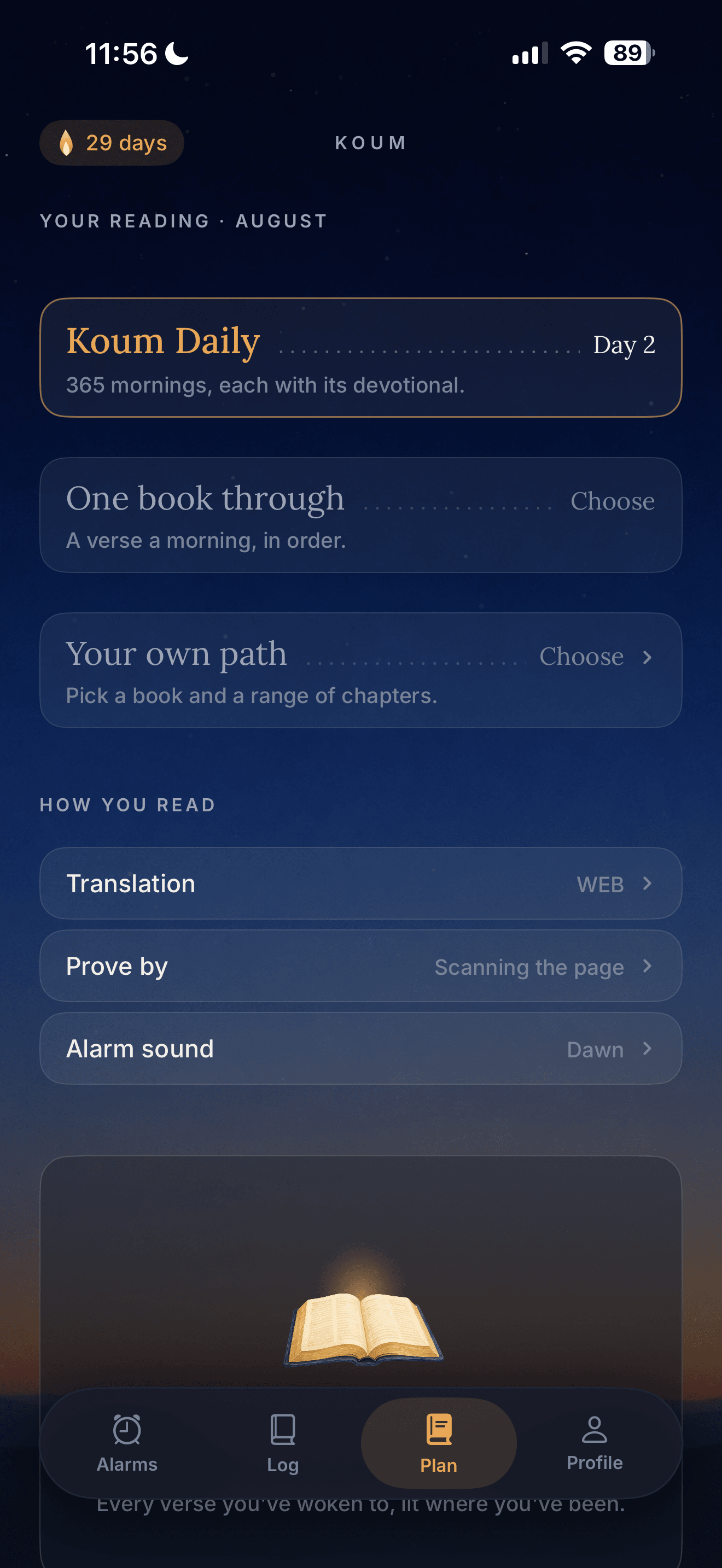
Frequently asked questions
How long should a morning prayer passage be?
Choose a passage small enough to read attentively, often a paragraph, psalm section, or Gospel scene. Read the surrounding context when possible. The goal is not to cover a set number of verses but to understand what you are reading and respond honestly.
Should I choose a Bible verse based on how I feel?
Your feelings can help you name where to begin, but they should not decide what the text means. Choose a passage that meets your real situation, then read it in context and allow it to challenge or enlarge your first reaction.
Can I use a Bible reading plan for morning prayer?
Yes. A plan, a book read in order, a church schedule, or a small list of prayer passages can all work. Use the path that reduces daily decision fatigue and helps you return to Scripture with attention. A missed day does not require starting over.
Sources and fact checks
- 01Psalm 143:8 (Bible Gateway) — Supports the morning prayer for love, trust, and guidance.
- 02Mark 1:35 (Bible Gateway) — Supports the Gospel account of Jesus praying early in a solitary place.
- 03James 1:5 (Bible Gateway) — Supports asking God for wisdom when choosing how to respond.
- 04Luke 24:27 (Bible Gateway) — Supports reading Scripture as a connected story rather than isolated sayings.
- 05How to Study a Bible Passage (American Bible Society) — Supports prayerful, repeated reading, genre, speaker, audience, and surrounding context.
- 06How to Read the Bible (BibleProject) — Supports attending to literary styles and the Bible's larger story.