Bible reading
How to Read the Bible When You Work Night Shifts
Quick answer
If you work nights, let your “morning” begin when you wake from your main sleep, not when the sun rises. Protect enough sleep first, then choose a short passage you can read in context, pray honestly, and carry into the shift ahead. Keep the same simple sequence when your schedule rotates, but change the clock time and length as needed. A Scripture-first alarm such as Koum can cue the reading after you wake; it should serve your real life, never pressure you to sacrifice rest.
If your workday begins after dark, your morning does not have to match the sunrise. Read the Bible after your main sleep, when you can pay attention, and build the practice around the shift you actually work. Protect rest first, choose a passage small enough to read in context, pray about the hours ahead, and let the routine flex when your rota changes. A faithful morning is measured by honest attention, not by an impressive clock time.
Let your morning be the moment you wake
If you work nights, your morning may begin at four in the afternoon. If you rotate between day and night shifts, it may move from one day to the next. That does not make your time with God less real. Define morning by the beginning of your awake period, not by sunrise or by somebody else’s devotional schedule. Mark 1:35 shows Jesus praying while it was still dark, but it does not turn one hour into a command for every Christian. Psalm 5:3 gives the wider pattern: bring your voice and requests to God at the beginning of the day and wait for him. Your beginning may happen after a protected block of daytime sleep. Start by identifying the first calm moment you can usually protect after your main sleep. It might be when you wake before a 7 p.m. shift, when you return home and have slept, or during a break on a long rotation if that is the only honest option. The important question is not, “Did I do this early enough?” It is, “Can I meet Scripture with enough alertness to listen?” A short, attentive reading is more faithful to your actual life than copying a routine that requires you to be exhausted. Give the practice a name that fits: first cup, first light, first quiet, or simply the start of my day.
Protect sleep before adding devotional ambition
Sleep is part of the foundation, not an obstacle to spiritual discipline. CDC guidance says most adults need at least seven hours, and NIOSH describes nonstandard schedules as a source of disrupted or shortened sleep. Fatigue can slow reaction time, reduce concentration, and affect judgment. A Bible-reading plan should never ask you to trade away the rest you need to drive safely, care for someone, or do your job well. Scripture-first does not mean sleep-blind. Build the reading window around the sleep you are actually trying to protect. A night worker may read after waking, before food and notifications take over, rather than staying awake longer after a shift. Someone on rotating shifts may keep the same sequence but change the clock time. Make the transition easier by preparing the passage before work, dimming distractions when you come home, and keeping the Bible or reading note visible for the next waking period. If sleep problems persist or you regularly feel unsafe from fatigue, talk with a qualified health professional; a devotional routine is not sleep treatment. Let rest remain a responsible part of receiving the day.
Choose a passage that fits your real attention
A night shift can leave you alert at an unusual hour but mentally crowded. Choose a passage small enough to read carefully rather than a large plan you will rush through. You might read one psalm, a paragraph from a Gospel, or the next section of a book you are following. Read it once to hear the movement, then once more with three questions: What is happening? What does this show about God and people? What response is being invited? These questions keep a verse from becoming a slogan detached from its setting. Prepare three versions of the same practice. On a rested day, read a full scene and write a few observations. On a busy day, read one paragraph and name one truth to carry. On a depleted day, read a short passage aloud and pray one sentence. This is not lowering the standard of Scripture; it is giving attention a truthful shape. Keep a note with tomorrow’s reference so the first decision after sleep is not a search through an endless feed. If you are following a church plan, study group, or biblical book, let that continuity do more work than constant novelty.
Turn reading into a prayer for the shift ahead
After reading, let the passage become a conversation rather than a test. Thank God for one thing the text reveals. Confess one place where your life resists it. Ask for help with a specific responsibility in the next hours. Then name a person you will meet or serve. Psalm 5:3 can give the shape of bringing your request before God and waiting, even when your “day” begins at an hour most people call evening. You are not trying to create a mood or guarantee an easy shift. You are placing the real shift, the tiredness, the patient task, and the difficult conversation before God. Keep the prayer concrete. “Help me be loving today” can become “Help me listen to the new nurse before I answer,” “Help me drive home without rushing,” or “Give me wisdom for the family conversation after I sleep.” If your mind wanders, write the distraction down and return to the passage. If you have only two minutes, speak one sentence honestly. A brief prayer that tells the truth is not a failed version of a longer one. It may be exactly what this season can hold. When the shift is over, notice one place where the Scripture returned to you, and carry that observation into the next reading.
Use a Scripture-first alarm on your schedule
Koum can make your chosen reading the first deliberate interaction after your main sleep. Its Bible alarm can ask you to open, scan, speak, or type a verse before the alarm ends; after that, the app leaves room for a devotional, prayer, and private reflection. Set it for a realistic waking time that respects the sleep you need, whether that time is 4:30 p.m. before a night shift or 6:00 a.m. before a day shift. Choose the passage before bed or before your sleep block so the alarm points to a decision you have already made. Use the Daily plan to keep the reading and alarm connected, then adjust the plan when your rota changes. Koum is a cue, not a sleep coach or a substitute for a backup alarm when being late would have serious consequences. If a loud alarm would disturb someone sleeping, use the most considerate setup available and keep the responsibility for your schedule in view. The point is not to prove that every waking period can look the same. It is to help Scripture meet you before the next shift’s urgency fills the room.
Adapt across rotations without starting over
For a changing rota, plan by scenario rather than trying to force one permanent clock time. Write down the passage, prayer, and practical response for a day shift, a night shift, and a recovery day. The sequence can stay familiar: wake, read, pray, choose one faithful action. The duration and clock can change. On a recovery day, the faithful action may be sleeping longer and refusing to turn rest into guilt. On a night-shift day, it may be asking for patience with a coworker. On a day off, it may be reading a larger section with a friend or church community. Missing a reading is information about the schedule, not a verdict about your faith. Notice whether the problem was a late shift, an interrupted sleep window, a phone within reach, or a plan that was too long. Change one practical detail and begin at the next honest waking. Over time, your routine can become a trellis for attention without becoming a performance. The goal is not to make your life look like a sunrise photograph. It is to receive Scripture, answer God honestly, and carry a little more love into the hours you actually live.
Put this into practice with Koum.
Koum asks you to open, scan, speak, or type a Bible verse before the alarm ends. Then it gives the morning room for prayer, a devotional, and a private reflection.
Get Koum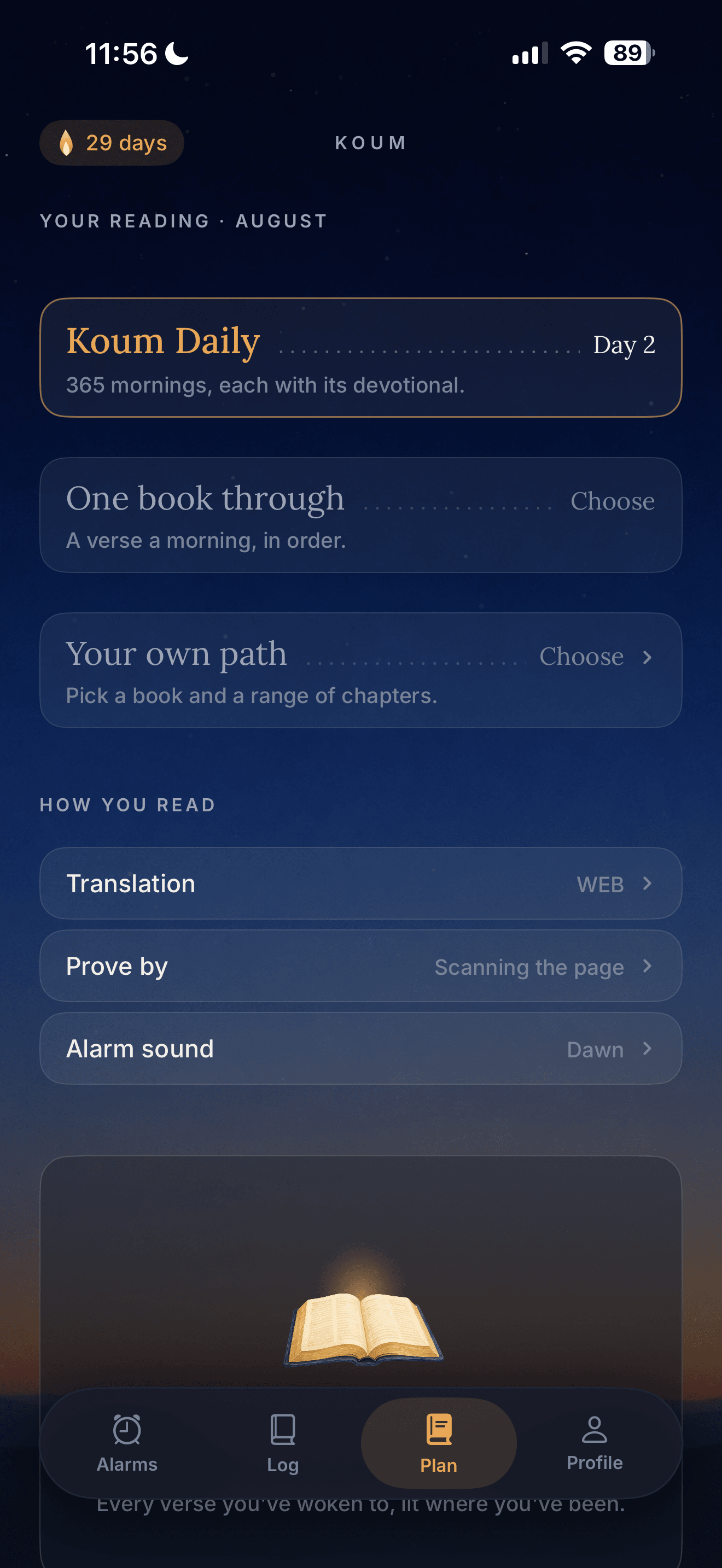
Frequently asked questions
Should I read the Bible before or after a night shift?
Usually, read after your main sleep if that is when you are most alert and can give the passage attention. Reading after a shift can work if you are rested and it does not extend your wakefulness or delay sleep. Choose the window that protects rest and helps you listen rather than forcing a universal rule.
What if my night-shift schedule changes every week?
Keep the sequence familiar—wake, read, pray, and choose one response—while changing the clock time and passage length. Prepare separate versions for a day shift, night shift, and recovery day. When you miss a reading, adjust one practical detail and begin at the next honest waking instead of restarting from shame.
Can Koum replace my regular alarm for a night shift?
Koum can make Scripture the first deliberate interaction after you wake, but it is not a guarantee against oversleeping or a replacement for a backup alarm when punctuality has serious consequences. Set a realistic time, protect your sleep, and use an additional alarm when you need extra reliability.
Sources and fact checks
- 01CDC: About Sleep — Adults generally need at least seven hours of sleep, and sleep quality matters.
- 02CDC/NIOSH: Fatigue and Work — Nonstandard schedules can disrupt or shorten sleep, and fatigue can affect attention, judgment, and safety.
- 03CDC/NIOSH: Shift Work and Sleep — Night and rotating shifts are associated with sleep problems, so strategies need to fit the worker and schedule.
- 04CDC/NIOSH: Improve Sleep — A realistic sleep window and consistent sleep times support better sleep.
- 05Bible Gateway: Mark 1:35–39, WEB — Jesus prays while it is still dark; the passage encourages intentional prayer without prescribing one clock time.
- 06Bible Gateway: Psalm 5:3, WEB — The psalm gives a picture of bringing a request to God in the morning and waiting expectantly.