Bible reading
What to Do When You Miss a Morning of Bible Reading
Quick answer
If you miss a morning of Bible reading, do not try to repay the missed day. Name what happened, choose a passage small enough to read with attention, pray one honest response, and prepare the next realistic return. A missed morning is information about your schedule—not a verdict on your faith.
If you miss a morning of Bible reading, do not try to repay the missed day or decide that the habit is over. Thank God for his mercy, name the reason the morning went differently, and return at the next realistic moment with a small passage. Read it in context, pray one honest response, and make the next reading easier to begin. A missed morning is information about your life and schedule, not a verdict on your faith. The goal is a returning relationship with Scripture, not an unbroken record.
Do not turn one missed morning into a verdict
The first danger after missing a reading is often not the missed reading itself. It is the story you tell about it. “I failed again” can quietly become “I am not the kind of person who can seek God,” and that conclusion is much heavier than the original event. Lamentations 3:22–24 gives a better place to begin: God’s mercies do not fail, and they are new every morning. That passage is not a productivity slogan. It is a confession about God’s character in a difficult book. The fresh morning is first about his faithfulness, not your ability to create a flawless streak.
You may have overslept, cared for a child, worked late, felt ill, traveled, or simply made a poor choice with your bedtime. Tell the truth without adding shame. Confession can be specific—“I stayed up scrolling and now I am tired”—without becoming self-contempt. If the reason needs a change, change one thing. If the reason was outside your control, receive that reality without pretending it was a moral failure. Second Corinthians 4:16–18 describes renewal “day by day,” which leaves room for the ordinary pace of real life. It does not ask you to manufacture yesterday again.
Choose the right kind of restart for today
A restart should fit the day you are actually having. There are at least three faithful ways to return. If you have time and attention, go back to the passage you planned to read and study it slowly. If you are busy, read a shorter paragraph from the same book and write one sentence about what you noticed. If you are exhausted or your morning has already become afternoon, read a brief passage aloud and pray one sentence. The shortest option is not automatically the least spiritual. Honest attention is better than a large plan completed while resenting every word.
Before opening the Bible, ask two questions: “What can I genuinely receive today?” and “What would help me return tomorrow?” The first question protects the reading from becoming a performance. The second turns grace into a practical next step. You might set aside ten minutes after lunch, read during a quiet commute only if you are not driving, or move the practice to the beginning of your next waking period. A Christian morning routine is meant to serve your life with God; it is not a clock that God uses to grade you.
Do not make the restart a punishment. You do not need to add an extra chapter, skip rest, or force yourself to catch up because you missed one morning. If you turn Scripture into a debt, the next reading will carry the anxiety of repayment. Return as a welcomed reader. The point is not to prove that you can suffer through a schedule. It is to hear and respond to God’s word with enough freedom to let it shape you.
Return to the passage without trying to catch up
When you reopen your reading plan, resist the urge to rush through yesterday’s passage and today’s passage at once. Start with the next meaningful section. If the missed reading was part of a book, continue from where you left off. If the plan was a topical list, choose the next reference rather than rebuilding the entire sequence. Psalm 1 pictures a person who is rooted by streams and meditates on God’s instruction over time. A tree does not become rooted by panicking about the day it failed to grow visibly. It receives water and continues.
Read beyond the line that first catches your attention. Notice who is speaking, what problem or promise is present, and what changes from the beginning to the end of the paragraph. Then ask what your chosen passage reveals about God, people, and faithful response. Luke 8:4–15 describes the seed as the word of God and praises those who hear, retain, and bear fruit with perseverance. That emphasis on retaining and persevering helps correct our obsession with novelty. A missed day does not require a new plan. It calls for patient receiving.
If yesterday’s reading still matters, write down its reference and return later in the week. You are allowed to leave a passage unfinished. A note such as “Read Psalm 27:1–6 again on Saturday” protects curiosity without letting curiosity derail today’s return. Keep a simple bookmark, paper note, or private journal line. The record is there to help memory, not to accuse you.
Make the next reading easier to begin
Most missed mornings have a practical shape. The Bible was not nearby. The reading choice was unclear. The alarm came after too little sleep. The phone opened directly into messages and news. The morning was shared with people whose needs mattered more urgently. Find the smallest obstacle you can remove tonight. Put the Bible or reading note where you will see it. Choose tomorrow’s passage before you are tired. Set out the clothes you need. Put the phone far enough away that turning off the alarm requires a decision, but do not use a setup that compromises needed rest or safety.
Use a plan that can bend. For a stable week, you might read one Gospel scene each day. For a changing schedule, prepare a “full,” “short,” and “very tired” version: a chapter or scene, a paragraph, and a few verses with one prayer. The subject remains Scripture; only the amount of attention changes. If you care for someone or share a room, choose a quiet and considerate arrangement. A routine that repeatedly disturbs another person’s sleep needs adjustment, not a spiritual defense.
Set a restart point that you can see. “I will read sometime tomorrow” is easy to postpone. “After I make coffee, I will read the marked paragraph before opening social apps” is concrete without being rigid. If your schedule changes, move the cue to the next honest moment. Planning around the life you have is not lowering the value of the Bible. It is refusing to build a practice on an imaginary life.
Let reading become prayer and one faithful action
A missed reading becomes useful when it brings you back to God rather than only back to a task. After you read, answer the passage in prayer. Thank God for one truth you saw. Confess one way you resist it. Ask for help with one responsibility in the next few hours. Name one person you will meet or serve. Your prayer can be short: “Lord, help me trust you with this conversation,” or “Teach me to receive your patience and offer it to my family.”
Then choose one action that carries the reading into the day. Forgive an irritation instead of rehearsing it. Tell the truth in a difficult email. Listen without preparing your defense. Take a needed rest instead of treating exhaustion as proof of devotion. Scripture is not a way to avoid ordinary responsibilities. It gives ordinary responsibilities a truer center. A single passage remembered during a conversation may be more significant than a page count you cannot recall.
If you feel nothing while reading, do not invent an emotion. If you do not understand the passage, write the question down and seek help from a trusted teacher, church, or study resource. If you are grieving, anxious, or spiritually dry, say that plainly to God. Returning does not require pretending the morning was easy. It requires bringing the real morning into the light.
Let other Christians help you return
A Bible-reading habit can become private pressure when no one knows how you are carrying it. Hebrews 10:23–25 joins holding fast to hope with considering how to encourage one another. That does not mean reporting every missed morning to a supervisor. It means allowing Christian community to be part of your formation. Tell a friend what book you are reading. Ask a small group to discuss a question you wrote down. Read with a spouse, child, or church member when the season allows. Let encouragement replace comparison.
Community also keeps a missed practice in proportion. Someone who knows your life may remind you to sleep, ask whether the plan is too large, or pray with you about what made the morning difficult. They may also help you notice that the passage is calling you toward love rather than toward a better self-image. You do not have to earn the right to return before you rejoin the people who care for you.
If your church follows a shared reading plan, use its continuity as a gift rather than a demand. If you have no current plan, choose a short biblical book and begin with the next section. Ask a trusted Christian how they handle missed readings. You will likely discover that faithfulness looks less like never interrupting a practice and more like learning how to come back.
Put this into practice with Koum
Koum can make your chosen passage a deliberate first interaction after sleep. Its Bible alarm can ask you to open, scan, speak, or type a verse before the alarm ends; afterward, it leaves room for a devotional, prayer, and private reflection. That can help when the problem is not a lack of desire but the first few seconds of a morning being claimed by a feed. Choose a realistic waking time, connect the alarm to a passage you have already selected, and keep a shorter restart option for demanding days.
Koum is a cue, not a spiritual scoreboard. It does not replace a Bible, a church, pastoral care, or a backup alarm when being late would have serious consequences. If you miss a morning, do not treat the app—or yourself—as a judge. Select the next passage, adjust one practical detail, and begin again. The goal is not an impressive streak. It is to meet Scripture with honesty often enough that its words can accompany the way you love and serve.
The next faithful step is small: open the passage you planned, read what you can receive, pray what is true, and prepare the next return. You have not lost the whole practice because one morning went differently. Grace gives you a place to begin again.
Put this into practice with Koum.
Koum asks you to open, scan, speak, or type a Bible verse before the alarm ends. Then it gives the morning room for prayer, a devotional, and a private reflection.
Get Koum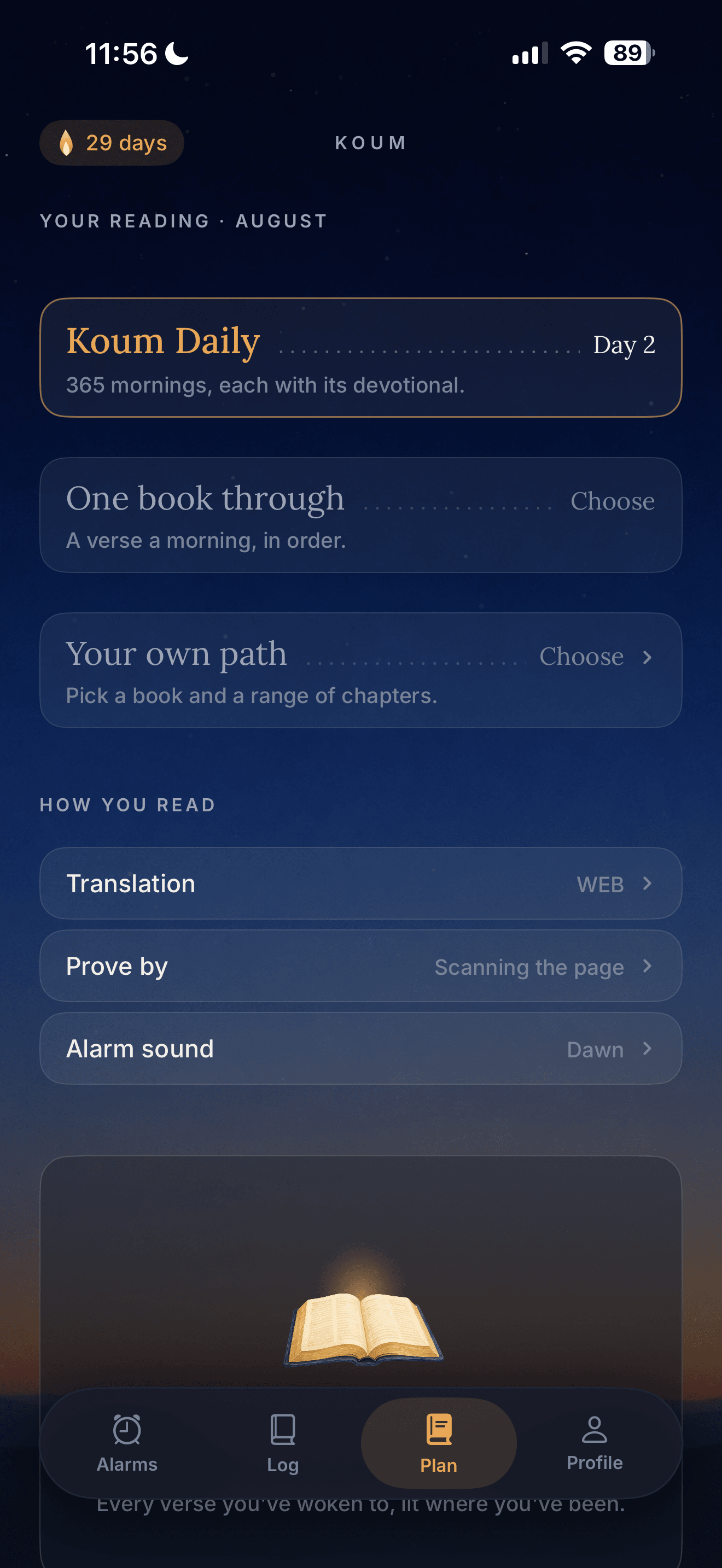
Frequently asked questions
Should I read extra chapters to make up for a missed morning?
Usually, no. Continue with the next meaningful section or choose a shorter passage you can read attentively. Catching up can turn Scripture into a debt. If an earlier passage still matters, mark it and return later without abandoning today’s honest restart.
What if I keep missing my morning Bible reading?
Look for the practical pattern rather than judging your character. Check your bedtime, the size of the plan, your phone setup, and the realities of work or caregiving. Prepare full, short, and very-tired versions, then ask a trusted Christian to help you make the routine fit your life.
Can a Bible alarm help me return to reading?
A Scripture-first alarm can provide a deliberate cue by asking you to open, scan, speak, or type a verse before the alarm ends. It is a cue rather than a spiritual scoreboard, so use it alongside your Bible, church community, and a backup alarm when needed.
Sources and fact checks
- 01Lamentations 3:22–24 (WEB) — Supports the distinction between God’s renewing mercy and a perfect daily record.
- 022 Corinthians 4:16–18 (ESV) — Supports returning to day-by-day renewal without losing heart.
- 03Psalm 1:1–3 (ESV) — Supports a rooted, patient picture of meditating on God’s instruction.
- 04Luke 8:4–15 (ESV) — Supports hearing, retaining, and persevering with the word rather than chasing a streak.
- 05Hebrews 10:23–25 (WEB) — Supports encouragement and Christian community when a practice becomes difficult.