Bible reading
How to Read the Bible in the Morning When You Have Young Children
Quick answer
To read the Bible in the morning with young children, choose a short passage the night before, read a few verses aloud, ask one simple question, and pray briefly. Treat interruptions as part of the morning rather than proof that the practice failed. On a rushed day, one verse and one honest sentence can be a faithful beginning. The goal is not to make children perform or to finish a long plan; it is to keep Scripture close and let love shape the way you respond to the people in front of you.
The goal is presence, not a quiet house
Reading the Bible with young children in the morning starts with a kinder definition of success. Success is not an uninterrupted chair, a matching set of mugs, or a devotional completed before anybody says your name. It is making a small, repeatable space to receive Scripture and respond to God, even when the room is ordinary and the timing is imperfect. A child waking early does not automatically cancel your attention to God. Sometimes it changes the form that attention takes.
Let Scripture shape a small family rhythm
Deuteronomy describes God’s words being kept close and repeated in the daily movement of life: at home, on the road, when lying down, and when getting up. Psalm 78 describes one generation telling the next about God’s works so that children can know them and put their confidence in him. These passages do not read like instructions for manufacturing a flawless morning ceremony. They point toward a faith that is woven into real life, where conversation and memory matter more than a polished performance.
Choose a passage your morning can carry
Begin with a passage that fits the attention you actually have. A short Gospel scene, a psalm, a paragraph from Proverbs, or one section from the reading you are already following can be enough. Choose it the night before if mornings are unpredictable. Mark the starting verse, put the Bible beside the place where you make coffee, or leave a paper copy near the breakfast table. The aim is to remove one decision from a tired brain, not to prove that a larger reading plan is more faithful.
Read aloud with a simple three-question pattern
When a child is nearby, read a short portion aloud and use three questions: What happened or what image did we notice? What does this show us about God, Jesus, people, or the way of love? What can we ask God or practice today? Keep the questions open enough for a child’s answer and simple enough for you to answer honestly. A child may notice one concrete detail while you notice a deeper tension. Both can be a beginning. Do not turn every response into a quiz or correct every imperfect observation.
Make room for children without making them perform
Jesus welcomed children when his disciples treated them as an interruption. That scene is a useful correction for a hurried household: children are not obstacles you must clear away before spiritual life can begin. They are neighbors entrusted to your care, with their own attention, questions, limits, and dignity. Invite them to listen, draw, ask a question, or choose a word to repeat. Participation can be quiet. It can also be absent. A child who wanders off has not failed a Bible test, and neither have you.
Use a plan for the mornings that fall apart
Decide ahead of time what the smallest faithful version looks like. On a spacious morning, read the passage, talk about one observation, pray for one person, and choose one response. On a rushed morning, read one verse and say one sentence of prayer while a child puts on shoes. On a hard morning, whisper the reference and return to it later. If the children are sick, the night was broken, or conflict has already begun, care is not a distraction from discipleship. Loving the people in front of you may be the most truthful response available.
Move from Bible reading to a short prayer
A simple prayer can follow the text without trying to sound impressive: “God, thank you for showing us ____. Help us notice ____ today. Give us patience with ____. Amen.” Name a real need rather than forcing a lesson. You can pray for a teacher, a sibling, a difficult appointment, a friend, or courage to apologize. Ephesians speaks about instruction in the Lord while also warning parents not to provoke their children. That combination matters. Biblical formation should make a home more truthful and loving, not more anxious about getting every word right.
Let Koum protect your first Scripture step
If the hardest part is opening the Bible before messages and errands take over, Koum can give the first step a visible cue. Its Daily Plan lets you select a Bible reading and an alarm for the next morning. In the Bible alarm flow, Koum can ask you to scan, speak, or type the verse before the alarm turns off, depending on the selected mode. That can help an adult begin with Scripture before the household gathers. Afterward, you can pray, read a short devotional, or write a private reflection. Koum is not a family curriculum, a substitute for church, or a way to make children perform. It simply helps you keep an appointment with the passage you chose.
Build a rhythm that can survive real life
Try the same short pattern for one week: choose a passage at night, read a few verses in the morning, ask one question, pray briefly, and release the rest of the day to God. Keep a longer reading for a quieter time when possible, but do not despise the small practice. Mark 1 tells us that Jesus rose early to pray, yet the Gospel does not turn that scene into a competition about wake-up times. Your morning may begin at dawn, during a child’s snack, or after the house is already loud. Faithfulness is returning to Scripture with the people and responsibilities God has actually placed in front of you.
Remember what this practice is for
The purpose is not to produce a family photograph of devotion. It is to let Scripture become a familiar place where you and your children can meet truth, mercy, questions, and hope. Some days you will read beautifully. Some days you will only remember the reference. Both days can teach you to return. A child may remember your calm apology more than your explanation of a passage, and that apology can itself become a living response to what you read. Keep the Bible open, keep the invitation gentle, and let tomorrow be another chance to begin.
Put this into practice with Koum.
Koum asks you to open, scan, speak, or type a Bible verse before the alarm ends. Then it gives the morning room for prayer, a devotional, and a private reflection.
Get Koum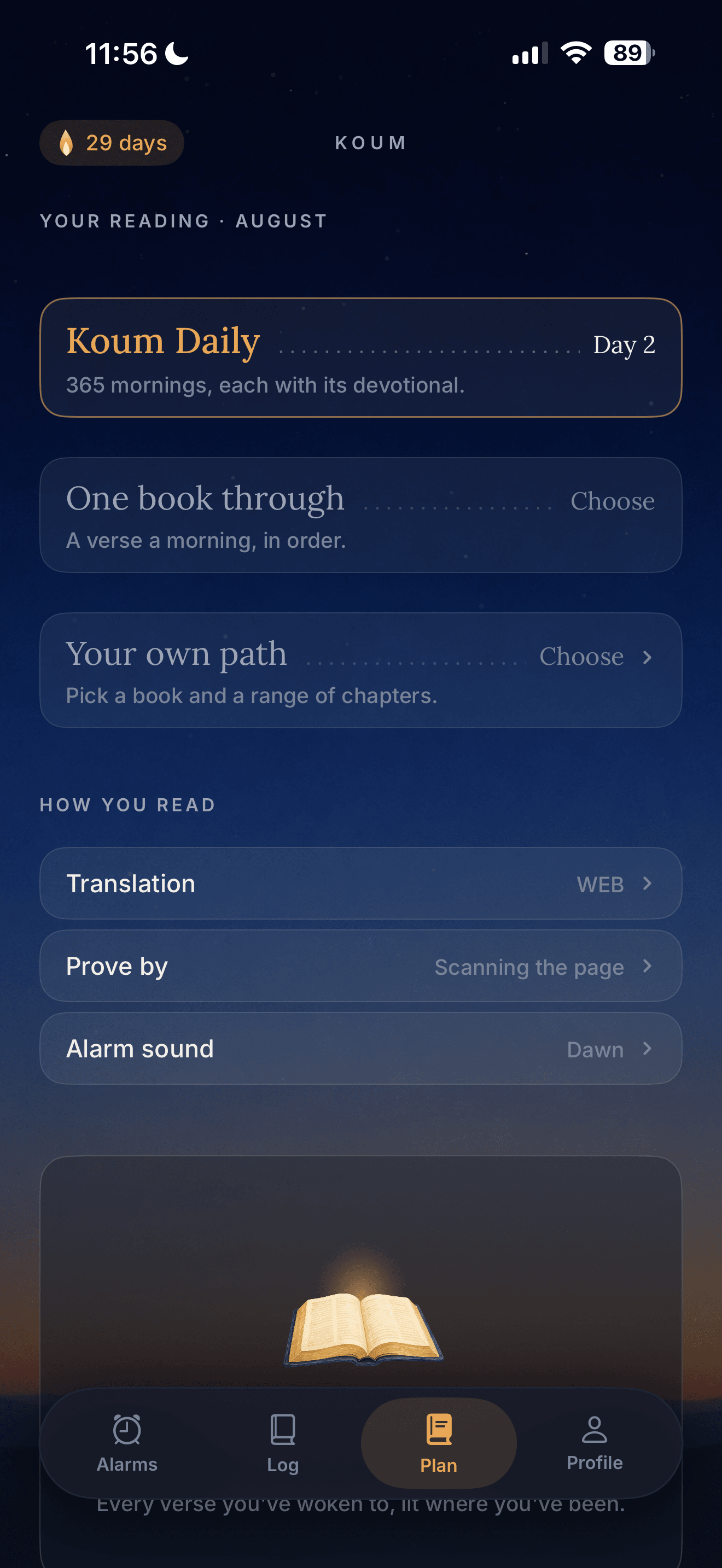
Frequently asked questions
How long should Bible reading take when I have young children?
Start with five to ten minutes, but define a smaller version for difficult mornings. A short passage, one question, and one prayer can be enough. The length matters less than returning to Scripture without turning the practice into pressure.
What if my child will not sit still or listen?
Do not make stillness the measure of spiritual success. Invite the child to listen, draw, ask a question, or simply remain nearby, and continue later if needed. A child can be included without being forced to perform or answer correctly.
Should I read a children’s Bible or the full Bible?
Use a trustworthy edition that fits the child’s age and your shared attention. A children’s Bible can help introduce a story, while the adult can also read a short passage from a standard Bible. Keep the focus on receiving and responding to Scripture rather than comparing formats.
Sources and fact checks
- 01USCCB: Deuteronomy 6 — Supports keeping God’s words close and speaking about them in the ordinary rhythms of home, travel, bedtime, and rising.
- 02USCCB: Psalm 78 — Supports telling the next generation about God’s works so that children may know them and place their confidence in God.
- 03USCCB: Mark 10 — Supports Jesus welcoming children and warning his disciples not to prevent them from coming to him.
- 04USCCB: Ephesians 6 — Supports bringing children up with the training and instruction of the Lord without turning the household into a place of provocation.
- 05USCCB: Mark 1 — Supports the Gospel account of Jesus rising early to pray, while the article distinguishes his example from a demand for a perfect schedule.